Key Takeaways
- Rybelsus (oral semaglutide) follows an FDA-approved titration schedule: 3 mg for at least 30 days, then 7 mg for at least 30 days, then up to 14 mg as a maximum maintenance dose.
- Rybelsus is FDA-approved only for type 2 diabetes — any use for weight loss is off-label, meaning it’s legal but not the medication’s approved purpose.
- Rybelsus must be taken the same way as the Wegovy pill: in the morning, on an empty stomach, with no more than 4 ounces of plain water, followed by a 30-minute wait before food, other liquids, or oral medications.
- The 3 mg starting dose is not considered effective for either blood sugar control or weight loss — it exists solely to help the body adjust before moving to therapeutic doses.
- Only a prescriber can determine the appropriate starting dose, titration pace, and maximum dose for a given patient.
What Is Rybelsus?
Rybelsus is the brand name for oral semaglutide, approved by the FDA in September 2019 as the first oral GLP-1 receptor agonist ever brought to market. It is indicated specifically for the treatment of type 2 diabetes in adults, as an adjunct to diet and exercise. Rybelsus is not FDA-approved for weight loss — though because semaglutide is well known for its weight-loss effects, off-label prescribing for that purpose does occur. For more on that off-label reality, see our guide to Rybelsus for weight loss: what to know about off-label use.
Rybelsus contains the same active ingredient, semaglutide, found in the Wegovy pill and in injectable products like Ozempic and Wegovy. Like the Wegovy pill, it’s formulated with the SNAC absorption enhancer to allow a peptide molecule to survive the digestive tract long enough to be absorbed — which is why its dosing rules mirror the Wegovy pill’s closely, even though the two products are approved for different conditions and dosed differently.
The FDA-Approved Titration Schedule
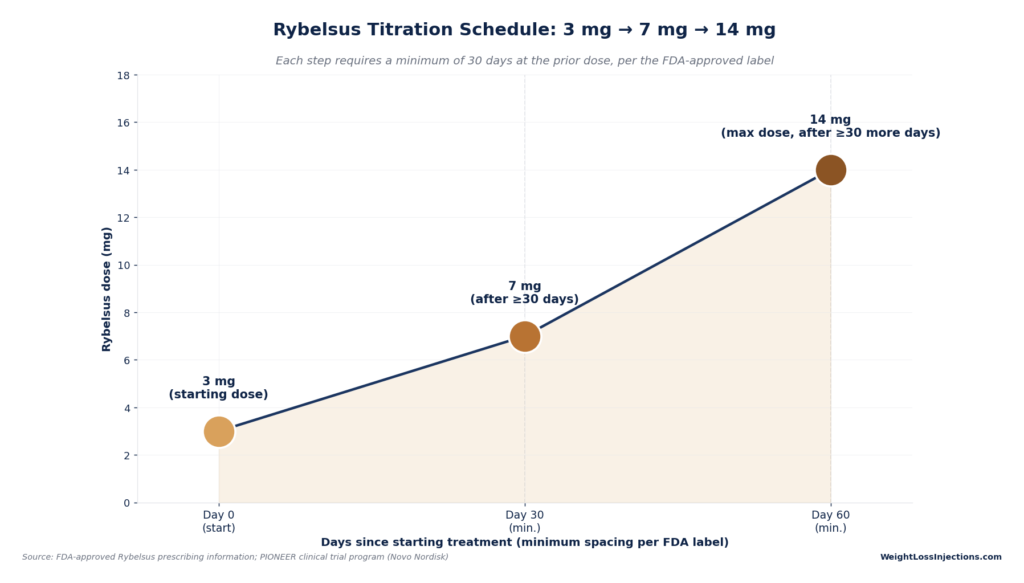
Per the FDA-approved prescribing information, Rybelsus dosing follows a defined three-step titration:
- 3 mg once daily for at least 30 days. This starting dose is used to allow the body to begin adjusting to the medication. Per the label, the 3 mg dose is not considered adequate for sustained glycemic control and functions primarily as an initiation dose.
- 7 mg once daily for at least 30 days. After the initial 30-day period, the dose may be increased to 7 mg if appropriate, based on the prescriber’s assessment of tolerability and response.
- 14 mg once daily (maximum dose). If additional glycemic control is needed and the 7 mg dose has been tolerated, the dose may be increased again to the maximum approved dose of 14 mg after at least 30 days at 7 mg.
This step-up structure — starting low, waiting a defined interval, then increasing — is a standard feature of the GLP-1 drug class, designed to reduce the gastrointestinal side effects that tend to be more pronounced with faster dose increases. The exact pace and whether to progress to the next dose level is a decision for the prescribing provider, based on the official FDA label and the patient’s individual response.
Why the 30-Day Intervals Matter
The minimum 30-day spacing between dose increases isn’t arbitrary — it reflects how long it typically takes for the body to adjust to a given dose and for side effects to settle before introducing a higher amount. Moving through the titration schedule faster than approved is not recommended and should never be done without a prescriber’s guidance, since faster titration is associated with a higher likelihood of gastrointestinal side effects like nausea and vomiting.
Same Fasting Rules as the Wegovy Pill
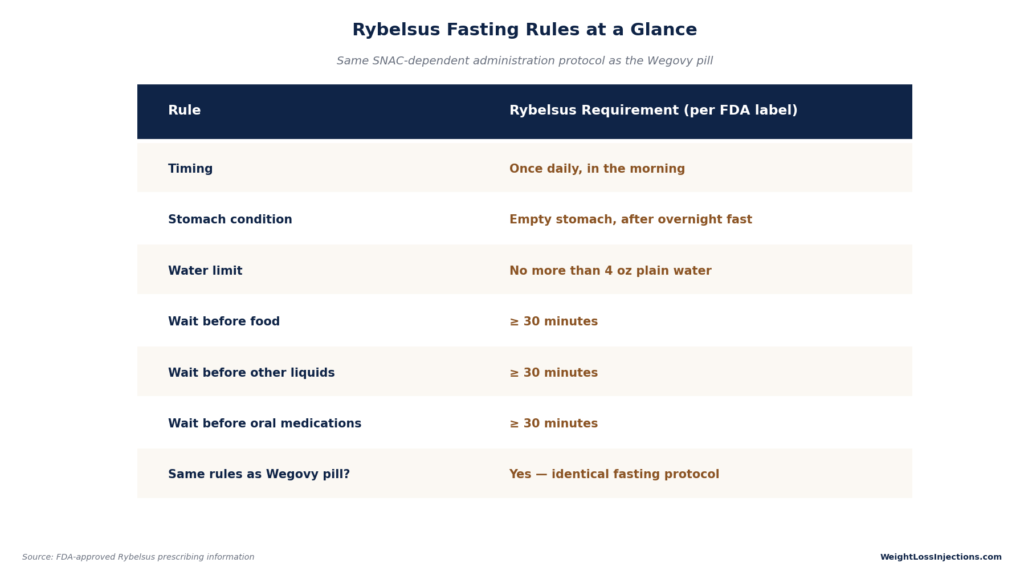
Because Rybelsus and the Wegovy pill share the same active ingredient and the same SNAC-based absorption technology, they also share the same strict administration requirements, per their respective FDA labels:
- Take once daily, in the morning
- Take on an empty stomach, after an overnight fast
- Use no more than 4 ounces of plain water with the dose
- Wait at least 30 minutes before eating, drinking any other liquid, or taking other oral medications
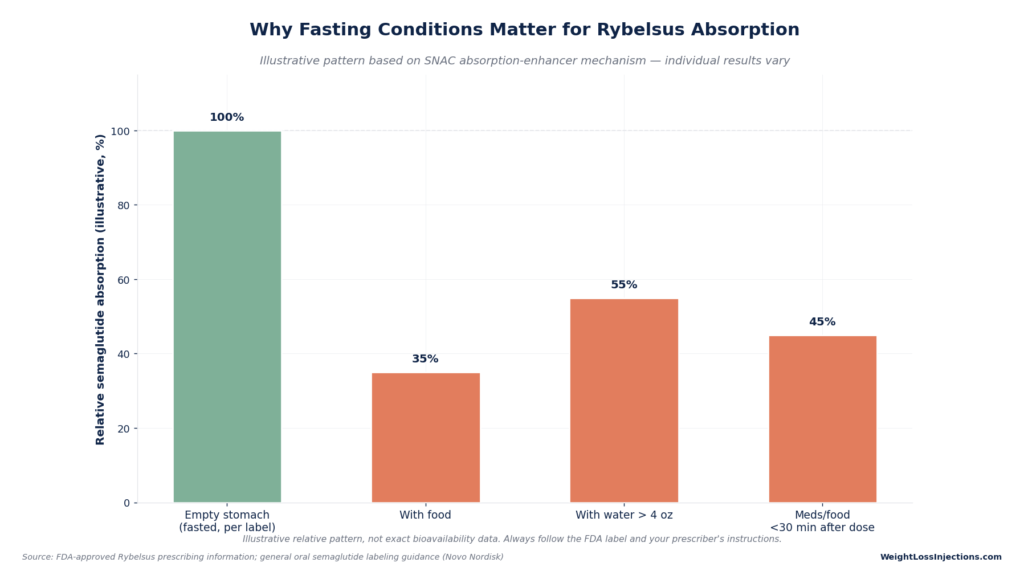
These conditions exist because semaglutide is a peptide molecule that would otherwise be broken down by digestion before it could be absorbed. The SNAC absorption enhancer only works effectively under these specific, narrow stomach conditions — food, extra water, or other medications taken too soon can meaningfully reduce how much of the dose is actually absorbed. For a deeper explanation of why this differs so much from Foundayo’s dosing, see our comparison of oral GLP-1 pill timing: when to take each one for best absorption.
Our Top 3 · September 2026
The best GLP-1 providers right now
Independently reviewed. Ranked by price, medication access, provider quality, and patient outcomes.
Renew GLP
Personalized GLP-1, GIP plans: Semaglutide & Tirzepatide.
Medvi
No membership or hidden fees. Everything you need is included.
Trimi
US-licensed clinicians and shipped to your door, from $99/mo.
T2D Indication Reminder
It’s worth restating clearly: Rybelsus is FDA-approved only for type 2 diabetes management, not for weight loss. The original approval was supported by the PIONEER clinical trial program, which demonstrated HbA1c reductions of approximately 1.0% to 1.4% across studied doses. Weight loss of roughly 4 to 6 pounds was observed as a secondary endpoint in those trials — a modest effect compared to the weight-loss results seen with the Wegovy pill (around 16.6% in the OASIS 4 trial) or Foundayo (roughly 11% to 16.9% in ATTAIN-1), both of which are dosed at much higher milligram amounts and approved specifically for weight management.
Off-Label Weight-Loss Use
Some prescribers do prescribe Rybelsus for weight loss in patients who do not have type 2 diabetes. This is legal — off-label prescribing is a normal and accepted part of medical practice in the United States when a clinician determines it’s appropriate for a specific patient — but it means the dosing schedule, monitoring, and expected outcomes are not backed by the same FDA-reviewed weight-loss data that supports the Wegovy pill or Foundayo. Insurance coverage for off-label use can also differ significantly, and patients considering this route should have a detailed conversation with their prescriber about realistic expectations, monitoring, and cost. For a full cost breakdown across all three oral GLP-1s, see how much does oral GLP-1 cost.
What If You’re Not Tolerating a Dose Increase?
If gastrointestinal side effects are difficult to manage at any stage of the Rybelsus titration schedule, the appropriate step is to contact the prescribing provider rather than adjusting the dose independently. Depending on the situation, a prescriber might recommend staying at the current dose for a longer period before increasing further, or exploring other adjustments to the treatment plan. Never increase the dose ahead of schedule in hopes of faster results, and never split or double a dose without explicit medical guidance.
FAQ
Is the 3 mg Rybelsus dose effective on its own?
No. Per the FDA label, the 3 mg starting dose is intended to help the body adjust to the medication and is not considered adequate for meaningful blood sugar control. It’s a stepping stone to the 7 mg and 14 mg doses, reached through the approved titration schedule under a prescriber’s guidance.
How long does it take to reach the maximum Rybelsus dose?
Following the FDA-approved schedule, it takes a minimum of 60 days to reach the 14 mg maximum dose — at least 30 days at 3 mg, followed by at least 30 days at 7 mg, before a possible increase to 14 mg. The actual pace depends on individual tolerability, as assessed by the prescriber.
Can Rybelsus be taken at a different time of day, like at night?
No. Per the FDA label, Rybelsus should be taken in the morning, on an empty stomach, with no more than 4 ounces of water, followed by a 30-minute wait before food, other liquids, or medications. This timing is required for the medication to be properly absorbed.
Is taking Rybelsus for weight loss the same as taking the Wegovy pill?
They contain the same active ingredient and follow the same administration rules, but they are different products with different approved doses and different FDA-approved indications. The Wegovy pill is approved specifically for weight loss at a 25 mg dose, while Rybelsus is approved for type 2 diabetes at doses up to 14 mg, with any weight-loss use considered off-label. See our full comparison in how to take the Wegovy pill.
What happens if I miss a dose during Rybelsus titration?
General guidance for missed doses differs by scenario and should be confirmed with your prescriber or pharmacist. For a full breakdown, see what happens if you miss a dose of your oral GLP-1.
Medical Disclaimer
Medical disclaimer: This article is for informational purposes only and does not constitute medical advice, diagnosis, or treatment recommendations. Foundayo (orforglipron), Wegovy pill (oral semaglutide 25 mg), and Rybelsus (oral semaglutide 3/7/14 mg) are prescription medications with important safety information and contraindications. Discuss any medication decision with a qualified healthcare provider. Content published by WeightLossInjections.com, your complete resource for GLP-1 medications — injections and pills alike.
Sources: FDA-approved Rybelsus prescribing information; PIONEER clinical trial program (Novo Nordisk); Drugs.com Rybelsus monograph; Novo Nordisk press materials on Rybelsus approval (September 2019).