Mental Health and GLP-1 Medications: What the Studies Show
Medically reviewed by WeightLossInjections.com Staff•Updated July 24, 2026•10 min readMedically reviewed
Medical disclaimer: This article is educational and not a substitute for professional medical advice, diagnosis, or treatment. GLP-1 medications carry FDA-mandated warnings about mood changes and suicidal thoughts. Never start, stop, or change a medication based on this article. If you’re having thoughts of suicide or self-harm, call or text 988 (Suicide & Crisis Lifeline) in the U.S., available 24/7.
Regulators and researchers have spent three years untangling whether GLP-1 drugs affect mood — the answer is more reassuring, and more nuanced, than headlines suggest.
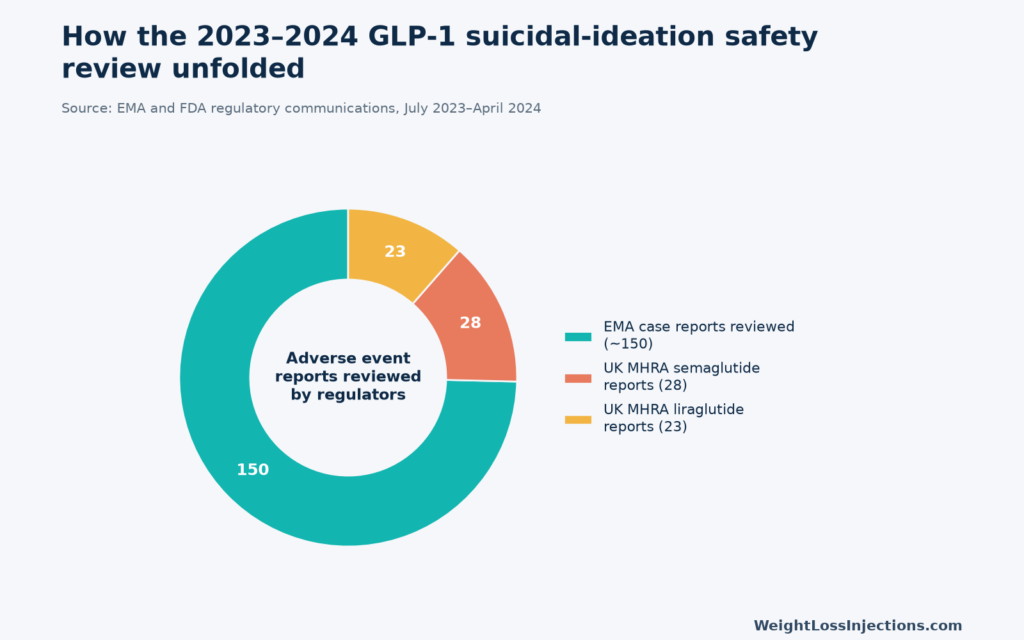
The scare started in Iceland. In July 2023, the EMA opened a safety review after Iceland’s medicines agency flagged suicidal-thoughts reports in patients on liraglutide and semaglutide, expanding to ~150 reports globally (EMA, July 2023).
Both major regulators found no causal link. FDA’s January 2024 evaluation found “no evidence” these drugs cause suicidal thoughts (FDA, Jan. 2024); EMA’s PRAC agreed (EMA PRAC, April 2024).
The largest real-world study found the opposite of the fear. A TriNetX study of 1.8M+ patients found semaglutide associated with a 49–73% lower risk of suicidal ideation versus other anti-obesity/diabetes drugs (Wang et al., Nature Medicine, 2024).
Clinical trial data mirrors that reassurance, with one lingering signal. Pooled STEP trial data found semaglutide not linked to more depression than placebo (Wadden et al., JAMA Internal Medicine, 2024), but a WHO database analysis found a signal concentrated among people also taking antidepressants or benzodiazepines (Schoretsanitis et al., JAMA Network Open, 2024).
Every major label still carries a warning, and obesity itself is already linked to depression. Wegovy’s label tells clinicians to “avoid” the drug in patients with active suicidal ideation (Wegovy label), while a classic meta-analysis found obesity and depression raise each other’s risk by ~55–58% (Luppino et al., 2010).
Introduction: Do GLP-1 drugs help depression, cause it, or both?
Few drug classes have generated as much whiplash coverage as GLP-1 receptor agonists — semaglutide (Ozempic, Wegovy, Rybelsus), tirzepatide (Zepbound, Mounjaro), and liraglutide (Saxenda, Victoza). One month headlines warn these injections might trigger suicidal thoughts; the next, researchers float that they could work as adjunct antidepressants and curb alcohol cravings.
Both threads are grounded in real data, which is what makes this genuinely confusing rather than simply hyped. Regulatory reviews, huge EHR studies, RCT post-hoc analyses, and case reports all exist, and they don’t always agree. This article walks through what each type of evidence says and what it means for someone with a history of depression considering these drugs.
The short version: high-quality evidence doesn’t support the idea that these drugs cause depression or suicidal thoughts on average, and some evidence suggests they may modestly reduce depressive symptoms tied to obesity. But the concern wasn’t invented from nothing, individual vulnerability varies, and every approved GLP-1 label still carries a suicidal-ideation warning worth taking seriously.
Where the concern started: Iceland, the EMA, and the FDA
The mental-health scare has a specific origin point. In July 2023, the Icelandic Medicines Agency alerted the EMA to case reports describing suicidal thoughts and self-injury in people on liraglutide (Saxenda) and semaglutide (Ozempic, Wegovy). The EMA’s Pharmacovigilance Risk Assessment Committee (PRAC) opened a formal review, pulling in roughly 150 case reports globally (EMA statement, July 11, 2023), and by December 2023 had expanded it to nearly the entire GLP-1 class (BMJ, December 2023).
The FDA opened a parallel evaluation, releasing its first public update on January 11, 2024: “Our preliminary evaluation has not found evidence that use of these medicines causes suicidal thoughts or actions.” Reviews of trials, observational studies, and postmarketing data “did not find an association,” though FDA added a key caveat: “because of the small number of suicidal thoughts or actions observed… we cannot definitively rule out that a small risk may exist” (FDA, Jan. 2024).
Three months later, EMA’s PRAC completed its review and concluded “the available evidence does not support a causal association,” determining “no update to the product information is warranted” (EMA PRAC, April 2024). The UK’s MHRA logged just 28 reports for semaglutide and 23 for liraglutide out of millions of prescriptions — too small to establish causation (Pharmaceutical Journal, April 2024).
WeightLossInjections.com editorial note: “No causal link found” isn’t “no risk exists.” Both agencies used hedged language, since rare psychiatric events are hard to detect even in huge databases.
The big data: what large observational studies actually found
Signal-detection systems like FAERS and VigiBase raise early alarms but can’t prove causation — they lack a comparison group. The next research wave used real-world databases with matched controls, a stronger design.
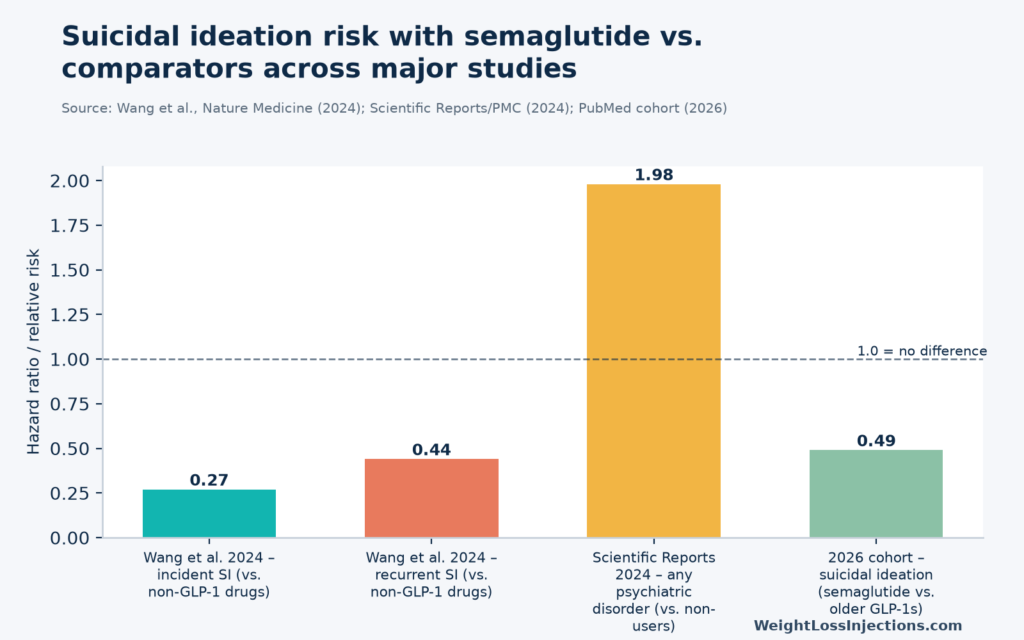
The most cited is Wang, Volkow, and colleagues’ TriNetX analysis in Nature Medicine (January 2024): 240,618 obesity patients on semaglutide versus matched non-GLP-1 users, replicated in 1,589,855 patients with type 2 diabetes. Results ran opposite the feared direction — hazard ratios of 0.27 (incident) and 0.44 (recurrent) suicidal ideation, a 49–73% lower risk (Wang et al., Nature Medicine, 2024). Co-author Dr. Nora Volkow of NIDA said the findings suggest semaglutide “can be safe for those with mental health conditions.”
Not every study agrees: a separate TriNetX cohort of 11.6 million obesity patients in Scientific Reports (October 2024) found GLP-1 RA use linked to 98% higher relative risk of any psychiatric diagnosis versus non-users (Scientific Reports/PMC, 2024) — a design more vulnerable to confounding than Wang et al.’s active comparator.
Others split the difference: a 2025 target-trial-emulation found small, non-significant differences (2025 cohort study); a French case-time-control found lower odds of suicide attempt (OR 0.62) (eClinicalMedicine, 2024); and a 2026 TriNetX study found semaglutide lower-risk than older GLP-1 RAs (2026 cohort study).
Comparing the major observational studies
Study
Data source & size
Comparator
Key finding
Wang et al., Nat Med 2024
TriNetX EHR; 1.8M+ patients
Non-GLP-1 anti-obesity/diabetes drugs
49–73% lower risk of suicidal ideation with semaglutide (Nature)
Scientific Reports cohort, 2024
TriNetX EHR; 11.6M adults with obesity
Non-GLP-1 users (general population)
98% higher risk of any psychiatric disorder; 195% higher MDD risk (PMC)
Schoretsanitis et al., JAMA Netw Open 2024
WHO VigiBase; 30,527 semaglutide reports
All other drugs in database
45% higher disproportionate reporting; signal concentrated in antidepressant co-users (JAMA Network)
No significant difference; CIs allow a small increase (PubMed)
Tirzepatide vs. semaglutide cohort, 2026
TriNetX Global; 165,000+ pairs
Semaglutide vs. tirzepatide; vs. older GLP-1s
Similar tirzepatide/semaglutide risk; semaglutide lower than older GLP-1s (PubMed)
Our take at WeightLossInjections.com: When six large studies reach different conclusions, the honest reading isn’t “pick the one you like” — average population-level risk appears low or protective for most users, but study design (comparator, population, confounding) can swing results substantially, and average findings may not apply to your specific psychiatric history.
Large real-world cohort studies mostly point toward lower or neutral suicidal-ideation risk with semaglutide versus comparator drugs — though not unanimously.
What the randomized trials show: SELECT and the STEP program
Observational data can be confounded no matter how large the sample. Randomized controlled trials (RCTs) offer a cleaner, if smaller, window into causation.
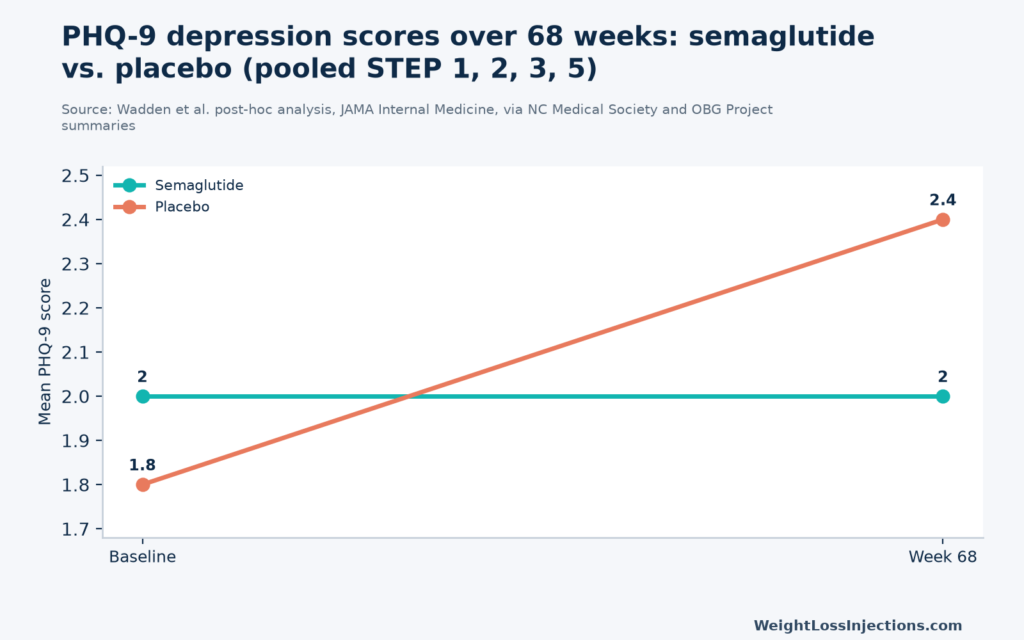
The STEP program is the core RCT dataset behind Wegovy’s approval. A pooled post-hoc analysis of STEP 1, 2, 3, and 5 (3,681 participants) by Thomas Wadden and colleagues at Penn, published in JAMA Internal Medicine, found PHQ-9 depression scores lower — better — with semaglutide than placebo at week 68 (mean 2.0 vs. 2.4; treatment difference −0.56, p<0.001), with semaglutide-treated participants less likely to shift into a more severe depression category (OR 0.63). Suicidal ideation/behavior was rare in both groups (under 1%) with no significant difference (Wadden et al. summary). Co-author Gregory Brown, director of Penn’s Center for the Prevention of Suicide, said “persons not taking semaglutide… are equally likely” to experience these symptoms.
The SELECT trial, following 17,600+ cardiovascular patients for nearly 40 months, wasn’t designed to test psychiatric safety, but a dedicated safety analysis in Obesity (2025) found suicide/self-injury adverse events at identical rates in both arms (0.11% each), judged unlikely related to the study drug (SELECT safety analysis, 2025). Cleveland Clinic’s summary stated semaglutide “was not associated with higher risks for… psychiatric disorders” (Cleveland Clinic, 2023).
WeightLossInjections.com editorial note: SELECT and STEP are reassuring, but both excluded participants with significant untreated psychiatric illness or recent suicide attempts — the “no signal” finding applies most to people without severe pre-existing mental illness.
The case for a protective, even antidepressant-like effect
Beyond “doesn’t seem to hurt mood,” research is exploring whether GLP-1 drugs might actively help mood — and there are plausible biological reasons why.
A 2025 review in the journal Life summarized preclinical evidence that GLP-1 RAs modulate dopaminergic reward pathways, enhance hippocampal neurogenesis, and reduce microglial activation (a neuroinflammation marker) — mechanisms implicated in depression. It noted “early clinical trials… suggest improvements in depressive symptoms, quality of life, and cognitive function, with some effects independent of weight loss,” while cautioning that large RCTs in primary psychiatric populations are still lacking (Life, 2025).
The clearest positive signal is for addiction and reward-related behavior, mechanistically close to mood regulation. A 2025 randomized trial of low-dose semaglutide in adults with alcohol use disorder found reduced heavy drinking and cravings versus placebo (JAMA Psychiatry, 2025), and a 2026 follow-up combining it with cognitive behavioral therapy showed further reductions (NIH, May 2026).
Separating weight-loss-dependent from weight-loss-independent effects matters: some STEP-program PHQ-9 improvement could simply reflect people feeling better as they lose weight, not a direct brain-chemistry effect. Disentangling the two requires trials in people with depression who aren’t significantly overweight, which remain rare (Life, 2025).
Across the pooled STEP 1, 2, 3, and 5 trials, semaglutide-treated participants showed a small but statistically significant improvement in depression screening scores relative to placebo.
Why the concern isn’t baseless: labels, subgroups, and obesity’s own link to depression
Several caveats deserve equal billing.
Every approved GLP-1 weight-loss label carries a warning. Wegovy’s FDA label includes section 5.9, “Suicidal Behavior and Ideation,” instructing prescribers to “monitor patients… for the emergence or worsening of depression, suicidal thoughts or behavior,” to “discontinue WEGOVY in patients who experience suicidal thoughts or behaviors,” and to “avoid WEGOVY in patients with a history of suicidal attempts or active suicidal ideation” (Wegovy FDA label) — real, binding guidance.
Certain subgroups may carry higher risk. The WHO-database study found the suicidal-ideation signal for semaglutide concentrated almost entirely in patients also taking antidepressants (ROR 4.45) or benzodiazepines (ROR 4.07); lead author Dr. Georgios Schoretsanitis said prescribers “should… assess the psychiatric history and evaluate the mental state of patients before starting treatment” (JAMA Network Open, 2024). A 2025 case report described a diabetes patient with no prior psychiatric history who attempted suicide after starting semaglutide, rated “probable” on the Naranjo scale (SAGE Journals, 2025).
Trials excluded the people most at risk. STEP, SURMOUNT, and SELECT largely excluded participants with active suicidal ideation, recent attempts, or unstable major psychiatric illness, so “no signal” results generalize most to people without severe pre-existing mental illness.
Obesity and depression were already intertwined before GLP-1 drugs existed. A landmark meta-analysis found obesity raises later depression risk ~55% (OR 1.55), while depression raises later obesity risk ~58% (OR 1.58) (Luppino et al., 2010); Mendelian randomization studies estimate ~33% higher depression risk per unit of genetically-instrumented obesity (systematic review, 2023) — so obesity-selected populations show elevated baseline depression unrelated to any later-prescribed drug.
Practical guidance: what to discuss with your prescriber
None of this evidence supports self-diagnosing or self-managing psychiatric risk. If you’re considering or taking semaglutide, tirzepatide, or liraglutide and have a personal or family history of depression, anxiety, or suicidal thoughts, raise these points directly with your prescriber, consistent with guidance from SAMHSA’s 988 program:
Disclose your full psychiatric history — past suicidal ideation, current antidepressant or benzodiazepine use, and recent mood changes — since the WHO-database signal concentrated almost entirely in patients on these co-medications (JAMA Network Open, 2024).
Ask about a monitoring plan. Labels recommend watching for new or worsening depression or emerging suicidal thoughts, especially after starting or increasing a dose (Wegovy label).
Know the warning signs: new hopelessness, withdrawal, talking about wanting to die or feeling like a burden, or sudden calm after severe depression.
Understand when to avoid or stop. Labels advise avoiding these drugs with active suicidal ideation or a recent attempt, and discontinuing if suicidal thoughts emerge.
If you’re in crisis, don’t wait for your next appointment. Call or text 988 for free, confidential support 24/7, or go to the nearest emergency room (988lifeline.org).
Frequently Asked Questions
Pooled STEP trial data and SELECT’s safety analysis haven’t found that semaglutide increases depression or suicidal thoughts versus placebo; some observational studies even found lower rates (Wadden et al. summary; SELECT safety analysis). FDA and EMA both found “no evidence”/”no causal association,” though neither fully ruled out a small risk (FDA; EMA).
Pooled STEP trial data showed a small, significant PHQ-9 improvement with semaglutide versus placebo, possibly via reduced neuroinflammation (STEP analysis; Life review, 2025). Larger trials in primary depression populations are still needed.
People with active suicidal ideation, a recent attempt, or unstable major psychiatric illness were largely excluded from trials, and labels advise avoiding these drugs in that population; the WHO signal was strongest in patients on antidepressants or benzodiazepines (Wegovy label; JAMA Network Open, 2024). A 2026 cohort found semaglutide lower-risk than older drugs (2026 cohort study).
Yes — the strongest new positive evidence. A 2025 randomized trial found low-dose semaglutide reduced heavy drinking and cravings, and a 2026 follow-up with therapy showed further reductions (JAMA Psychiatry, 2025; NIH, 2026).
Contact your prescriber promptly — don’t stop or adjust your dose without guidance unless in crisis. If you have thoughts of suicide or self-harm, call or text 988, or go to the nearest ER (988lifeline.org).