![Unbranded [pillar-drug-class] injection pen on a neutral background — WeightLossInjections.com editorial hero](https://weightlossinjections.com/wp-content/uploads/2026/07/hero_mounjaro_c3_safety-1200x675.png)
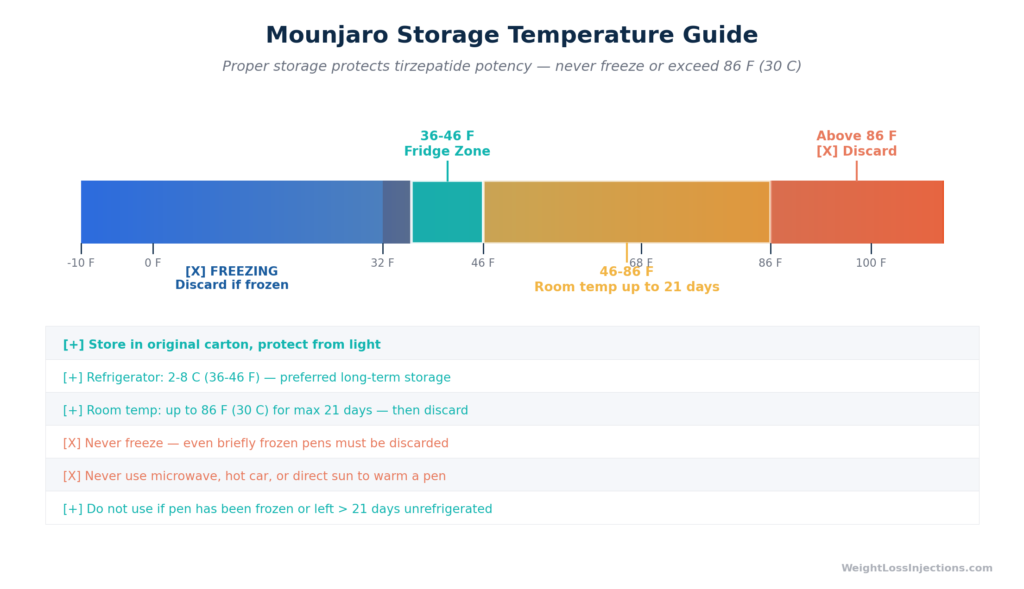
Temperature safety zones for Mounjaro KwikPen storage. Green zone (36–46°F / 2–8°C) = optimal refrigerated storage. Yellow zone (up to 86°F / 30°C) = safe for up to 21 days at room temperature. Red zones = discard.
- Store Mounjaro KwikPens refrigerated at 36–46°F (2–8°C) in the original carton. This is your default storage mode from the day you pick them up at the pharmacy.
- Once out of the refrigerator, each single-dose pen can stay at room temperature not exceeding 86°F (30°C) for up to 21 days — then discard, even if you haven’t used it.
- Never freeze a Mounjaro pen. If it has been frozen, discard it immediately — do not use it.
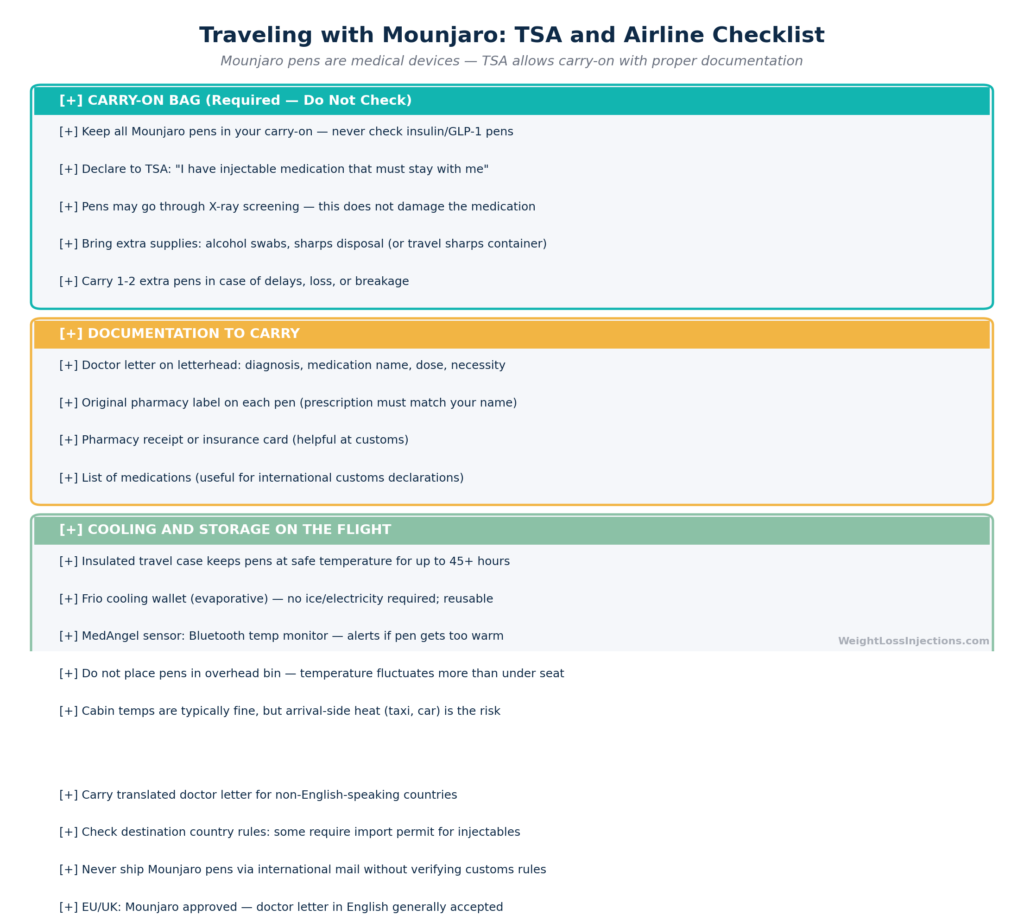
- TSA permits injectable diabetes medications in carry-on bags, exempt from the 3-1-1 liquid rule. Always keep Mounjaro in your carry-on, never checked luggage.
- For trips up to 21 days, a quality insulated travel case (FRIO wallet, MedActiv iCool, PCM cooling case) keeps your pen within safe temperature range without electricity.
- For trips longer than 21 days, you need access to a functioning refrigerator at your destination — plan ahead with your hotel, Airbnb, or cruise ship.
- If your pen was frozen, exposed to temperatures above 86°F, left out more than 21 days, or the solution looks cloudy or discolored — discard it and contact your pharmacy.
Jump to section:
- Official Mounjaro storage requirements
- How long can Mounjaro be left at room temperature?
- Traveling with Mounjaro — TSA and air travel
- International travel and customs
- Time-zone changes and your weekly dose schedule
- Keeping Mounjaro cold on the road — cooler options
- Hot weather, cold weather, and edge cases
- What to do if your pen gets too warm or too cold
- Lost or damaged pen replacement
- Pre-injection handling and visual inspection
- Safe disposal of used Mounjaro KwikPens
- Frequently asked questions
You just picked up a 28-day supply of Mounjaro — four KwikPens in a small refrigerated bag — and the pharmacist hands you the box with the instruction “keep refrigerated.” Simple enough at home. But a week later you’re planning a weekend trip, a two-week vacation, or an international work trip, and suddenly “keep refrigerated” raises a string of very practical questions: Can I leave it on the counter while I pack? What happens if I forget it in the car for a few hours? How do I get through airport security with a needle-based medication? What if my hotel room doesn’t have a mini-fridge?
These are not minor logistical concerns. Tirzepatide, the active molecule in Mounjaro, is a peptide — a protein-based drug — and like all peptides, it is sensitive to temperature extremes. Use a degraded pen and you are not just wasting [$X/month]; you are potentially taking a dose with reduced or zero efficacy, meaning poor glycemic control for the week ahead. The stakes are real, and the guidance from Eli Lilly’s FDA-approved Mounjaro prescribing information is clear, though not always fully understood by patients.
This guide gives you everything you need: the official storage rules explained in plain English, a complete travel protocol for every trip type, the cooling products that actually work, and a decision framework for when you’re not sure if your pen is still good. We’ll also cover replacement pathways and how to dispose of used pens safely, whether you’re at home or 5,000 miles away.
Mounjaro Storage Requirements — The Official Rules {#official-storage}
Every storage rule in this section comes directly from Section 16 of the FDA Mounjaro Prescribing Information — the official Eli Lilly label as approved by the FDA. These are not suggestions; they are the validated storage conditions under which Mounjaro’s stability, potency, and safety have been confirmed.
Refrigerated Storage (Primary)
Store Mounjaro pens in the refrigerator at 2°C–8°C (36°F–46°F). This is standard household refrigerator temperature — the setting most refrigerators maintain when set to their factory defaults. A few important placement notes that most patients don’t receive from their pharmacist:
- Do not store in the refrigerator door. The door is the warmest part of a refrigerator and is subject to temperature swings every time the door opens. Pens stored in the door may cycle between adequate and marginal temperatures repeatedly. Keep them on a middle shelf or in a produce drawer where temperature is most stable.
- Do not store against the back wall. In many refrigerator models, the cooling element runs along the back wall, and temperatures near it can drop below freezing. A pen touching the back wall is at risk of freezing — which, as discussed below, is irreversible damage. Give pens a few inches of clearance from the back.
- Store in the original carton. The carton’s primary job is light protection. Tirzepatide, like most peptide-based biologics, can be degraded by light exposure over time. Keeping the pen in the box until the moment you use it protects the active ingredient. Source: FDA Prescribing Information §16
Room-Temperature Storage (When Needed)
This is the rule that matters most for travelers and for everyday patients who occasionally leave a pen on the counter. Per the FDA label §16: Each single-dose Mounjaro pen may be stored at temperatures not to exceed 30°C (86°F) for up to 21 days.
Several points of clarification that create confusion in practice:
The 30°C/86°F limit is the number that matters — not 70°F. Some third-party sources and even some pharmacies cite a lower temperature limit (21°C/70°F). That figure does not match the FDA label. The validated maximum room-temperature storage limit is 30°C, which corresponds to 86°F — a warm room, not an air-conditioned one. A typical U.S. home at standard indoor temperature (68–75°F) is well within this limit.
The 21-day clock starts when the pen leaves the refrigerator. It does not restart if you return it to the fridge and take it out again. It does not reset if you haven’t injected from it yet. The 21-day window is cumulative time at room temperature.
After 21 days at room temperature, discard the pen — even if the dose window hasn’t expired and the solution looks fine. Do not return it to the refrigerator and continue using it. Source: FDA Prescribing Information §16
Use within 21 days OR by the expiration date, whichever comes first. A pen that was manufactured recently may have a year or more before its expiration date — but once it leaves refrigerated storage, the 21-day room-temperature limit applies regardless of that printed date.
The Freeze Rule
Do not freeze Mounjaro. If frozen, discard immediately. Do not use. Source: FDA Prescribing Information §16
Freezing causes two problems simultaneously: it can denature (unfold) the tirzepatide peptide, destroying its biological activity; and it can damage the KwikPen autoinjector mechanism, which contains springs, seals, and a retractable needle that may not function correctly after being frozen and thawed. A pen that has been frozen may look and feel normal after thawing, may contain solution that looks clear — and still be non-functional or ineffective. There is no reliable way to test whether a frozen-then-thawed pen is still viable, which is why the FDA label gives a simple bright-line rule: frozen = discard.
Quick-Reference Storage Rules
| Condition | Rule |
|---|---|
| At home, long-term storage | Refrigerate at 36–46°F (2–8°C) in original carton |
| Room-temperature storage | Safe up to 86°F (30°C) for maximum 21 days |
| After 21 days at room temp | Discard — do not return to fridge |
| Exposed to freezing temperatures | Discard immediately — do not use |
| Exposed to >86°F (30°C) | Discard — do not use |
| Past expiration date | Discard — do not use |
| Solution appears cloudy or discolored | Discard — do not use |
Source: FDA Mounjaro Prescribing Information §16
How Long Can Mounjaro Be Left Out of the Refrigerator? {#room-temp}
This is the single most searched practical question about Mounjaro storage — and it deserves a direct, scenario-based answer, because context changes the answer significantly.
The official FDA answer: up to 21 days at temperatures not exceeding 30°C (86°F). That is the outer limit. Within that boundary, different scenarios have different implications.
Scenario Table: Was My Pen Compromised?
| Scenario | Temperature During Exposure | Duration | Action |
|---|---|---|---|
| Left on kitchen counter overnight | ≤86°F (30°C) | 8–10 hours | Safe — this is Day 1 of your 21-day room-temp window |
| Left on desk at work, forgot to refrigerate | ≤86°F (30°C) | 5 days | Safe — within 21-day window; track remaining days |
| Left on counter for 22 days | ≤86°F (30°C) | 22 days | Discard — exceeds 21-day limit |
| Left in air-conditioned car during errand | ~72°F (22°C) | 2 hours | Safe — well within all limits |
| Left in parked car on hot summer day | >86°F (>30°C) | Any duration | Discard — exceeded temperature maximum |
| Accidentally placed in freezer | 32°F (0°C) or below | Any duration | Discard — freezing damage |
| Left in checked luggage on cold flight | Potentially below 32°F | Duration of flight | Discard — freezing risk (see Travel section) |
| Kept in FRIO wallet outdoors in 95°F heat | Maintained ~64–78°F by evaporative cooling | Up to 45 hours | Safe — FRIO keeps temperature within room-temp limit |
A few scenarios deserve elaboration because they generate the most questions:
“I forgot it in the car for a couple of hours.” Whether this is safe depends entirely on the car’s interior temperature. On a mild day with windows cracked, a car may stay below 86°F. On a 90°F summer day, the interior of a parked car can reach 130°F or higher within minutes — far exceeding the 30°C limit. When in doubt about a car exposure in warm weather, discard and replace. The cost of a compromised dose (poor glycemic control for a week) outweighs the cost of the pen.
“I left it out and I’m not sure how long it’s been.” If you genuinely cannot determine how long the pen has been at room temperature, apply the conservative rule: if there is any realistic chance it has exceeded 21 days or been exposed to heat above 86°F, discard it. Tracking the date you removed the pen from the fridge with a sticker or calendar reminder is a good habit that eliminates this uncertainty.
“I put it back in the fridge after leaving it out.” The 21-day room-temperature clock does not reset when you return the pen to the refrigerator. The accumulated time at room temperature across all exposures counts toward the 21-day total. Keep a note of the first date the pen left refrigerated storage; that date plus 21 days is the discard deadline.
“The solution looks totally clear and normal after it was frozen.” Visual inspection is not sufficient to detect freeze damage. Freeze-thaw damage to peptides can be invisible to the naked eye. If the pen was frozen, discard it regardless of appearance. Source: FDA Prescribing Information §16
Traveling with Mounjaro — TSA and Air Travel Rules {#tsa-travel}
Air travel is where Mounjaro storage questions get the most complicated — and the most urgent, because security checkpoints happen at a fixed time whether you are prepared or not. The good news is that the rules are patient-friendly, and TSA security agents are trained for medical medication situations.
TSA Rules for Injectable Medications
Injectable diabetes medications — including Mounjaro (tirzepatide) KwikPens — are exempt from the TSA 3-1-1 liquid rule. The standard 3-1-1 rule restricts liquids, gels, and aerosols in carry-on bags to containers of 3.4 oz (100 mL) or less, with all containers fitting in a single quart-sized bag. Medical liquids that are necessary to treat a medical condition are not subject to this restriction. Each Mounjaro KwikPen contains 0.5 mL, which is well under 3.4 oz, but even larger volumes of injectable medications can be carried on when medically necessary.
Mounjaro qualifies for this exemption because it is an FDA-approved injectable medication for the management of type 2 diabetes mellitus — a documented medical condition. [Source: TSA medical accessibility policy per WeightLossInjections.com shared specification §7]
What to Carry and How to Declare It
Carry in the original packaging. The original pharmacy-labeled box or carton is your documentation that this is a legitimate prescription medication. The pharmacy label must show your name and the medication name (tirzepatide or Mounjaro). Do not transfer pens to unmarked cases or generic containers before going through security.
Declare your injectable medication at the checkpoint. Before your bags go through the X-ray machine, tell the TSA officer: “I have injectable medications in my bag.” This is standard procedure and will not raise concerns — TSA officers process insulin, insulin pens, GLP-1 injectors, and similar medications routinely. Declaration speeds the process and prevents the officer from having to interrupt your screening to ask questions.
Expect a swab test. Medical liquids are frequently swabbed for explosive residue — this is a routine secondary procedure, not a sign of a problem. Your pen will be returned promptly.
Bring your supplies. Needles for injectable medications (though the Mounjaro KwikPen has a built-in auto-retractable needle), alcohol swabs, and a travel sharps container are all permitted in carry-on bags when used for medically necessary injections.
Carry-On — Not Checked Luggage
Always keep Mounjaro in your carry-on bag. Never check it. This rule is non-negotiable for two reasons:
- Freezing risk. Aircraft cargo holds are unheated during flight and regularly reach temperatures well below 0°C at cruising altitude. Mounjaro left in a checked bag will likely be frozen by the time you arrive — rendering it unusable and requiring immediate replacement.
- Loss or delay risk. Checked luggage can be delayed, misrouted, or lost. If your medication is in your checked bag and your bag goes to the wrong city, you have a medical problem compounded by a logistical one. Your carry-on is the only bag that goes where you go, every time.
If a gate agent asks you to check your bag due to overhead bin space, request to keep your medications with you. Federal medical accommodation rules support this, and gate agents typically accommodate it without issue.
Prescription Documentation
While TSA does not strictly require a prescription or physician’s letter for domestic U.S. flights, carrying documentation is a best practice that eliminates friction:
- A copy of your prescription label or a printout from your pharmacy
- A brief letter from your prescribing provider at [WeightLossInjections.com — service detail] on provider letterhead stating your diagnosis, medication name, and dosing frequency
- The original pharmacy carton with all labels intact
For domestic trips, this documentation is rarely needed. For international travel, it becomes essential (see below).
International Travel with Mounjaro {#international-travel}
International travel introduces three additional layers of complexity: customs regulations, differing airline rules regarding medical liquids, and the practical challenge of cold-chain maintenance over long-haul flights and multi-week trips.
Customs Declaration
Most countries require travelers to declare prescription medications at customs, particularly injectable medications containing needles. The specific rules vary by country:
- European Union / Schengen Area: Declaration required for quantities exceeding what is needed for personal use (typically interpreted as a supply proportionate to trip length, with a physician letter). Most EU customs officers are familiar with GLP-1 injectable medications, but documentation in the local language is helpful for longer stays.
- United Kingdom: Controlled drugs and injectable medications must be declared; a physician’s letter is strongly recommended for stays over 3 months.
- Canada: Similar to the U.S. — personal use quantities with original pharmacy labels are generally permitted without additional documentation.
- Japan, Australia, New Zealand: Stricter pharmaceutical import rules; carry a physician’s letter and be prepared to complete formal customs declaration forms.
- Countries with restricted pharmaceutical import: Some Middle Eastern and Southeast Asian countries have strict rules about importing medications, including biologics. Check with your destination country’s embassy or consulate before travel.
The Lilly Travel Letter Template. Eli Lilly provides a travel letter template for Mounjaro patients traveling internationally. Your prescribing provider at [WeightLossInjections.com — service detail] can complete this template, which describes your diagnosis, the medication’s medical necessity, the required storage conditions, and needle safety information. Request this letter at least two weeks before international travel to allow time for completion and any needed translation.
IATA Airline Rules
Under International Air Transport Association (IATA) guidelines, injectable medications are classified as medical supplies and are generally permitted in carry-on and checked baggage when properly labeled and accompanied by documentation. However, IATA rules are guidelines — individual airlines may have additional policies. Key points:
- Most major international airlines (United, Delta, American, British Airways, Lufthansa, Singapore Airlines) explicitly permit insulin and injectable diabetes medications in cabin baggage with prescription documentation.
- Some airlines allow you to request refrigerated storage of medications from flight attendants for long-haul flights (12+ hours). This is not guaranteed but is worth asking at check-in or on boarding.
- Do not pack Mounjaro in dry ice in your carry-on. Dry ice is classified as a hazardous material under IATA DGR and is subject to quantity restrictions. The far simpler solution is a properly insulated cooling case (see below).
Medication Shortages at Your Destination
Mounjaro is not available in all countries — it is approved in the United States, European Union, United Kingdom, Japan, Australia, and a growing number of markets, but availability at local pharmacies varies significantly. Do not assume that if you run out or lose a pen, you can easily replace it abroad. Always bring a complete supply plus one extra pen as a buffer. For very long trips (greater than 8 weeks), work with your provider and pharmacy to arrange an extended supply or mail-forward arrangements before departing.
Time-Zone Changes and Your Weekly Dose Schedule {#time-zones}
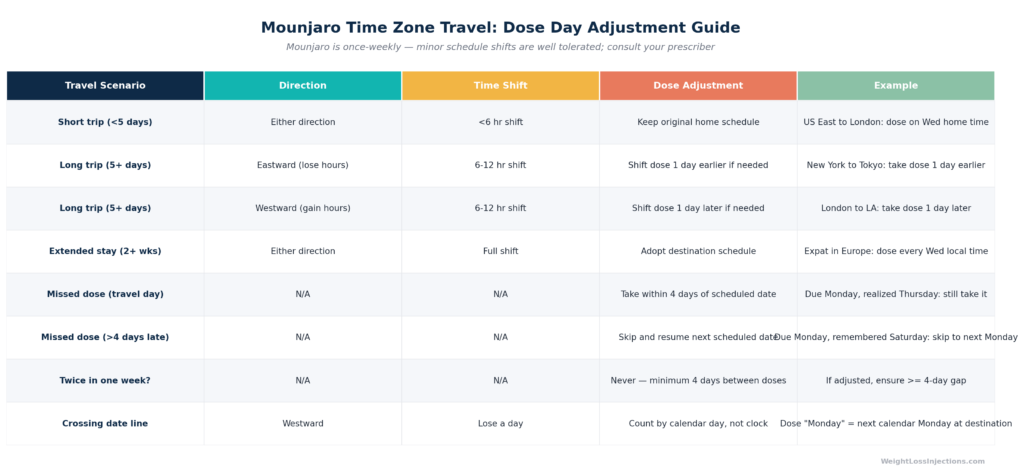
Mounjaro is dosed once weekly — which makes time-zone management far simpler than, say, a twice-daily medication. The specific day and time of your weekly injection is flexible, with one key constraint: the interval between doses must be at least 72 hours (3 days).
Per FDA Prescribing Information §2: “The day of weekly administration can be changed if necessary, as long as the time between the two doses is at least 3 days (72 hours).”
This means that when you cross time zones, you have practical flexibility in when you administer your next dose — you do not need to calculate a precise time-of-day adjustment. What matters is maintaining your weekly cadence.
Time-Zone Adjustment Table
| Scenario | Guidance |
|---|---|
| Travel within same time zone (domestic U.S.) | No adjustment needed — inject on your regular day |
| Travel 1–3 hours east or west | No meaningful adjustment needed — inject on regular calendar day |
| Long-haul travel crossing 6+ time zones (e.g., U.S. to Europe) | Maintain weekly calendar day in your home time zone for the first week; after full adjustment, shift to local calendar day if preferred |
| Travel crossing International Date Line westward (gaining a day) | Be aware of calendar day change; count at least 72 hours from last dose regardless of calendar |
| Travel crossing International Date Line eastward (losing a day) | Same 72-hour minimum interval applies; may need to delay dose by one calendar day |
| Extended stay in new time zone (>2 weeks) | Shift weekly injection day to preferred local day, ensuring ≥72 hours since last dose |
Practical advice for most travelers: If you take your Mounjaro every Sunday at home and you are traveling to Paris for two weeks, take your first travel dose on the Sunday after arrival (your usual calendar day). When you return home, take your dose on the following Sunday. The body does not care whether “Sunday” means 9 AM Eastern or 3 PM Central European Time — what the pharmacokinetics care about is the weekly interval.
Because tirzepatide has a half-life of approximately 5 days per FDA Prescribing Information §12.3, the drug accumulates and clears slowly. A shift of one or even two days in injection timing will not cause a clinically significant dip in drug levels for most patients. The 72-hour minimum is a conservative safety threshold, not a rigid pharmacokinetic boundary.
Keeping Mounjaro Cold During Travel: Cooler and Case Options
Mounjaro travel window chart. Green zone (days 1–21): a quality insulated travel case without refrigeration is sufficient at ambient temperatures ≤86°F. Orange zone (day 22+): active refrigeration at destination is required.
The right cooling solution depends on your trip length and the conditions you will be traveling through. Here is a framework for choosing:
Trips of 1–21 Days (Room-Temperature Window)
If your trip is three weeks or shorter and you can keep the pen in an environment where ambient temperatures stay below 86°F (30°C), refrigeration at your destination is convenient but not strictly required. The pen is within its validated room-temperature storage window.
For this scenario, an insulated travel case does double duty: it protects the pen from accidental heat exposure (a hot bag left in a car, beach sun, warm conference-room table) and helps maintain temperatures in an acceptable range during transit.
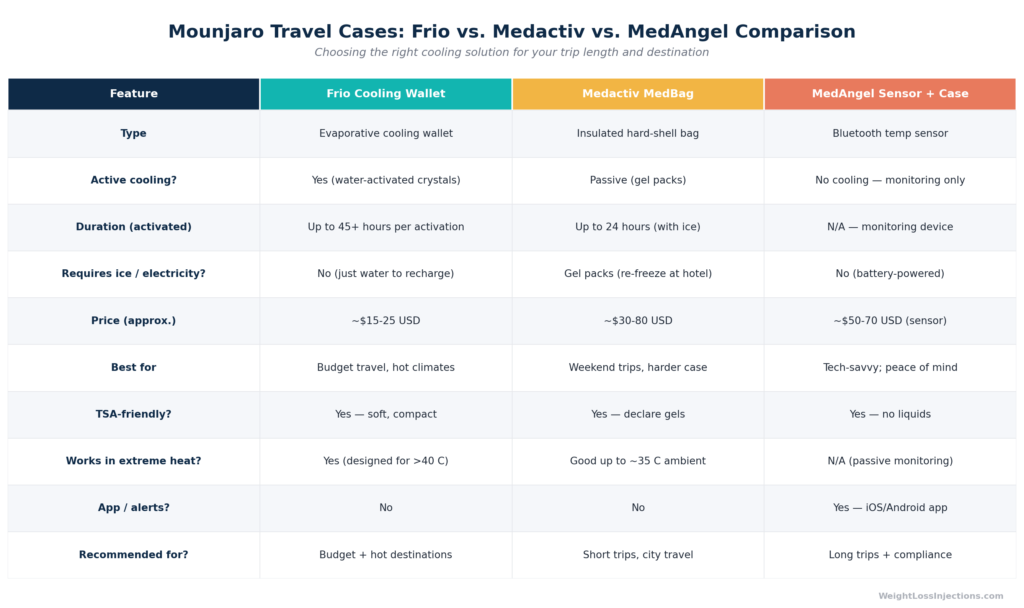
FRIO Cooling Wallets. The FRIO (available at friouk.com) is the most widely used insulin and injectable medication travel cooler. It uses evaporative cooling — you soak the inner panel in water for 5–10 minutes and it keeps the contents at approximately 18–26°C (64.4–78.8°F) for up to 45 hours, even in ambient temperatures up to 37°C (98.6°F). No ice, no electricity, no refrigerant packs that need to be frozen in advance. The FRIO works in any climate where the air is drier than the wallet — including dry heat, beach environments, and outdoor activities. For tropical or high-humidity environments, FRIO’s performance decreases; in 100% relative humidity, evaporative cooling stops entirely.
Note: The FRIO keeps medications at room temperature (within the 18–26°C range), not refrigerator temperature. If you need refrigerator-cold storage (2–8°C), the FRIO is not the right tool. For Mounjaro trips under 21 days where room-temperature storage is acceptable, it is ideal.
MedActiv iCool. The MedActiv iCool line (medactiv.com) uses phase-change material (PCM) technology — a wax-like substance that melts at a controlled temperature, absorbing heat and keeping the interior at a stable temperature. Depending on the product, MedActiv cases can maintain either refrigerator-level temperatures (2–8°C) or room temperatures. The iCool Nomad and similar products can maintain refrigerator temperatures for 12–18 hours, which is useful for full cold-chain maintenance during travel days. Recharge by placing the PCM pack in the refrigerator overnight.
4AllFamily Travel Cases. Products from 4allfamily.com combine insulation with gel packs and are well-sized for Mounjaro KwikPens. They maintain temperature for 12–48 hours depending on configuration and ambient conditions, and are available in TSA-compliant sizes.
MedAngel Temperature Sensors. Rather than a cooling case itself, MedAngel (medangel.com) produces small Bluetooth-connected temperature sensors that live inside your medication bag or case and connect to a smartphone app. The sensor logs temperature over time and alerts you if the pen has been exposed to temperatures outside the safe range. This is an excellent add-on to any insulated case that gives you peace of mind and an objective record — useful if you are unsure whether your bag got too hot during transit. If a temperature excursion was logged, you know to discard; if the log shows continuous safe temperatures, you can inject with confidence.
Insulin Coolers with Active Cooling. For very long trips or trips to hot climates where ambient temperatures routinely exceed 86°F, active-cooling insulin cases (battery or AC-powered) maintain true refrigerator temperatures continuously. Products like the Cooluli or portable car-refrigerator models are more expensive and bulkier, but provide full cold-chain maintenance. The Mounjaro pen itself is the same size as most insulin pens and fits in all insulin-compatible coolers.
Trips Longer Than 21 Days
If you are away for more than 21 days — extended vacations, expat assignments, study abroad, long-distance truck driving, or extended travel — you need access to a functioning refrigerator at your destination to store pens that will not be used within the 21-day window.
Hotels. The vast majority of hotels have mini-refrigerators in the room. When booking, confirm a mini-refrigerator is available, or specifically request a medical refrigerator. If you are staying in a hotel without in-room refrigeration, call ahead and ask the hotel kitchen staff or concierge to store your medication in their kitchen refrigerator — most hotels accommodate medical storage needs without issue. Put your name on the bag and mention it is prescription medication that must stay cold.
Airbnb and Vacation Rentals. Most full apartments and houses have full-size refrigerators. Confirm this in your listing research, or message the host in advance.
Cruise Ships. Cabin mini-fridges are standard on most cruise lines. For longer cruises or when uncertain, declare your injectable medications to the ship’s medical staff on boarding day. They can provide refrigerated medical storage in the ship’s medical facility and are required to do so for patients with documented medical needs.
International Pharmacy Refills. For very extended stays, it may be possible to obtain a local supply of tirzepatide (where Mounjaro is locally approved and available) with a letter from your U.S. provider. This is complex and requires planning, but is worth investigating for assignments over 60 days. [WeightLossInjections.com — service detail] for provider assistance with international prescription arrangements.
Cooling solution comparison for Mounjaro travel. Match your cooling method to your trip length and expected conditions.
Our Top 3 · October 2026
The best GLP-1 providers right now
Independently reviewed. Ranked by price, medication access, provider quality, and patient outcomes.
Renew GLP
Personalized GLP-1, GIP plans: Semaglutide & Tirzepatide.
Medvi
No membership or hidden fees. Everything you need is included.
Trimi
US-licensed clinicians and shipped to your door, from $99/mo.
Hot Weather, Cold Weather, and Special Environments {#weather}
Hot Weather
Summer travel, tropical destinations, outdoor events, festivals, beach days, camping, and hiking all create environments where temperatures easily exceed 86°F (30°C). At these temperatures, a Mounjaro pen that is not in an insulated case is at risk.
Hot car. Never leave Mounjaro in a parked car on a warm day. Car interiors can reach 130–170°F (54–77°C) within minutes in summer sun — temperatures that would rapidly destroy the tirzepatide molecule. This applies even on “mild” days (65°F outside = potential 100°F interior in direct sun after 30 minutes). [CITATION NEEDED — specific car temperature data; widely reported in medical safety literature]
Beach and poolside. Direct sun exposure raises temperatures significantly above ambient. Keep the pen in your insulated cooling case in the shade — not on a towel, in a sandy bag, or in a beach bag left in the sun.
Outdoor exercise and hiking. Body heat and solar radiation can raise temperatures in a hydration vest or backpack pocket. Use an insulated case, and consider a MedAngel sensor if you are doing multi-day outdoor activities where you cannot verify temperatures.
Humid tropical climates. High humidity reduces the effectiveness of evaporative-cooling cases (like the FRIO). In tropical destinations with temperatures consistently above 86°F and high humidity, a PCM cooling case or active refrigeration is a better choice.
Cold Weather
Cold weather creates the opposite risk: freezing. While rare in indoor environments, several scenarios create freezing risk:
Cold car. A car parked overnight in winter in cold climates can drop well below 32°F. A Mounjaro pen left in a glove box or back seat in a cold overnight parking situation is at risk of freezing.
Outdoor winter activities. Skiing, snowshoeing, ice fishing, or other cold-weather outdoor sports — keep the pen close to your body (inside layers, in a vest pocket next to skin) or in an insulated bag rather than in an outer pocket exposed to wind chill.
Airplane cargo hold. As noted, aircraft cargo holds reach below-freezing temperatures at cruising altitude. This is why checked-luggage storage is never acceptable for Mounjaro.
Cold hotel room or mountain cabin. In very cold climates, an unheated cabin or a hotel room where the heat was left off can drop to temperatures that risk freezing. Keep medication in the main living area at room temperature, not in an unheated entryway or on a windowsill.
What to Do If Your Mounjaro Pen May Be Compromised {#compromised-pen}
If you are uncertain whether your pen has been stored correctly, use this decision framework before injecting:
Follow this decision flowchart before every injection if you have any uncertainty about your pen’s storage history.
Visual Inspection Before Every Injection
Per FDA Prescribing Information §2, before each injection, visually inspect the Mounjaro solution. Normal appearance:
- Clear to colorless with possibly a very slight yellow tint — both are normal
- No visible particles — completely clear solution
- No cloudiness — solution should not appear milky, hazy, or opaque
If the solution is cloudy, discolored (unusual brownish or pink tint), or contains visible particles or floating matter — do not use the pen, discard it, and contact your pharmacy. These are signs of product degradation or contamination. Source: FDA Prescribing Information §2
When In Doubt, Discard
The rule is simple and worth repeating: when in doubt, discard the pen and contact your pharmacy for a replacement. The cost of discarding a single pen [$X/month normalized to one dose] is real, but it is far less consequential than injecting a degraded dose and spending a week with poor glycemic control, or a dose that does nothing while you believe it is working. Mounjaro’s pharmacological effect has a one-week window — a missed or degraded dose is not recoverable until the following week’s injection.
Lost or Damaged Pen Replacement {#replacement}
Losing a pen, having it damaged in transit, or discovering a temperature excursion after delivery are all situations that require quick action to avoid a missed dose.
Pharmacy Replacement
For pens that were damaged due to a shipping issue from a mail-order pharmacy, most mail-order services (including those processing prescriptions from [WeightLossInjections.com — service detail]) will replace the pen at no charge when a cold-chain breach is documented. If your mail-order delivery included a temperature indicator (common with specialty medications — small adhesive labels that permanently change color if temperature exceeded the threshold), photograph it before unpacking and report the breach immediately.
For pens damaged or lost after receipt (user error), contact your pharmacy about early refill options. Insurance coverage for early refills varies — most plans allow early refill within 7 days of the expected run-out date. Your pharmacist can advise on your specific plan’s rules.
Lilly Cares Foundation
For patients experiencing financial hardship or without insurance coverage, the Lilly Cares Foundation provides patient assistance for Mounjaro. This program can assist with replacement pens in cases of financial need. The application process requires documentation of income and insurance status.
Lilly Mounjaro Savings Card
If you are enrolled in the Lilly Mounjaro Savings Card program (available at mounjaro.lilly.com/savings-resources), the card applies at the pharmacy to lower your out-of-pocket cost on replacement fills. For patients with commercial insurance covering Mounjaro for T2DM, the card can bring your cost to as low as $25 for a 1-month supply (or as low as $75 for a 3-month supply), up to the card’s annual maximum savings. (NiceRx Savings Card overview, March 2026)
The savings card does not apply to Medicare or Medicaid patients, and it requires the prescription to be for the FDA-approved T2DM indication. (Mounjaro Savings Resources — Lilly.com)
Emergency Replacement While Traveling
If you lose a pen while traveling domestically, any pharmacy can dispense a replacement fill if your prescription has remaining refills and your insurance allows it. Call your pharmacy or the [WeightLossInjections.com — service detail] provider line to arrange an emergency fill at a local pharmacy. Bring a photo of your prescription label or your pharmacy app for the fastest processing.
For international travel, replacement is more complex because Mounjaro may not be available under that brand name or may require a local prescription. In countries where tirzepatide is approved (EU, UK, Japan, Australia), it may be available under a different brand name or through a different distribution path. Contact your travel insurance medical assistance line for guidance; many travel insurance policies include emergency prescription assistance.
Pre-Injection Handling: What to Do Before You Inject {#pre-injection}
Allow to Reach Room Temperature
Remove the Mounjaro pen from the refrigerator approximately 30 minutes before your scheduled injection. Injecting a cold pen directly from the refrigerator is not harmful to the medication, but it is noticeably more uncomfortable — the cold solution entering subcutaneous tissue causes a stinging or burning sensation that room-temperature solution does not. Allowing the pen to warm up naturally eliminates most of this discomfort. [CITATION NEEDED — specific clinical data on cold injection pain; standard clinical guidance for all refrigerated subcutaneous injectables]
Do not speed up the warming process by placing the pen in warm water, a microwave, or next to a heating element. Rapid heating can exceed the 30°C limit. Natural room-temperature warming for 30 minutes is the correct method.
Inspect Before Every Injection
Even if you are confident the pen has been stored correctly, inspect the solution every time before injecting. This takes five seconds and could prevent you from using a pen that was damaged in an unnoticed way:
- Remove the pen from the carton.
- Hold it up to a light source.
- Tilt and rotate the pen gently — do not shake it.
- Verify the solution is clear, colorless to slightly yellow, and free of particles.
- Verify the expiration date has not passed.
- Verify the pen is within its room-temperature window (if applicable).
If everything checks out, proceed with your injection per the standard KwikPen technique. Source: FDA Prescribing Information §2
Do Not Shake the Pen
Shaking the pen is not necessary and not advisable — it can cause foaming in the solution and mechanical stress on the pen components. If you want to gently mix or warm the solution, roll the pen slowly between your palms once or twice, but avoid any vigorous motion.
Rotate Your Injection Sites
Per FDA Prescribing Information §2, approved injection sites for Mounjaro are: the abdomen (at least 2 inches from the navel), the outer thigh, or the back of the upper arm. Rotate the injection site with every dose. Repeated injection into the same spot causes lipohypertrophy — a buildup of fibrous, fatty scar tissue that impairs drug absorption and can reduce the effectiveness of your doses. A systematic rotation plan across all three regions is the best way to protect your injection sites for years of therapy.
For more detail on injection technique and site rotation, see our full guide to Mounjaro injection site reactions.
Safe Disposal of Used Mounjaro KwikPens {#disposal}
Why Sharps Containers Are Required
The Mounjaro KwikPen contains a retractable needle. After activation and injection, the needle auto-retracts — but it has still been in contact with tissue and carries a biohazard risk. Used KwikPens must be disposed of in an FDA-cleared sharps container, not in regular household trash or recycling bins. Needles in household trash are a serious safety hazard for sanitation workers and anyone handling garbage.
Sharps Container Options
Dedicated sharps containers. Available at most pharmacies (CVS, Walgreens, Walmart, Rite Aid) for approximately $5–$15. These are the simplest and most reliable option. Fill to the marked line (not the top), then seal and dispose of per local regulations.
Pharmacy take-back programs. Many pharmacies offer free sharps disposal kiosks where you can drop sealed containers. Walgreens and CVS both operate in-store kiosk programs in many locations. Check availability at your local pharmacy.
Mail-back programs. Some states and pharmacies offer sharps mail-back programs. You purchase a pre-addressed, pre-paid container, fill it, seal it, and mail it. Stericycle’s MailBack program is one national option.
Household alternative (if sharps container unavailable). If you are traveling and do not have a sharps container, use a heavy-duty, puncture-resistant plastic container (such as a laundry detergent jug or a thick-walled plastic bottle) with a screw-top lid. Label it clearly: “SHARPS — DO NOT RECYCLE.” This is an acceptable temporary measure per FDA guidance, not a permanent solution. (FDA sharps disposal guidance)
Travel disposal. Bring a travel-size sharps container in your carry-on. TSA permits sealed sharps containers in carry-on bags (declare at checkpoint). Do not attempt to dispose of used pens in airplane lavatory trash bins — this is prohibited and creates safety risks for airline staff.
Lilly’s disposal guidance. Eli Lilly provides sharps disposal resources and information for Mounjaro patients at mounjaro.lilly.com/savings-resources. (Lilly Mounjaro Savings Resources)
Our Take at WeightLossInjections.com
Storage and travel logistics are an underestimated part of Mounjaro therapy. Most of the conversation around tirzepatide focuses on efficacy, dosing, and side effects — but for patients who travel frequently, work outside, live in extreme climates, or have complex logistics, storage mistakes are among the most common reasons a weekly dose fails to deliver the expected results.
The rules are not complicated once you understand them: refrigerate it, don’t freeze it, use it within 21 days of leaving the fridge, protect it from heat above 86°F, inspect it before every injection, and discard any pen you are uncertain about. The travel rules — TSA carry-on, original packaging, physician documentation for international travel — are patient-friendly once you know them.
The investment in a quality travel cooling case (typically $15–$50 for a FRIO or PCM option) and a MedAngel temperature sensor (~$30) is modest compared to the cost of a single Mounjaro pen. For patients on Mounjaro for the long term, these are tools worth having in your kit permanently.
If you have specific questions about how [WeightLossInjections.com — service detail] can help you obtain travel documentation, arrange extended supplies for international travel, or connect with a provider for replacement pen prescriptions, reach out through the patient portal.
Frequently Asked Questions {#faq}
How should I store Mounjaro at home?
Store Mounjaro pens in the refrigerator at 2°C–8°C (36°F–46°F) in the original carton to protect from light. Do not freeze. Keep away from the refrigerator door (temperature fluctuates with each opening) and the back wall (risk of freezing near the cooling element). Keep in the original carton until immediately before use. Source: FDA Prescribing Information §16
How long can Mounjaro be left out of the refrigerator?
Each Mounjaro KwikPen may be stored at room temperature not exceeding 30°C (86°F) for up to 21 days. After 21 days at room temperature, discard the pen regardless of remaining medication or appearance. Do not return the pen to the refrigerator once this window has started — the 21-day count does not reset. Source: FDA Prescribing Information §16
Can I take Mounjaro through TSA airport security?
Yes. Injectable diabetes medications are exempt from TSA’s 3-1-1 liquid rule. Carry in the original packaging with your pharmacy label, declare at the checkpoint, and always keep Mounjaro in your carry-on bag — never checked luggage, which can reach freezing temperatures in the cargo hold during flight.
What if my Mounjaro pen gets too warm?
If exposed to temperatures above 30°C (86°F) for any period, discard the pen and do not use it. Heat degrades the tirzepatide molecule. Inspect the solution before every injection — if it appears cloudy, discolored, or contains particles, do not use it. Contact your pharmacy for a replacement. Source: FDA Prescribing Information §16
Can I re-refrigerate Mounjaro after it’s been at room temperature?
No. Once a pen has been removed from the refrigerator and stored at room temperature, do not return it to the refrigerator and resume the storage clock. Use within 21 days of first removal from refrigerated storage or by the expiration date, whichever comes first. Re-refrigerating and re-warming repeatedly is not recommended. Source: FDA Prescribing Information §16
Can I bring Mounjaro on an international flight?
Yes, with preparation. Carry in original packaging with pharmacy label. For international travel, bring a physician’s letter on provider letterhead describing your diagnosis, medication name, and medical necessity for carrying injectable medication and needles. Declare to customs on arrival as required by your destination country. Check your destination country’s pharmaceutical import rules before travel.
What happens if my Mounjaro pen is accidentally frozen?
Discard it. Freezing can denature the tirzepatide peptide and damage the KwikPen autoinjector mechanism. A pen that has been frozen may appear normal after thawing but is not reliable. Do not attempt to use a frozen pen. Contact your pharmacy for a replacement. Source: FDA Prescribing Information §16
What travel cooling case should I use for Mounjaro?
For trips up to 21 days: a FRIO cooling wallet (evaporative cooling, no electricity needed, maintains 18–26°C, up to 45 hours at ambient temperatures up to 37°C) is ideal for most travel scenarios. For full cold-chain maintenance (2–8°C): a MedActiv iCool PCM case maintains refrigerator temperatures for 12–18 hours — good for travel days. For temperature logging and verification: add a MedAngel Bluetooth sensor to any case. For trips longer than 21 days, access to a functioning refrigerator at your destination is required.
Do I need to change my injection day when I travel across time zones?
Usually not. Mounjaro is dosed once weekly, and the FDA label permits changing the day of weekly administration as long as at least 72 hours (3 days) have passed since the last dose. For most time-zone changes, simply continue on your regular calendar day in your home time zone for the first week, then adjust to your preferred local day if staying long-term.
How do I dispose of used Mounjaro pens safely?
Discard used KwikPens in an FDA-cleared sharps container. Many pharmacies offer free sharps disposal kiosks or mail-back programs. Do not place used pens in regular household trash or recycling bins. When traveling, bring a travel-size sharps container in your carry-on and declare it at TSA checkpoints. See: FDA sharps disposal guidance; Lilly disposal resources at mounjaro.lilly.com
What should I do if my pen was damaged during shipping?
If your mail-order delivery included a temperature indicator that changed color (indicating a cold-chain breach), photograph it immediately and contact your pharmacy before using the medication. Most mail-order pharmacy services will replace pens damaged due to shipping errors at no charge. If you are a [WeightLossInjections.com — service detail] patient, contact our patient services line for expedited replacement assistance.
Medical Disclaimer: This article is written for informational purposes only and reviewed by the WeightLossInjections.com Staff. Storage guidelines cited are based on the official FDA Prescribing Information for Mounjaro (tirzepatide) as of the most recent label revision. Always follow the storage instructions on your specific pen carton and pharmacy label, which supersede general guidance. If you are unsure whether your medication has been stored correctly, contact your pharmacist before using. WeightLossInjections.com is not affiliated with Eli Lilly and Company.