Mounjaro vs. Zepbound: Why Two Brand Names Exist for the Same Drug
Medically reviewed by WeightLossInjections.com Staff•Updated July 23, 2026•22 min readMedically reviewed
⤢
Medical Disclaimer: Mounjaro is FDA-approved for type 2 diabetes. Zepbound is FDA-approved for chronic weight management and obstructive sleep apnea. Although they contain the same active ingredient, prescribing and coverage rules differ by indication. This article is for educational purposes. WeightLossInjections.com does not provide medical advice. Always consult a licensed provider about which medication is right for your situation.
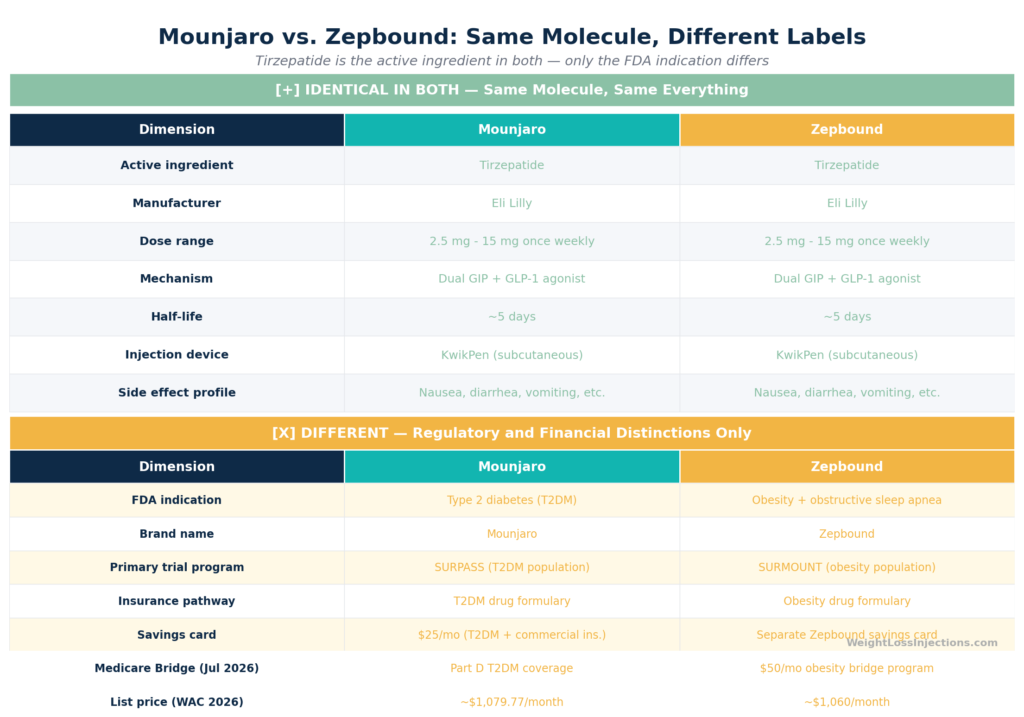
Split-panel brand comparison table showing Mounjaro vs
Mounjaro and Zepbound contain the exact same active ingredient — tirzepatide — manufactured by Eli Lilly to identical specifications, at identical doses (2.5 mg through 15 mg), with the same once-weekly injection schedule.
The only regulatory difference: Mounjaro (NDA 215866, approved May 2022) is FDA-approved for type 2 diabetes; Zepbound (NDA 217806, approved November 2023) is FDA-approved for chronic weight management and obstructive sleep apnea.
That one-sentence distinction controls your insurance pathway, your savings card eligibility, your access to LillyDirect self-pay pricing, and whether you qualify for the 2026 Medicare GLP-1 Bridge Program.
Mounjaro is the right on-label choice if your primary diagnosis is T2DM. Zepbound is the right on-label choice if your primary goal is weight management.
Patients with both T2DM and obesity may qualify for either brand — insurance and coverage pathway will determine which is more accessible.
No washout period is required when switching between the two brands. However, each brand requires its own prescription and its own prior authorization.
The two brands must never be used at the same time. They contain the same molecule; combining them is a dangerous double dose.
The Short Answer: Mounjaro and Zepbound Are the Same Molecule
When a physician, pharmacist, or news article tells you that Mounjaro and Zepbound are “the same drug,” they are chemically correct. Both products contain tirzepatide, a synthetic dual agonist of the GIP (glucose-dependent insulinotropic polypeptide) receptor and the GLP-1 (glucagon-like peptide-1) receptor — and the first drug in its class ever approved by the FDA, per the FDA Mounjaro Prescribing Information. Both are manufactured by Eli Lilly and Company. Both are delivered via the same subcutaneous injection device (the KwikPen). Both use the same six dose strengths: 2.5 mg, 5 mg, 7.5 mg, 10 mg, 12.5 mg, and 15 mg per 0.5 mL. Both are injected once weekly, with the same titration schedule and the same pharmacokinetics — an elimination half-life of approximately 5 days and mean absolute bioavailability of about 80%, per the FDA Mounjaro Prescribing Information.
The mechanism of action is identical: tirzepatide selectively binds and activates both the GIP receptor and GLP-1 receptor, enhancing insulin secretion in a glucose-dependent manner, suppressing glucagon, slowing gastric emptying, reducing food intake, and reducing body weight — all through the same dual pathway, per WebMD’s GLP-1 comparison. Because no other GLP-1 drug on the market also activates the GIP receptor, tirzepatide occupies a distinct pharmacological class regardless of which brand name it carries.
The side effects are identical across both brands. The boxed warning is the same: tirzepatide causes thyroid C-cell tumors in rats and mice, so both Mounjaro and Zepbound are contraindicated in patients with a personal or family history of medullary thyroid carcinoma (MTC) or Multiple Endocrine Neoplasia syndrome type 2 (MEN 2), per the FDA Mounjaro Prescribing Information. The most common adverse reactions — nausea, diarrhea, vomiting, constipation, decreased appetite, dyspepsia, abdominal pain — are the same for both products. The drug interaction profile (delayed gastric emptying affecting oral medications including warfarin and levothyroxine; hypoglycemia risk with insulin or sulfonylureas; oral contraceptive efficacy) is the same for both.
So why do two brand names exist? This is standard pharmaceutical practice. The FDA approval system is indication-specific: a manufacturer must file a separate New Drug Application (NDA) for each approved indication, supported by independent clinical evidence. Eli Lilly ran two parallel development programs for tirzepatide — the SURPASS program (type 2 diabetes trials) and the SURMOUNT program (obesity and weight management trials). Each produced its own NDA, its own regulatory review, and its own brand:
Mounjaro → NDA 215866, approved May 13, 2022, for type 2 diabetes mellitus as an adjunct to diet and exercise to improve glycemic control, per the FDA Mounjaro Prescribing Information.
Zepbound → NDA 217806, approved November 8, 2023, for chronic weight management in adults with obesity (BMI ≥30) or overweight (BMI ≥27 with at least one weight-related comorbidity), and subsequently for moderate-to-severe obstructive sleep apnea in adults with obesity (approved December 2024), per glp1.md’s drug comparison.
The brand name is not cosmetic. It signals your FDA indication to your insurer, which determines which formulary benefit applies and which insurance codes govern your prior authorization.
FDA Approvals — What Each Brand Is Officially Indicated For
Understanding the regulatory boundary between the two brands is the foundation of every practical decision that follows.
Mounjaro: Type 2 Diabetes Only
Mounjaro’s FDA label is narrow and specific. It is indicated solely as an adjunct to diet and exercise to improve glycemic control in adults with type 2 diabetes mellitus. That is the full scope of Mounjaro’s FDA-approved use. There is no weight management indication. There is no obstructive sleep apnea indication. When a provider prescribes Mounjaro for any purpose other than T2DM glycemic control, that constitutes off-label use — legal for physicians, but consequential for insurance.
The SURPASS clinical program provided the evidentiary basis for Mounjaro’s approval. Across five phase 3 trials enrolling over 20,000 adults with T2DM, tirzepatide demonstrated superiority over placebo, semaglutide 1 mg, insulin degludec, insulin glargine, and dulaglutide for HbA1c reduction — the primary endpoint. For example, in SURPASS-2, tirzepatide 15 mg reduced HbA1c by −2.30% versus −1.86% for semaglutide 1 mg (p<0.001), and 92% of tirzepatide patients achieved HbA1c <7.0%, per the SURPASS-2 publication in The New England Journal of Medicine. Weight loss was a meaningful secondary outcome — up to −11.2 kg (−12.4% body weight) at the 15 mg dose in SURPASS-2 — but T2DM glycemic control, not weight loss, was what Mounjaro was approved to treat.
Mounjaro shares the same boxed warning as Zepbound. Both products are contraindicated in patients with a history of MTC or MEN 2, and both carry warnings for pancreatitis, hypoglycemia (when used with insulin or sulfonylureas), acute gallbladder disease, acute kidney injury, and diabetic retinopathy, per the FDA Mounjaro Prescribing Information.
Zepbound: Chronic Weight Management and Obstructive Sleep Apnea
Zepbound was approved November 8, 2023, as an adjunct to a reduced-calorie diet and increased physical activity for chronic weight management in adults with:
Obesity: initial BMI ≥30 kg/m², or
Overweight: initial BMI ≥27 kg/m² with at least one weight-related comorbidity — hypertension, dyslipidemia, type 2 diabetes, obstructive sleep apnea, or cardiovascular disease.
A December 2024 indication expansion made Zepbound the first and only FDA-approved prescription medication for moderate-to-severe obstructive sleep apnea in adults with obesity — a distinct clinical use with its own insurance coding pathway.
Notably, type 2 diabetes is explicitly listed as a qualifying comorbidity for the Zepbound weight management indication. This means a patient with T2DM and obesity can be prescribed Zepbound under the obesity indication — they do not have to choose only the T2DM-labeled Mounjaro just because they have diabetes.
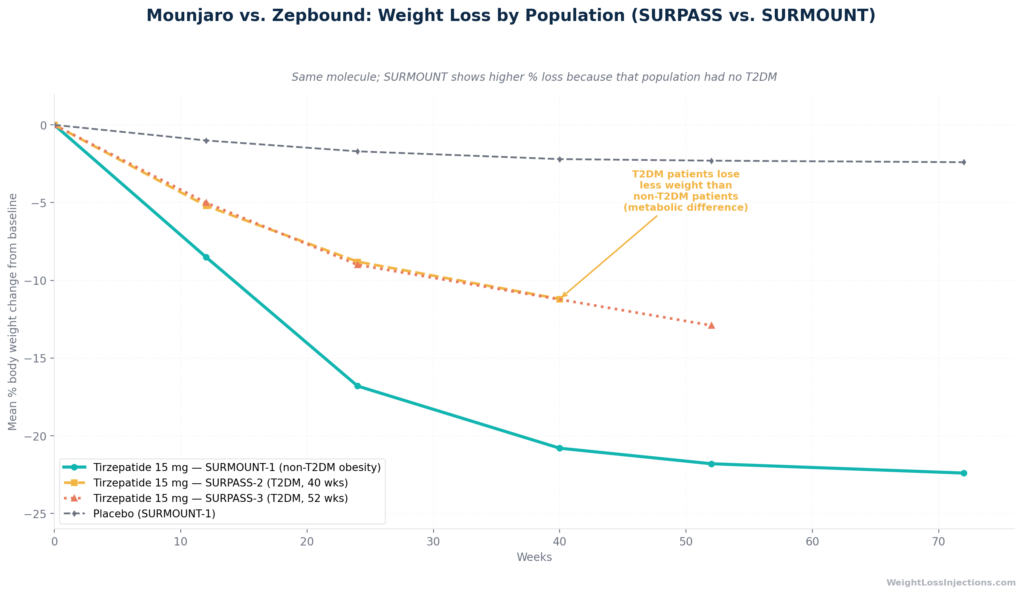
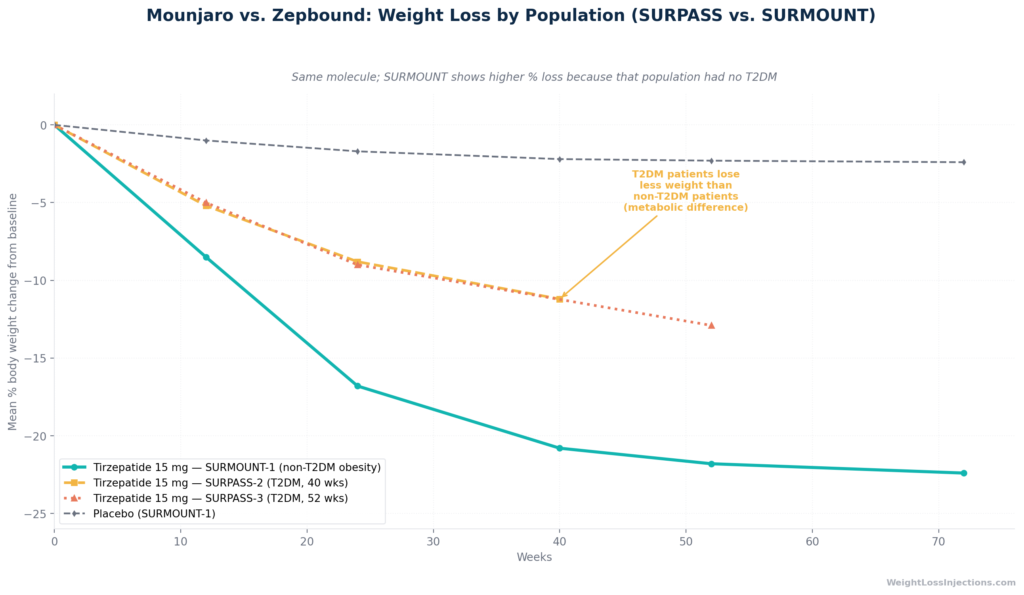
The evidentiary base for Zepbound was the SURMOUNT program, four phase 3 trials in adults with obesity or overweight. The pivotal SURMOUNT-1 trial enrolled 2,539 adults without T2DM and demonstrated −22.4% mean body weight reduction at 72 weeks with tirzepatide 15 mg, versus −2.4% for placebo, per the SURMOUNT-1 publication in The New England Journal of Medicine. These are the headline “22% weight loss” figures widely cited for tirzepatide — they derive from the SURMOUNT program in people without diabetes, not from the SURPASS program. SURMOUNT-2, which enrolled patients with both obesity and T2DM, showed −14.7% weight loss at the 15 mg dose — meaningfully lower, because T2DM patients experience greater metabolic resistance to weight loss, per the SURMOUNT-1 PMC publication.
Line chart showing weight loss progression across SURMOUNT-1 (non-T2DM population, Zepbound indication) vs
Insurance Coverage — Why the Brand Name Matters Enormously
This is the section that most patients care about the most, and the one where the Mounjaro vs. Zepbound distinction produces the largest real-world consequences.
How the Billing Framework Works
When a provider prescribes Mounjaro, the pharmacy claim is submitted with type 2 diabetes ICD-10 diagnostic codes (E11.x). Your insurer evaluates the claim against its diabetes drug benefit formulary. Most major commercial plans — employer-sponsored, marketplace/ACA — cover Mounjaro for T2DM, subject to prior authorization. Insurance approval rates for Mounjaro under the T2DM indication run approximately 60–70% for commercially insured patients, per FormBlends’ prescription access guide.
When a provider prescribes Zepbound, the claim is billed under obesity ICD-10 diagnostic codes (E66.x). Your insurer evaluates it against a separate obesity or weight management drug benefit. This is a different formulary administered under different rules. Many employer-sponsored plans still exclude weight management drugs entirely — and those that do cover them often require stricter prior authorization criteria, per Noom’s 2026 insurance guide.
The practical result: a patient with both T2DM and obesity may find Mounjaro covered under their diabetes benefit while Zepbound is denied under their obesity benefit — for the identical molecule at the identical dose.
Prior Authorization Requirements
For Mounjaro (T2DM indication), typical commercial PA criteria include:
Documented diagnosis of type 2 diabetes mellitus (ICD-10: E11.x)
Recent A1C level — generally ≥7.0% or ≥8.0% depending on the plan
Documentation of metformin trial at maximally tolerated dose (typically ≥2,000 mg for ≥3 months) or documented intolerance/contraindication
Confirmation the drug is not being used for chronic weight management (off-label use)
Clinical notes documenting comorbidities
Some plans require step therapy: a prior trial of a GLP-1 agonist such as Ozempic or Trulicity before authorizing Mounjaro, per Noom’s insurance guide.
For Zepbound (obesity indication), typical PA criteria include:
Documented BMI ≥30, or BMI ≥27 with at least one qualifying weight-related comorbidity
Documentation of prior lifestyle intervention (typically ≥6 months of diet and exercise counseling)
Confirmation of clinical appropriateness and absence of contraindications
Plan-specific comorbidity documentation
Coverage approval rates for Zepbound under the obesity indication are significantly lower than Mounjaro under T2DM. If your insurer denies Zepbound’s prior authorization, both a formal appeal and a peer-to-peer review request through your prescriber remain viable options, per FormBlends’ coverage guide.
Medicaid Coverage
All 50 states and the District of Columbia cover Mounjaro for T2DM with prior authorization — this is standard formulary practice for a diabetes medication, per FormBlends’ Medicaid guide. Medicaid coverage for obesity/weight management GLP-1s is far more restricted: as of mid-2026, approximately four states (Vermont, Rhode Island, Connecticut, and Minnesota) cover tirzepatide for obesity with BMI ≥35 plus comorbidities. All remaining states cover Mounjaro for diabetes only; off-label obesity prescriptions are typically denied, per FormBlends’ Medicaid guide. Several additional states that had briefly expanded obesity GLP-1 coverage subsequently reversed course due to budget constraints in 2025–2026.
Medicare Coverage
Medicare Part D may cover Mounjaro when prescribed for the FDA-approved T2DM indication, per understoodcare.com’s 2026 Medicare guide. This is the most accessible Medicare coverage pathway for tirzepatide in 2026 for patients with diabetes.
For obesity, a significant policy development took effect in 2026: starting July 1, 2026, a Medicare GLP-1 Bridge Program provides Zepbound at a $50/month copayment for eligible Part D enrollees — patients with BMI ≥35, or BMI ≥27 with qualifying clinical criteria. This program specifically covers Zepbound, not Mounjaro, for the obesity indication. It is designed to bridge coverage until the BALANCE Model demonstration program begins in 2027, per understoodcare.com’s Medicare guide.
The Lilly Savings Card for either brand is not available to Medicare or Medicaid beneficiaries due to federal anti-kickback statute requirements.
The Key Insurance Insight
A patient who has both T2DM and obesity faces a genuinely interesting decision: Mounjaro prescribed under the diabetes indication may be far easier to get covered on commercial insurance, but Zepbound prescribed under the obesity indication may open the Medicare Bridge Program, the Zepbound savings card, and LillyDirect self-pay pricing. Ask your provider to check both pathways with your specific insurer before defaulting to one label over the other.
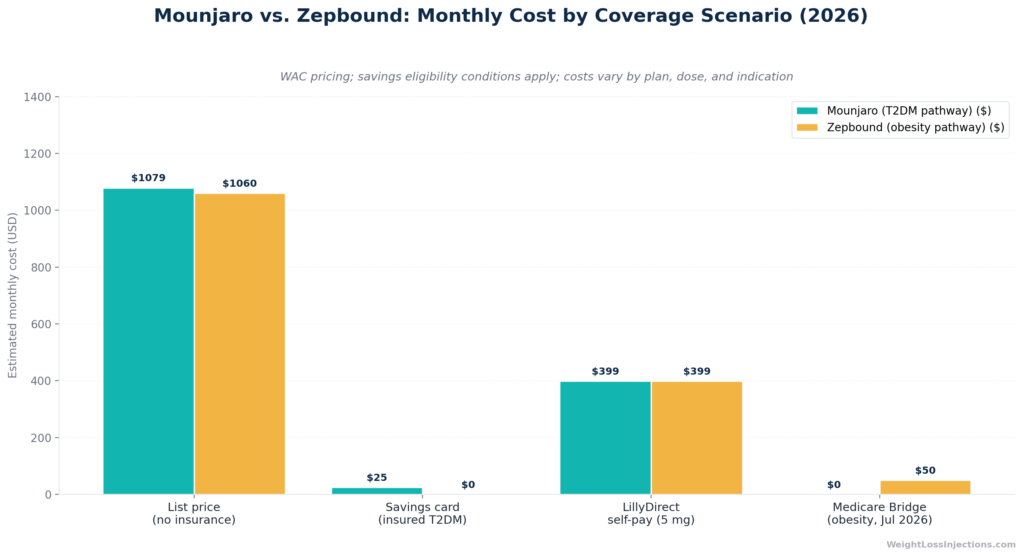
Grouped bar chart showing monthly out-of-pocket cost comparison for Mounjaro vs
Cost Comparison — Mounjaro vs. Zepbound Pricing in 2026
At list price, both brands are priced nearly identically. The differences emerge when savings programs, insurance, and self-pay channels enter the picture.
List Price (WAC)
The wholesale acquisition cost for Mounjaro as of January 1, 2026, is $1,079.77 per 28-day supply (four pens) regardless of dose strength, per Eli Lilly’s official WAC disclosure. Zepbound carries a comparable list price of approximately $1,060/month at comparable strengths — the two brands are within roughly $20/month of each other at list price, per BestMedsHub’s Mounjaro guide.
Without insurance or financial assistance, either brand runs approximately $12,957–$13,440 per year. For most patients, list price is not what they pay — which is why the savings programs below matter far more than the WAC figure.
Mounjaro Savings Card (T2DM Patients with Commercial Insurance)
The card provides up to 13 prescription fills per calendar year, with a maximum annual benefit of $1,950 for covered patients ($150/month cap), per NiceRx’s savings card overview. A three-month supply runs as low as $75 for covered patients. Important caveat: the savings card does not reduce costs during the deductible phase of coverage — patients pay more until their deductible is met even if they hold the card.
Critical restriction: The Mounjaro Savings Card applies only to on-label T2DM use. A patient prescribed Mounjaro off-label for weight loss without a T2DM diagnosis does not qualify for the $25/month rate — they would pay the non-covered rate ($499/month with the card) or full list price, per NiceRx’s savings card overview.
Zepbound Savings Card
Eli Lilly offers a comparable savings card for Zepbound for commercially insured patients. Current terms are available at zepbound.lilly.com. The Zepbound savings card applies to patients with obesity/weight management coverage under their commercial plan and similarly brings out-of-pocket cost to as low as $25/month for covered patients. Government beneficiaries are excluded.
LillyDirect Self-Pay Vials
Eli Lilly’s LillyDirect program offers tirzepatide products directly to cash-pay patients with a valid prescription, at substantially below list price. As of 2026, LillyDirect self-pay pricing applies to both brands, per BestMedsHub’s guide:
Dose
LillyDirect Monthly Price
2.5 mg (Mounjaro or Zepbound)
$299/month
5 mg (Mounjaro or Zepbound)
$399/month
7.5–15 mg (Mounjaro or Zepbound)
$449/month
For self-pay patients whose primary goal is weight loss, Zepbound via LillyDirect at $299–$449/month is dramatically cheaper than filling Mounjaro off-label at list price (~$1,079.77/month), per Eli Lilly’s WAC disclosure. The molecule is the same — the label is what opens the LillyDirect pricing.
Medicare Bridge Program (July–December 2026)
Starting July 1, 2026, eligible Medicare Part D enrollees can access Zepbound at $50/month through the Medicare GLP-1 Bridge Program, per understoodcare.com’s 2026 guide. This is a Zepbound-specific program — Mounjaro is not available under it. Medicare beneficiaries with T2DM who also meet obesity criteria may want to discuss with their prescriber whether transitioning to Zepbound for the duration of the Bridge Program makes financial sense ($50/month vs. their current Medicare Part D cost-sharing for Mounjaro).
Our Top 3 · October 2026
The best GLP-1 providers right now
Independently reviewed. Ranked by price, medication access, provider quality, and patient outcomes.
Pharmacologically, switching between Mounjaro and Zepbound involves no clinical risk whatsoever — you are taking the same molecule in the same dose. What changes is the prescription label, the insurance billing code, and which savings program applies to you.
“Switching between Mounjaro and Zepbound is not a clinical event — it’s an administrative one. The drug doesn’t change. What changes is the indication, the billing pathway, and in some cases, the patient’s access to savings programs that can cut their monthly cost by hundreds of dollars. I consider it with any patient whose coverage situation changes — a job change, Medicare eligibility, a new obesity diagnosis documentation.” — the WeightLossInjections.com Staff, reviewed June 2026
No Washout Period Required
Because both brands contain tirzepatide with the same approximately 5-day half-life, per the FDA Mounjaro Prescribing Information, no washout period is required when switching between them. A patient on Mounjaro 10 mg/week can receive their first Zepbound 10 mg prescription on the same weekly schedule, per the SingleCare switching guide. There is no pharmacological reason to restart the titration from 2.5 mg, though some prescribers may use clinical judgment to step down briefly if the patient had tolerability issues at the current dose.
New Prescription Required
Despite the identical active ingredient, Mounjaro and Zepbound cannot be substituted at the pharmacy counter. They are different NDAs with different brand names and require separate prescriptions. Your pharmacist is legally required to dispense the brand written on the prescription. If you are switching brands, your provider must write a new prescription for the new brand, per WebMD’s comparison.
Insurance Re-Authorization Is Required
Insurers treat Mounjaro and Zepbound as separate medications. A prior authorization issued for Mounjaro under your T2DM benefit does not transfer to Zepbound under your obesity benefit. Each brand requires its own PA process through the relevant formulary benefit, per SingleCare’s switching guide. Before initiating a brand switch, confirm with your insurer:
Does your plan cover the new brand under the relevant indication?
What are the PA criteria?
How long does PA review take so you can plan for continuity of supply?
Practical Switching Scenarios
Scenario 1 — Gaining Medicare, wanting Zepbound Bridge access: A patient on commercial insurance Mounjaro (T2DM indication) turns 65 and becomes Medicare-eligible. They also have obesity (BMI ≥35). The Medicare GLP-1 Bridge Program (July–December 2026) covers Zepbound at $50/month — not Mounjaro under this program. Switching their prescription from Mounjaro to Zepbound, coded under the obesity indication, can unlock the $50/month Bridge rate. Medicare Part D continues to cover Mounjaro for T2DM separately.
Scenario 2 — Off-label Mounjaro patient, Zepbound now accessible: A patient was prescribed Mounjaro off-label for weight loss before Zepbound was available in late 2023. Since then, their commercial plan has added Zepbound to its obesity benefit formulary. Switching to Zepbound puts the prescription on-label for the insurance system, enabling the Zepbound savings card and potentially coverage under the obesity benefit — a financial win with no clinical change, per SingleCare’s guide.
Scenario 3 — New T2DM diagnosis while on Zepbound: A patient was on Zepbound for weight management and receives a new T2DM diagnosis. Their prescriber may choose to switch to Mounjaro so the prescription is covered under the T2DM formulary benefit, which may have a more favorable prior authorization pathway at their specific insurer, and the Mounjaro Savings Card ($25/month) may apply.
Which Brand Makes Sense for You? — A Decision Framework
Flowchart-style decision tree helping patients decide between Mounjaro and Zepbound
The drug is identical. This decision is entirely about your diagnosis, your insurance plan, and your financial access. Here is a direct framework:
You have T2DM (diagnosed, ICD-10 E11.x)
→ Mounjaro is the on-label choice. Most commercial insurance covers it under the diabetes benefit. The Mounjaro Savings Card can bring your cost to $25/month with covered commercial insurance, per NiceRx’s savings card overview. Medicare Part D may also cover it for T2DM.
However, check whether your plan also covers Zepbound under an obesity benefit — especially if you also have a qualifying obesity comorbidity. You do not have to default to Mounjaro just because you have T2DM. A prescriber evaluation of both coverage pathways at your specific insurer may reveal that Zepbound is also accessible, per FormBlends’ coverage guide.
You have obesity or overweight without T2DM
→ Zepbound is the on-label, FDA-approved choice for weight management. Mounjaro prescribed off-label for weight loss in a non-diabetic patient is the worst of both worlds: insurance approval rates of only approximately 15–25%, per FormBlends; the Mounjaro Savings Card does not apply to off-label use; and LillyDirect self-pay pricing is accessible for the Zepbound label.
If you are self-pay, Zepbound via LillyDirect at $299–$449/month is the only branded tirzepatide option with below-list self-pay pricing. Mounjaro without insurance coverage at list price runs approximately $1,079.77/month, per Eli Lilly’s WAC disclosure.
You have both T2DM and obesity
→ Either brand can be prescribed; your coverage pathway and insurance plan will determine which is more accessible and affordable. Ask your prescriber to evaluate both options with your insurer before defaulting to either. If you are approaching Medicare eligibility, the upcoming Zepbound Bridge Program may tip the calculation toward Zepbound.
You are on Medicare
→ Mounjaro: May be covered under Part D for T2DM. The Lilly Savings Card is not available.
→ Zepbound: The Medicare GLP-1 Bridge Program (July 1–December 31, 2026) covers Zepbound at $50/month for eligible enrollees with obesity criteria. This is a Zepbound-specific program — it does not apply to Mounjaro, per understoodcare.com.
You are self-pay (no insurance coverage for either)
→ Zepbound is the financially superior option. LillyDirect self-pay pricing begins at $299/month for the 2.5 mg dose and caps at $449/month for 7.5–15 mg. The equivalent Mounjaro prescription would cost approximately $1,079.77/month at list price. Same drug; very different out-of-pocket cost under different labels, per BestMedsHub.
Savings Card Note: Mounjaro Savings Card eligibility requires commercial insurance and a T2DM diagnosis. The card does not apply to off-label weight-loss prescriptions or Medicare/Medicaid beneficiaries. Verify current terms at mounjaro.lilly.com.
The core takeaway: the drug is pharmacologically identical — the choice between Mounjaro and Zepbound is an insurance and access decision, not a clinical one. If your goal is weight loss and you do not have T2DM, Zepbound is the correct on-label option. If your goal is glycemic control in T2DM, Mounjaro is the correct on-label option. Patients with both diagnoses should evaluate both coverage pathways. Off-label prescribing is legal in the United States — any licensed physician may prescribe either brand for any clinical indication based on medical judgment — but off-label use creates coverage barriers that almost always result in significantly higher out-of-pocket costs.
Our Take at WeightLossInjections.com
The Mounjaro vs. Zepbound question is one of the most searched and most misunderstood topics in the GLP-1 space. Patients arrive at their pharmacy with a Mounjaro prescription for weight loss and a $1,079.77 bill — when a different label on the same pen could have meant $299/month through LillyDirect or $50/month through the Medicare Bridge. That is not a clinical failure; it is an access failure. And it is avoidable with the right guidance.
Here is our honest read on each situation:
For patients without T2DM who want weight loss: Ask for Zepbound. There is no pharmacological argument for Mounjaro off-label in a non-diabetic patient — it is the on-label weight management option, it carries better savings and self-pay economics, and it is the product Lilly built LillyDirect’s consumer pricing model around. Off-label Mounjaro for weight loss in a non-diabetic patient costs more, covers less, and provides zero clinical benefit over Zepbound. Get the right label for your indication, per FormBlends.
For patients with T2DM who also have significant weight to lose: The calculus is more nuanced. Mounjaro’s diabetes coverage pathway is more established and may be accessible with a $25/month savings card. But Zepbound is also an option — T2DM qualifies as a comorbidity for Zepbound’s obesity indication — and it unlocks a different savings structure and potentially the Medicare Bridge if you are approaching 65. Run both pathways with your insurer before your prescriber writes the prescription. Changing the label after the PA is submitted restarts the clock, per SingleCare’s switching guide.
For Medicare patients: Mounjaro for T2DM remains the most accessible standard Medicare coverage option. But the GLP-1 Bridge (July–December 2026) at $50/month for Zepbound is a time-limited opportunity that eligible patients should not ignore — discuss it with your prescriber before the window closes, per understoodcare.com.
One rule that is not up for debate: These two products cannot be used simultaneously. They are the same molecule. Using Mounjaro and Zepbound at the same time is equivalent to taking a double dose of tirzepatide — a serious risk of adverse events including severe nausea and vomiting, dehydration, acute kidney injury, and hypoglycemia (in patients on insulin or sulfonylureas), per the FDA Mounjaro Prescribing Information. Switching between them is safe; using both simultaneously is not.
A licensed provider can help determine which brand fits your insurance and health profile — [service detail] at WeightLossInjections.com starts from [$X/month] and includes a full review of your diagnosis, coverage, and the savings programs available for your situation.
Physician Review: This article was reviewed for medical accuracy by the WeightLossInjections.com Staff. Reviewed June 2026.
FAQ
Yes — at the molecular level, Mounjaro and Zepbound contain the exact same active ingredient: tirzepatide. They are manufactured by Eli Lilly to identical specifications, come in the same six dose strengths (2.5 mg through 15 mg), and work identically in the body through the same dual GIP + GLP-1 receptor agonism, per the FDA Mounjaro Prescribing Information. The only difference is the FDA-approved indication: Mounjaro (NDA 215866) is approved for type 2 diabetes, and Zepbound (NDA 217806) is approved for chronic weight management and obstructive sleep apnea. That regulatory distinction controls your insurance pathway, savings card eligibility, and access to LillyDirect self-pay pricing.
The higher weight loss numbers associated with tirzepatide — up to −22.4% mean body weight reduction at 15 mg over 72 weeks — come from the SURMOUNT-1 trial, which enrolled adults without type 2 diabetes, per the SURMOUNT-1 publication in the NEJM. The SURPASS trials (the basis for Mounjaro’s approval) enrolled T2DM patients, who experience greater metabolic resistance to weight loss on GLP-1 agents. Tirzepatide at 15 mg in a T2DM population produces approximately −11–13% weight loss versus −22.4% in a non-T2DM obesity population. The drug is identical — the population difference explains the gap entirely, per SURMOUNT-1 PMC.
Legally and medically, yes — off-label prescribing is lawful in the United States. Any licensed physician may prescribe Mounjaro for weight management based on clinical judgment. However, there are important practical differences: Mounjaro prescribed off-label for weight loss in a patient without T2DM is rarely covered by insurance (~15–25% approval rate), and the Mounjaro Savings Card does not apply to off-label weight-loss prescriptions, per FormBlends. LillyDirect self-pay pricing is also more accessible via the Zepbound label for non-T2DM patients. If weight loss is your goal and you do not have T2DM, Zepbound is the on-label option with better insurance and financial access.
Medicare Part D may cover Mounjaro for type 2 diabetes when prescribed for the T2DM indication and included on the plan’s formulary, per understoodcare.com. For obesity, a Medicare GLP-1 Bridge Program starting July 1, 2026 covers Zepbound — not Mounjaro — at $50/month for eligible Part D enrollees with obesity criteria. The Lilly Savings Card for either brand is not available to Medicare or Medicaid beneficiaries. Medicare beneficiaries with both T2DM and obesity should discuss with their prescriber whether both coverage pathways are available through their specific plan.
No. Because the molecule is identical — same amino acid sequence, same dose, same pharmacokinetics, same mechanism of action — there is no pharmacological or clinical basis to prefer one brand over the other. The choice between Mounjaro and Zepbound is entirely driven by your FDA indication (T2DM vs. obesity), which drug your insurance covers, and which savings program you qualify for, per WebMD’s comparison. A patient who is clinically ideal for tirzepatide is ideal for both; the label is an administrative decision, not a therapeutic one.
Yes. Since both brands contain the same tirzepatide molecule with the same approximately 5-day half-life, no washout period is required when switching between them, per the SingleCare switching guide. You continue at the same dose on the same weekly schedule. However, a new prescription is required — the pharmacy cannot substitute brands, and each brand requires its own insurance prior authorization. The administrative process takes time even if the clinical transition is seamless. Plan ahead so the switch does not create a gap in your supply.

![Unbranded [pillar-drug-class] injection pen on a neutral background — WeightLossInjections.com editorial hero](https://weightlossinjections.com/wp-content/uploads/2026/07/hero_mounjaro_c4_compare-1200x675.png)