![Unbranded [pillar-drug-class] injection pen on a neutral background — WeightLossInjections.com editorial hero](https://weightlossinjections.com/wp-content/uploads/2026/07/hero_tirzepatide_c4_compare-1200x675.png)
Legal Status as of June 2026: The FDA removed tirzepatide from its drug shortage list on December 19, 2024. Mass-market 503A and 503B compounding of tirzepatide ended no later than March 2025. A narrow personalized-medicine exception under 503A rules survives under April 2026 FDA guidance — but it applies only to documented cases of individual clinical need, capped at four prescriptions per calendar month per pharmacy. This article explains the full regulatory framework. the WeightLossInjections.com Staff reviewed the clinical content; this is not legal advice. Consult qualified legal counsel for compliance questions.
Last updated: June 27, 2026 | This page is reviewed and updated quarterly.
Medical & Legal Disclaimer: This article provides regulatory and legal information for educational purposes only. It does not constitute legal or medical advice. Regulatory status may change; verify current status at the FDA website and consult a licensed healthcare provider or qualified attorney for specific guidance.
Introduction
In 2023 and 2024, hundreds of compounding pharmacies were legally producing tirzepatide — the same active molecule found in Mounjaro and Zepbound — and shipping it directly to patients at a fraction of the branded price. A patient paying $1,086 per month at retail for Zepbound could obtain what appeared to be the same drug from a compounding telehealth program for $200 to $400 per month. For many patients managing obesity or type 2 diabetes without adequate insurance coverage, that price difference was not academic — it was the difference between accessing a transformative medication and going without.
By March 2025, that era was essentially over. Understanding exactly why — and understanding where the narrow legal remnant of the compounding pathway now lives — requires understanding the difference between two distinct categories of compounding facility under federal law: Section 503A and Section 503B of the Federal Food, Drug, and Cosmetic Act (FDCA).
These two sections are not interchangeable terms. They represent fundamentally different regulatory frameworks, with different inspection standards, different manufacturing requirements, different prescription requirements, and different legal authorities. The rules that ended 503B outsourcing facility compounding of tirzepatide are not the same rules that ended most 503A pharmacy compounding, and the surviving narrow exception applies specifically to 503A pharmacies under a different part of the statute. Conflating 503A and 503B — which most available online content does — produces a fundamentally inaccurate picture of what is and is not legal today.
This article explains the full regulatory framework clearly: what each category is, why tirzepatide was compoundable during the shortage, what ended the permission separately for each category, what narrow exception still exists, and how patients, prescribers, and pharmacy operators can navigate the current landscape. For patients, prescribers, and compounding pharmacies, getting this wrong has real legal and safety consequences.
This content is for informational purposes only and does not constitute legal or medical advice. Consult a licensed healthcare provider and, for compliance matters, qualified legal counsel.
Decision-tree flowchart: Is your pharmacy 503A or 503B? Branching paths show the legal status of tirzepatide compounding for each type, with green (legal), amber (conditional), and red (prohibited) nodes reflecting June 2026 status.
503A and 503B Explained: A Plain-Language Primer
Most patients have never heard the terms “503A” and “503B” before they start researching compounded tirzepatide. These are sections of the Federal Food, Drug, and Cosmetic Act — the primary federal statute governing drugs, devices, and food safety in the United States. Understanding them requires a brief step back to understand why Congress created them in the first place.
Traditional pharmaceutical compounding has existed for as long as pharmacy itself. A licensed pharmacist, working with a valid prescription for an individual patient, could prepare a customized medication that served that patient’s specific clinical needs — a different dose strength, an alternative formulation, a product without a specific ingredient a patient was allergic to. This was the original purpose of pharmacy as a profession, long before modern mass-manufacturing pharmaceutical companies existed. Congress has always recognized this role and exempted legitimate compounding from the full regulatory burden applicable to drug manufacturers.
What Congress did not want was for compounding pharmacies to become de facto drug manufacturers — producing large batches of commercially available drugs in the guise of “personalized medicine,” undercutting the FDA approval process and bypassing the manufacturing standards that approval requires. The distinction between those two activities — genuine individualized compounding versus mass pharmaceutical manufacturing — is the regulatory line that the 503A and 503B framework attempts to draw.
503A — Traditional Compounding Pharmacies
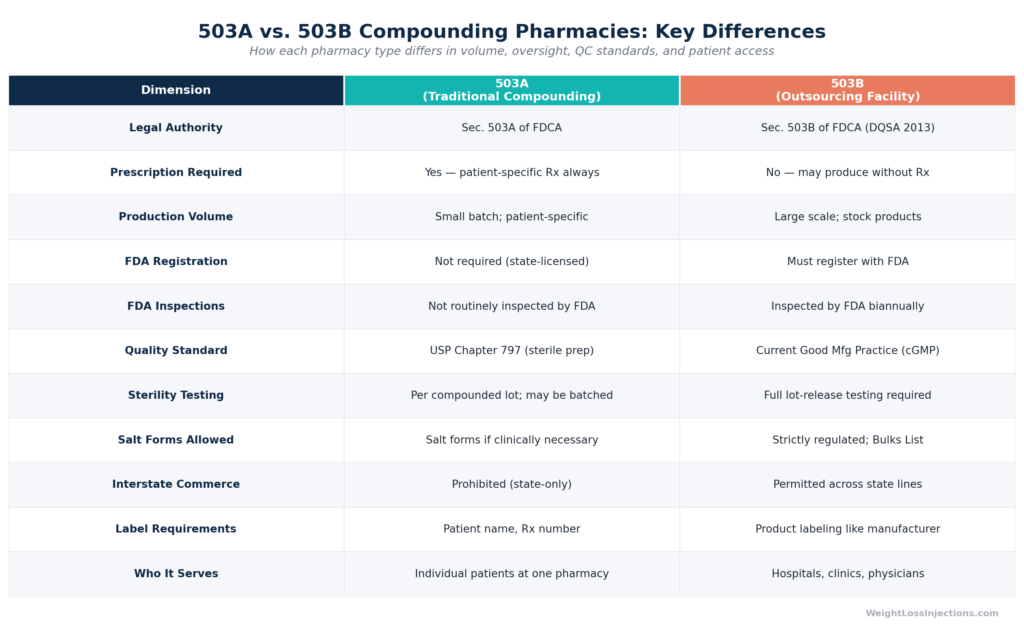
Section 503A of the FDCA governs what the law calls “traditional” or “conventional” compounding pharmacy practice. A 503A pharmacy is a state-licensed pharmacy that compounds medications for individual patients based on a valid prescription from a licensed practitioner. (FDA GLP-1 Compounding Clarification Page)
The critical word is “individual.” A 503A pharmacy compounds for an identified, specific patient with a specific valid prescription. It does not compound in anticipation of future orders. It does not produce batch inventory for clinics to stock. The entire legal structure of 503A is built around the patient-specific prescription as the trigger for compounding activity.
In exchange for operating within those constraints, 503A pharmacies are exempt from two of the most demanding federal regulatory requirements that apply to commercial drug manufacturers: the New Drug Application (NDA) or Abbreviated New Drug Application (ANDA) approval requirement, and the Current Good Manufacturing Practice (CGMP) requirements. A 503A pharmacy producing a customized formulation for an individual patient does not need an FDA-approved New Drug Application for that product, and it does not need to meet the CGMP manufacturing standards that apply to pharmaceutical manufacturers like Eli Lilly.
This exemption is conditional, however. It applies only if the 503A pharmacy meets the specific conditions set out in Section 503A of the FDCA:
- The pharmacy must compound based on a valid prescription for an identified individual patient.
- The pharmacy must not regularly compound drugs that are “essentially copies” of commercially available FDA-approved products.
- The bulk substances (active pharmaceutical ingredients, or APIs) used in compounding must either appear on an FDA-approved bulk substance list, be approved by FDA, or meet other specified criteria.
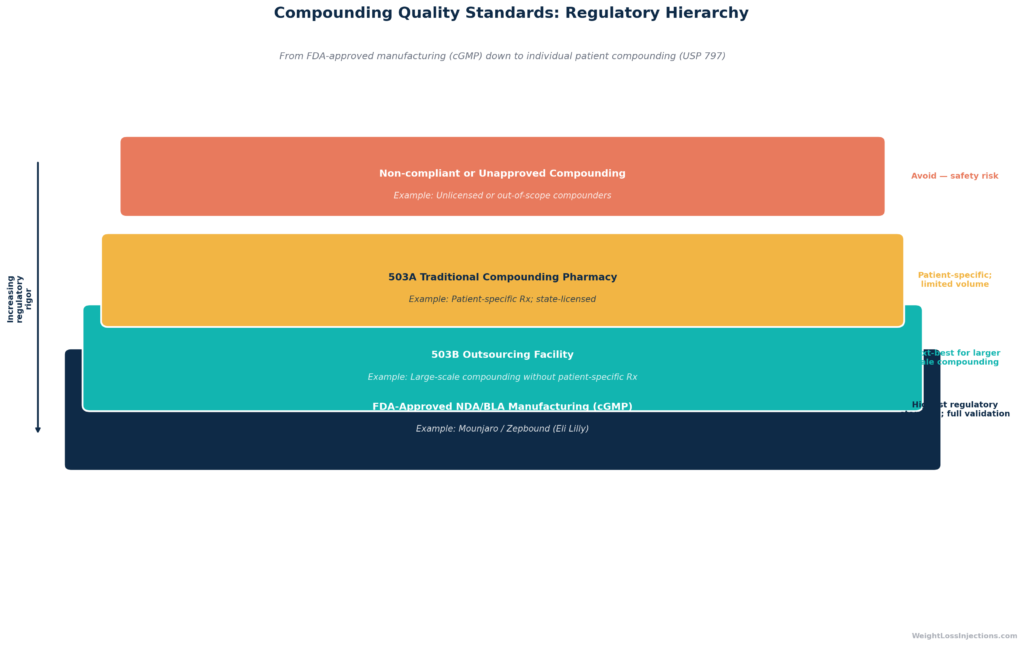
Section 503A pharmacies are inspected by state pharmacy boards, not the FDA (for routine inspections). They must comply with USP \<797> for sterile-injectable compounding — the United States Pharmacopeia’s nationally recognized standard for sterile preparation. USP \<797> governs environmental monitoring, sterilization processes, beyond-use dating, personnel training, and quality control for sterile compounded preparations. It is a meaningful standard, but it operates at a different tier than CGMP.
A key practical distinction: because 503A pharmacies compound only for individual patients with valid prescriptions, they cannot produce bulk batches for office stock distribution to clinics or healthcare practices. Each compounded unit must correspond to a specific, identified patient.
503B — Outsourcing Facilities
Section 503B is a newer creation. It was added to the FDCA by the Drug Quality and Security Act (DQSA) of 2013, enacted in response to a 2012 meningitis outbreak that killed 64 people and was traced to contaminated sterile injectable drugs produced by a compounding pharmacy — the New England Compounding Center in Massachusetts. The outbreak exposed a regulatory gap: large-volume compounding pharmacies were operating at pharmaceutical-manufacturer scale without being subject to pharmaceutical-manufacturer regulatory standards.
The DQSA’s solution was to create a voluntary registration pathway: a compounding facility that wanted to produce drugs in larger volumes without patient-specific prescriptions — for distribution to clinics, hospitals, and healthcare practices as “office stock” — could register with the FDA as an “outsourcing facility” under Section 503B. In exchange for the ability to compound in bulk without patient-specific prescriptions, the facility must accept FDA registration, FDA inspections (including unannounced inspections), and compliance with full Current Good Manufacturing Practice (CGMP) standards — the same tier of manufacturing standards applicable to commercial pharmaceutical manufacturers. (FDA GLP-1 Compounding Clarification Page)
This is a fundamentally higher regulatory bar than 503A. CGMP covers facility design and environmental controls, equipment qualification and validation, written standard operating procedures, personnel qualification and training, in-process testing and finished-product release testing, stability studies, complaint and recall systems, and comprehensive documentation that creates an auditable record of every manufacturing decision. A 503B outsourcing facility is, for regulatory purposes, closer to a pharmaceutical manufacturer than to a neighborhood pharmacy.
What 503B outsourcing facilities can compound is also more constrained. They may use bulk API only if: (a) the substance is on the FDA’s 503B Bulks List — a list of substances that FDA has evaluated and determined may be used in 503B compounding — or (b) the drug appears on the FDA Drug Shortage List, or (c) other limited exceptions apply. (FDA April 30, 2026 Press Release) A 503B facility may not compound a drug that has been withdrawn from the market for safety or efficacy reasons.
The target customer for a 503B outsourcing facility is not the individual patient — it is the healthcare system. Clinics, hospitals, and ambulatory practices that need inventory on hand stock 503B products as “office stock.” The 503B framework was designed to bring that higher-volume activity under meaningful federal oversight while still permitting it to exist.
Helpful analogy: A 503A pharmacy is a neighborhood bakery that custom-bakes a cake for a specific customer’s order. A 503B outsourcing facility is a commercial bakery that produces large batches of products for distribution to restaurants — but must meet restaurant-supply FDA food manufacturing standards. The same basic activity scales to very different regulatory requirements.
Side-by-Side Comparison
| 503A Traditional Pharmacy | 503B Outsourcing Facility | |
|---|---|---|
| Federal registration with FDA required? | No (state-licensed only) | Yes (voluntary, but required to operate as 503B) |
| Inspected by | State pharmacy board | FDA (including unannounced) |
| Manufacturing standard | USP \<797> (sterile compounding) | CGMP (Current Good Manufacturing Practices) |
| Patient-specific Rx required? | Yes — every compounded unit | No — may produce for office stock |
| May produce office stock for clinic distribution? | No | Yes |
| Adverse event reporting | Voluntary | Mandatory FDA submission |
| Can use bulk API? | Limited — shortage list / 503A Bulks List / other criteria | Yes — if on 503B Bulks List or shortage list |
| Quality tier | High (state-regulated) | Highest (FDA-equivalent to pharma manufacturers) |
| Can compound tirzepatide in June 2026? | Only under narrow documented exception | No — no lawful pathway exists |
How Tirzepatide Compounding Operated Under the Shortage Exemption (2022–2025)
Understanding the current regulatory landscape requires understanding how the two-year compounding market came to exist — and why it was lawful for the time it operated.
The Molecule and Its Demand Surge
Tirzepatide is a synthetic 39-amino-acid peptide — the active pharmaceutical ingredient in Mounjaro (FDA-approved for type 2 diabetes, May 2022) and Zepbound (FDA-approved for chronic weight management, November 2023). (StatPearls / NCBI Bookshelf) It is the first-in-class dual GIP and GLP-1 receptor agonist — meaning it activates two distinct hormone receptors that regulate appetite, insulin secretion, and metabolism simultaneously — producing weight loss outcomes that significantly exceeded anything previously seen in obesity pharmacotherapy. In the SURMOUNT-1 trial (72 weeks, n=2,539 adults without type 2 diabetes), participants at the highest dose achieved mean body weight reduction of 20.9%. (PubMed SURMOUNT-1, NEJM 2022) That kind of efficacy created immediate and explosive demand that Eli Lilly’s existing manufacturing infrastructure could not keep pace with.
The Shortage Listing — December 15, 2022
On December 15, 2022, tirzepatide injection was added to the FDA Drug Shortage List, reflecting the FDA’s determination that supply was insufficient to meet medical need. (FDA Declaratory Order, Dec 19, 2024 — PDF) This was not a symbolic designation. Under the Federal Food, Drug, and Cosmetic Act, when a drug appears on the FDA’s Drug Shortage List, a specific legal consequence attaches: the “essentially a copy” prohibition that normally prevents 503A and 503B compounders from producing commercially available drugs is suspended for that drug, for as long as it remains on the shortage list.
The legal theory is straightforward. If patients genuinely cannot obtain an FDA-approved drug through normal channels, the public health interest in providing access outweighs the interest in preventing compounding of essentially-copy products. The shortage exemption is a congressional safety valve built directly into the FDCA structure.
The Market That Emerged (2022–2024)
The practical consequences of the shortage listing were immediate and large-scale. 503A pharmacies began compounding tirzepatide as patient-specific prescriptions; 503B outsourcing facilities began producing it in bulk batches for distribution to clinics and telehealth platforms as office stock. Hundreds of direct-to-patient telehealth programs launched subscription-based compounded tirzepatide offerings at prices ranging from approximately $200 to $500 per month — compared to the $1,086 retail list price for branded Mounjaro or Zepbound. For many patients who could not access GLP-1 therapy through commercial insurance, this was the only financially viable pathway.
This market was, for the most part, operating within the law. The shortage exemption provided the statutory authorization. Both 503A and 503B compounders were legally permitted to produce tirzepatide during the shortage listing period — 503A pharmacies with patient-specific prescriptions, 503B outsourcing facilities as office stock for clinic distribution. The business models that emerged, while commercially aggressive, were built on a genuine legal foundation.
There were quality concerns, however. FDA received more than 320 adverse event reports related to compounded GLP-1 products through February 2025 — including reports of subpotent batches (where patients received essentially no drug effect), superpotent batches (where reconstitution errors delivered massive overdoses causing severe GI and cardiovascular symptoms), and contamination from non-sterile compounding environments. Some non-FDA-registered facilities also entered the market during the shortage, operating without the state pharmacy board oversight applicable to legitimate 503A pharmacies. (FDA GLP-1 Compounding Clarification Page) These reports informed the FDA’s increasingly active oversight posture as the shortage approached resolution.
The Resolution Timeline — October Through December 2024
Eli Lilly spent 2024 aggressively expanding tirzepatide manufacturing capacity. By fall 2024, fill rates — the FDA’s primary metric for shortage assessment — had improved to the point where supply was meeting or exceeding demand.
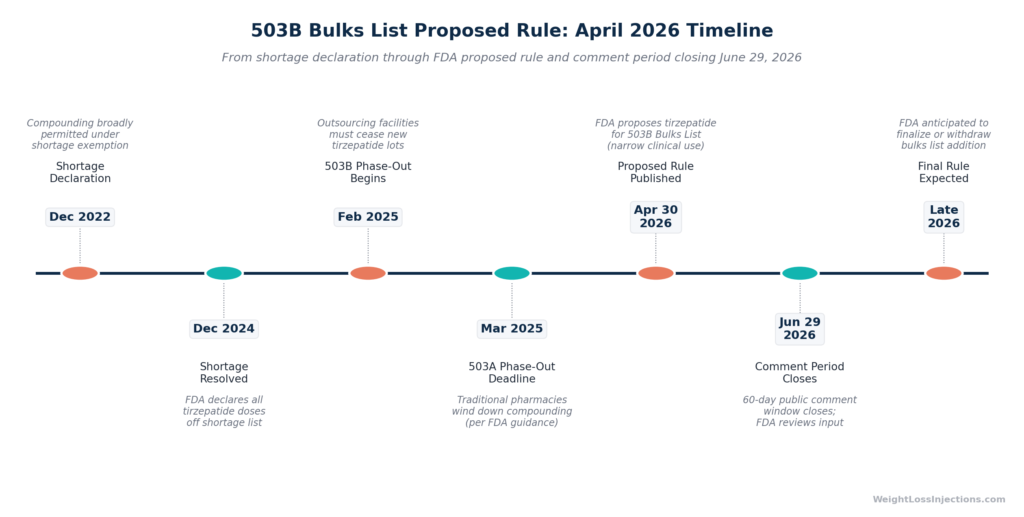
October 2, 2024: The FDA made its initial formal determination that the tirzepatide shortage was resolved. Under the shortage exemption framework, this determination would end compounding authority for both 503A and 503B facilities.
October 8, 2024: The Outsourcing Facilities Association (OFA) — the trade group representing 503B compounders — filed suit in the Northern District of Texas (OFA v. FDA, No. 4:24-cv-953, N.D. Tex.), arguing the FDA’s determination was arbitrary and capricious and that supply was not actually adequate. The FDA agreed to reconsider voluntarily while the case proceeded, pausing enforcement. (Frier Levitt Legal Update)
December 19, 2024: After re-examining distribution data, manufacturer inventory, and fill rates from Eli Lilly, the FDA issued a formal Declaratory Order reaffirming its prior finding: the tirzepatide shortage was resolved and supply met or exceeded demand. (FDA Declaratory Order — PDF) The shortage exemption that had supported compounding since December 2022 was legally over.
Horizontal Gantt chart showing: shortage active period (Dec 2022 – Dec 2024) in blue; 503A grace period (Dec 2024 – Feb 2025) in amber; 503B grace period (Dec 2024 – Mar 2025) in amber; post-shutdown enforcement period (Mar 2025 – present) in red. Key regulatory milestones annotated.
The 503A Shutdown — February 18, 2025, and Its Aftermath
The December 2024 Declaratory Order set the legal clock running on enforcement grace periods. The FDA had committed to providing each category of compounders a window to wind down operations.
The February 18, 2025 Enforcement Date
February 18, 2025 was the enforcement discretion end date for 503A state-licensed pharmacies. After this date, 503A pharmacies could no longer compound tirzepatide under the shortage exemption without triggering the “essentially a copy” prohibition. Any pharmacy that continued compounding tirzepatide as a mass-market essentially-copy product after this date was operating in violation of federal law. (FDA GLP-1 Compounding Clarification Page)
The “essentially a copy” prohibition under Section 503A is the fundamental rule that, under normal circumstances (i.e., without a shortage exemption), prevents 503A pharmacies from serving as de facto generic drug manufacturers. A drug is “essentially a copy” if it contains the same active ingredient, the same route of administration, and the same or similar strength as a commercially available FDA-approved product — unless the prescribing practitioner makes a documented determination that the compounded product provides a clinically significant difference for the specific patient. Tirzepatide, after the shortage was resolved, became subject to this prohibition — because Mounjaro and Zepbound are commercially available in multiple dose strengths.
The March 10, 2025 Court Ruling
March 10, 2025: Federal Judge Mark Pittman denied the OFA’s motion for a preliminary injunction. For 503A pharmacies, this ruling was the final chapter. A preliminary injunction, if granted, would have temporarily halted FDA enforcement while the litigation proceeded. Its denial meant the FDA was free to enforce against compounders without judicial interference. The 503A grace period effectively closed. Compounding tirzepatide under the shortage exemption was no longer defensible in any court in the United States. (Alliance for Pharmacy Compounding)
To understand the significance of this ruling: the OFA’s legal argument — that the shortage had not truly been resolved because access was uneven — was a serious argument under Administrative Procedure Act arbitrary-and-capricious review. If the court had granted the preliminary injunction, it would have signaled meaningful judicial skepticism about the FDA’s determination, and the compounding market might have persisted through extended litigation. The denial of the injunction, which requires finding at least some likelihood of success on the merits for the party seeking the injunction, was the clearest available judicial signal that the FDA’s determination was legally sound.
Aftermath and Enforcement
Many 503A pharmacies immediately ceased tirzepatide compounding after the February 18, 2025 enforcement date. Others continued operating and received FDA warning letters. The FDA’s warning letter database identifies multiple 503A facilities cited for “essentially a copy” violations related to tirzepatide compounding after the grace period expired. (Writer note: Search FDA Warning Letters Database for “tirzepatide” for current case numbers before publication.)
State-level enforcement also followed. Texas, Florida, and California pharmacy boards issued cease-and-desist orders to pharmacies continuing to bulk-dispense tirzepatide post-March 2025. (Harris Beach Murtha Cullina, June 2026) The telehealth platforms that had built subscription-based compounding business models pivoted: some transitioned patients to LillyDirect vials, some switched to semaglutide (which remained on the shortage list briefly after tirzepatide was removed), and some substantially narrowed their offerings.
The 503B Shutdown — March 19, 2025, and the OFA Lawsuit Outcome
The 503B outsourcing facility timeline differs from 503A in critical ways — both in timing and in the absence of any surviving exception.
The March 19, 2025 Enforcement Date
March 19, 2025 was the enforcement discretion end date for 503B outsourcing facilities. After this date, 503B facilities could not lawfully compound tirzepatide for any purpose. The analysis here is structurally different from 503A. Under the 503B framework, a facility may only use bulk API to compound a finished drug product if that drug is either (a) on the FDA Drug Shortage List or (b) on the FDA’s 503B Bulks List. (FDA GLP-1 Compounding Clarification Page)
Tirzepatide is no longer on the Drug Shortage List (removed December 2024). Tirzepatide has never been on the 503B Bulks List. There is no third pathway. Unlike 503A, which retains a narrow essentially-copy exception for patient-specific prescriptions with documented clinical need, 503B has no analogous survival mechanism. The authority to compound was entirely dependent on the shortage listing. When that listing ended, 503B authority ended — completely and with no exceptions.
The March 10, 2025 preliminary injunction denial foreclosed the last legal protection that 503B compounders had sought. Without a court order blocking enforcement, the FDA was free to treat 503B tirzepatide compounding as an illegal activity. The OFA’s argument that supply remained inadequate was rejected at the injunction phase. (Frier Levitt Legal Update)
April 30, 2026 — The Proposed Permanent Exclusion
The FDA’s regulatory response did not stop with the end of the grace period. On April 30, 2026, the FDA proposed to formally exclude tirzepatide, semaglutide, and liraglutide from the 503B Bulks List — finding no clinical need for outsourcing-facility bulk compounding given adequate commercial supply. (FDA April 30, 2026 Press Release)
The public comment period on this proposed rule closes June 29, 2026 — two days from the date of this article’s current update. This action, if finalized, will create a permanent regulatory prohibition on 503B outsourcing facility compounding of tirzepatide that goes beyond the shortage-determination framework. It would close the 503B pathway even if a future shortage were declared — because the Bulks List exclusion would prohibit bulk API use independent of shortage status.
This is a significant policy move. During the 2022–2024 shortage, 503B compounders had the same statutory authority as 503A compounders to produce tirzepatide under the shortage exemption. A future shortage declaration, absent this proposed rule, would presumably restore that authority. If the proposed exclusion is finalized, a future shortage would restore 503A authority but not 503B authority — creating an asymmetry in the compounding framework that would require new rulemaking to change.
Red Flags — 503B Compounding Claims to Walk Away From
As of June 2026, there is no lawful pathway for a 503B outsourcing facility to compound tirzepatide. Any claim to the contrary deserves immediate skepticism:
- Any “503B compounding pharmacy” or “outsourcing facility” currently offering tirzepatide is operating outside the law.
- Websites claiming to offer tirzepatide from “FDA-registered outsourcing facilities” are making fraudulent representations in the current regulatory environment.
- Platforms offering large-quantity, subscription-based tirzepatide from “outsourcing facilities” without documented individualized clinical need are not operating within current FDA guidance, regardless of how they characterize their regulatory status.
- The fact that a facility holds valid FDA registration as a 503B outsourcing facility does not create authority to compound tirzepatide — 503B registration is a facility credential, not a per-drug authorization. A registered outsourcing facility compounding tirzepatide today is violating the same law it registered under.
Our Top 3 · October 2026
The best GLP-1 providers right now
Independently reviewed. Ranked by price, medication access, provider quality, and patient outcomes.
Renew GLP
Personalized GLP-1, GIP plans: Semaglutide & Tirzepatide.
Medvi
No membership or hidden fees. Everything you need is included.
Trimi
US-licensed clinicians and shipped to your door, from $99/mo.
What Narrow 503A Activity Remains Legal in 2026 — The Personalized Medicine Exception
This is the most consequential section of this article and the one most likely to be misunderstood. A narrow lawful pathway for tirzepatide compounding does survive — but it exists in a specific, carefully bounded legal space, and it is not a vehicle for the commercial-scale weight-loss compounding market that existed from 2022 to 2025.
The Statutory Basis
Section 503A of the FDCA permits a compounding pharmacy to prepare a drug product that is “essentially a copy” of a commercially available product when the prescribing practitioner has determined that the compounded product is clinically necessary for an identified individual patient — and that determination is documented in the prescription itself. (FDA GLP-1 Compounding Clarification Page — April 1, 2026)
This is not a broad “personalized medicine” exemption that any patient can invoke by expressing a preference for compounded products. The statute requires a genuine, documented clinical determination by the licensed prescriber that the commercial product does not adequately serve the individual patient’s clinical needs and that the compounded alternative would. The prescriber must make this determination and document it on the face of the prescription — not in general practice notes, not in boilerplate platform language, not in a separate “clinical justification form” that isn’t part of the actual prescription.
The April 2026 Safe Harbor
The FDA’s April 1, 2026 updated guidance established a ≤4 prescriptions per calendar month per 503A pharmacy safe harbor for essentially-copy compounding with documented clinical justification. This is a pharmacy-level volume limit, not a patient-level limit. A 503A pharmacy may fill up to four such prescriptions per calendar month and remain within the FDA’s current safe harbor for not “regularly compounding” essentially-copy products. A pharmacy that fills five or more prescriptions per calendar month of essentially-copy tirzepatide is, by the FDA’s current interpretation, “regularly compounding” an essentially-copy drug — and no longer exempt from the essentially-copy prohibition, regardless of the quality of individual clinical justifications. (FDA GLP-1 Compounding Clarification Page)
The logic of this cap is sound: a pharmacy that fills one or two such prescriptions per month is serving patients with genuinely unusual clinical needs. A pharmacy that fills 50 prescriptions per month — even if each comes with a clinical justification statement — has rebuilt the commercial-scale compounding market that the essentially-copy prohibition was designed to prevent.
What Qualifies as a Clinically Significant Difference
The FDA has identified specific, recognized bases for a clinically significant difference in the tirzepatide context:
1. Documented allergy or hypersensitivity to an inactive ingredient in the branded product. The most commonly applicable example is cresol — the preservative present in both Mounjaro and Zepbound autoinjector pens. Some patients have documented allergies or sensitivities to cresol or related phenol compounds. A documented allergy of this kind, confirmed through appropriate clinical evaluation and specifically cited on the prescription, constitutes a legitimate clinical basis for a prescriber to determine that the compounded product provides a clinically significant difference. (FDA GLP-1 Compounding Clarification Page) Important note: Zepbound single-dose vials available through LillyDirect do not contain cresol in the same formulation as the autoinjector pens. Patients and providers should evaluate whether the LillyDirect vial formulation resolves the allergy concern before pursuing a compounding exception.
2. Documented need for a dose strength not commercially available. Eli Lilly manufactures tirzepatide in six standard dose strengths: 2.5, 5, 7.5, 10, 12.5, and 15 mg. The titration schedule escalates by 2.5 mg increments every four weeks. Some patients experience clinically unmanageable GI adverse events at standard escalation intervals and require intermediate doses — for example, 3.5 mg or 6 mg — to titrate at a pace their body can tolerate. If a prescriber specifically documents that the standard titration schedule is clinically contraindicated for this individual patient and that a specific intermediate dose is medically necessary, this can support the compounding exception. (FDA GLP-1 Compounding Clarification Page)
3. A route of administration not commercially available. Branded tirzepatide is only available as a subcutaneous injection. This basis has limited practical applicability for most patients currently, though it remains a theoretically valid category.
What Does NOT Qualify — And Why This Matters
The FDA has been equally clear about what does not rise to the level of a clinically significant difference that would justify essentially-copy compounding:
- Patient cost preference. Wanting a less expensive alternative to branded tirzepatide is not a clinical basis. This is the most important disqualifier, because cost was the primary driver of the large-scale compounding market. The essentially-copy prohibition exists precisely to prevent compounding from serving as a permanent low-cost commercial alternative to FDA-approved drugs. Prescribers who document “patient cannot afford branded product” as the clinical justification are not creating a lawful basis for compounding — they are describing exactly what the prohibition was designed to prevent. (FDA GLP-1 Compounding Clarification Page)
- Patient preference for vials over autoinjector pens. This is a convenience preference, not a clinical necessity, and the existence of LillyDirect vials makes this argument even weaker — patients who prefer vials can access them at $299 to $449/month through LillyDirect’s self-pay program.
- Generic “personalization” boilerplate. Telehealth platform language about compounded products being “more personalized” or “individually calibrated” — without tying that characterization to a specific documented clinical characteristic of the individual patient — does not meet the legal standard. Boilerplate clinical justification language inserted by a platform rather than genuinely documented by the treating prescriber for the specific patient is not individualized clinical documentation.
- Combination products (tirzepatide + B12, tirzepatide + lipotropics) within 10% of a commercially available strength. FDA has specifically stated that combination products are considered essentially copies if the tirzepatide component is within 10% of commercially available strengths. Adding vitamin B12, lipotropics, or other compounds does not create clinical differentiation unless there is a specific, documented clinical basis for that additive beyond general “wellness” rationales. (FDA GLP-1 Compounding Clarification Page)
What a Compliant 503A Prescription Looks Like
For a 503A prescription to support lawful essentially-copy tirzepatide compounding, it must contain:
- A valid prescription from a licensed prescriber in the patient’s state.
- The patient’s full name, address, and relevant allergy history.
- A specific, individually documented clinical justification — not a template phrase. The prescriber must articulate why this specific patient cannot be adequately served by commercially available tirzepatide.
- The particular clinical need being addressed — e.g., “Patient has documented cresol allergy (confirmed by allergy specialist Dr. [X], date [Y]) — compounded cresol-free formulation required” or “Patient cannot tolerate 2.5 mg dose escalation steps due to severe nausea; intermediate 1.5 mg dose required during initiation.”
- The 503A pharmacy must independently confirm the justification before compounding — not simply fill based on the prescriber’s attestation without pharmacy-level review.
- The pharmacy must verify that this compounding event will not cause them to exceed four such prescriptions in the current calendar month.
Honest Assessment of This Exception
The 503A personalized-medicine exception is a legitimate legal pathway. It is not a loophole, a technicality, or a transitional placeholder that will be closed by the next regulatory action. Congress deliberately included this exception in the essentially-copy prohibition because genuine individualized clinical need can, in specific circumstances, be served by a compounded product that is substantially similar to a commercially available drug.
But this exception serves a narrow patient population: patients with documented cresol allergies, patients with documented intolerance to the standard titration schedule who require intermediate doses, and a small number of patients with other specific, verifiable clinical differences. It is not a vehicle for the hundreds of thousands of patients who used compounded tirzepatide from 2022 to 2025 primarily for cost reasons. Those patients are not served by this exception, and a prescriber who attempts to document a clinical justification that is primarily economic — however sympathetically motivated — is not creating a defensible legal basis for compounding.
As the WeightLossInjections.com Staff notes: “The personalized-medicine exception requires genuine, individually documented clinical differentiation. It exists to serve patients with real clinical needs that commercial products cannot meet — cresol allergies, specific titration challenges. It is not an access-to-cost pathway, and treating it as one creates legal exposure for the prescriber, the pharmacy, and ultimately the patient.”

Venn diagram — left circle: 503A only (state-inspected, patient-specific Rx, USP \<797>, no CGMP, narrow essentially-copy exception survives); right circle: 503B only (FDA-inspected, CGMP, office stock allowed, Bulks List required, no surviving exception for tirzepatide); overlapping center: valid pharmacy license, tirzepatide API, sterile compounding standards. Note below diagram: neither circle permits commercial-scale tirzepatide compounding in 2026.
![Venn diagram comparing 503A and 503B legal requirements for tirzepatide compounding]](https://weightlossinjections.com/wp-content/uploads/2026/07/tirz_art23_img3-1024x707.png)
Venn diagram — left circle: 503A only (state-inspected, patient-specific Rx, USP \<797>, no CGMP, narrow essentially-copy exception survives); right circle: 503B only (FDA-inspected, CGMP, office stock allowed, Bulks List required, no surviving exception for tirzepatide); overlapping center: valid pharmacy license, tirzepatide API, sterile compounding standards. Note below diagram: neither circle permits commercial-scale tirzepatide compounding in 2026.
Comparing Quality Standards: What the Regulatory Tiers Mean for Patient Safety
The regulatory distinction between 503A and 503B is not just a bureaucratic classification — it reflects meaningfully different levels of quality oversight, and those differences have practical implications for patients receiving compounded tirzepatide.
USP \<797>: The 503A Sterile Compounding Standard
USP \<797>, “Pharmaceutical Compounding — Sterile Preparations,” is the standard published by the United States Pharmacopeia that governs sterile compounding in 503A traditional pharmacy settings. It establishes requirements for:
- Classified cleanroom environments: Specific ISO air cleanliness classifications required for different types of sterile preparations.
- Garbing and personnel training: Requirements for gowning procedures, hand hygiene, and ongoing competency assessment of compounding personnel.
- Environmental monitoring: Regular air and surface sampling to detect microbial contamination.
- Beyond-use dating (BUD): Maximum storage times for compounded sterile preparations based on risk level and storage conditions.
- Sterility and potency testing: For higher-risk preparations, sterility testing before product release.
- Documentation: Compounding records, cleaning logs, environmental monitoring records.
USP \<797> represents meaningful patient protection for individualized sterile compounding. When a 503A pharmacy is operating in full compliance with USP \<797> — under the oversight of its state pharmacy board — it can produce sterile injectable preparations with a meaningful safety record. The state pharmacy board inspection process, however, is variable. Inspection frequency, inspector training, and enforcement rigor differ substantially across states. The 2012 New England Compounding Center disaster occurred at a facility that was nominally complying with state oversight while operating at scales and under conditions that no state inspection process caught in time.
CGMP: The 503B Manufacturing Standard
Current Good Manufacturing Practice (CGMP), codified in 21 CFR Parts 210 and 211, represents a substantially higher regulatory tier. CGMP was designed for commercial pharmaceutical manufacturing and has been adapted for 503B outsourcing facilities. Key CGMP requirements beyond USP \<797> include:
- Validated processes: Every manufacturing process must be demonstrated through formal validation studies to consistently produce product meeting specifications.
- Qualified equipment: Each piece of equipment used in manufacturing must be formally qualified for its intended use.
- Stability programs: Finished products must be tested under controlled conditions over time to establish shelf life.
- Lot release testing: Every manufactured batch must pass defined release specifications — potency, sterility, endotoxin, appearance — before distribution.
- Complaint and recall systems: Formal systems for tracking adverse events, investigating product complaints, and executing recalls when quality failures are identified.
- Comprehensive batch records: Complete manufacturing and testing documentation for every lot, retained and available for FDA review.
- Annual product reviews: Each product must be reviewed annually for quality trends.
- FDA-inspected: FDA conducts unannounced inspections of 503B facilities and has authority to take immediate enforcement action for CGMP deviations.
The CGMP tier also includes mandatory adverse event reporting: 503B outsourcing facilities must submit MedWatch reports to the FDA for adverse events associated with their compounded products. This creates a feedback loop that drives quality improvement and allows the FDA to identify systemic problems at specific facilities. 503A pharmacies, by contrast, make adverse event reports on a voluntary basis — a significant oversight gap for high-volume sterile compounding.
What This Means Practically for Patients
For patients who qualify for the narrow 503A exception and are considering using it, the quality tier difference is meaningful but manageable:
- A 503A pharmacy with an active state license, current USP \<797> compliance documentation, and a recent clean state board inspection represents legitimate patient safety oversight. Verify the pharmacy’s accreditation status through the NABP (National Association of Boards of Pharmacy) e-Profile directory or Pharmacy Compounding Accreditation Board (PCAB) accreditation.
- Ask for a Certificate of Analysis (CoA) from a third-party accredited laboratory confirming API identity, potency (concentration), and sterility of the specific lot dispensed to you. A reputable compounding pharmacy will provide this without hesitation.
- The ≤4 Rx/month volume cap for the essentially-copy exception has an indirect quality benefit: it ensures the pharmacy is producing in genuinely small quantities, reducing the risk of bulk-batch errors that have characterized higher-volume compounding quality failures.
The 320+ adverse event reports received by FDA through February 2025 were disproportionately associated with higher-volume operations and, critically, with non-registered facilities operating entirely outside the 503A/503B framework. A legitimate, USP \<797>-compliant 503A pharmacy producing four or fewer tirzepatide prescriptions per month is operating in a significantly different risk environment than the bulk commercial operations that drove those adverse event numbers.
Tirzepatide Salt Forms and the Bulks List — A Technical Note
One additional regulatory dimension deserves attention for patients and prescribers: the question of tirzepatide salt forms.
The FDA-approved branded products — Mounjaro and Zepbound — contain tirzepatide as the free peptide. Compounding pharmacies have sometimes used alternative salt forms of tirzepatide: tirzepatide acetate and tirzepatide sodium are the most commonly encountered forms in compounding contexts. These salt forms are chemically related to tirzepatide but are distinct chemical entities.
Salt forms are sometimes used in compounding because of differences in solubility, stability, or manufacturing convenience compared to the free peptide. The FDA has been clear that tirzepatide acetate and tirzepatide sodium are not the same as the approved active ingredient in Mounjaro and Zepbound, which uses the free base form of tirzepatide. These salt forms have not been FDA-approved in any formulation. Their pharmacokinetic properties — absorption, bioavailability, and effective dose — may differ from the approved free-peptide form.
For the purposes of the 503B Bulks List discussion: the FDA’s proposed April 30, 2026 exclusion covers tirzepatide and its related salt forms. The comment period closes June 29, 2026. If finalized, this would explicitly prohibit 503B outsourcing facilities from using tirzepatide acetate, tirzepatide sodium, or other salt forms as bulk API — not just the free-peptide form. (FDA April 30, 2026 Press Release)
For 503A essentially-copy analysis, a compounded preparation using tirzepatide acetate or tirzepatide sodium as the API is still likely to be considered an essentially-copy product if it functions through the same mechanism at the same effective dose as the branded product. The salt form distinction does not create a separate regulatory pathway for compounding — it is not a mechanism for evading the essentially-copy prohibition by using a chemically adjacent molecule.
The Regulatory Road Ahead — Could Compounding Tirzepatide Come Back?
This question comes up frequently, and it deserves a careful, complete answer rather than a dismissal.
Future Shortage Scenario
If tirzepatide were to return to the FDA Drug Shortage List — possible if Eli Lilly experienced a significant manufacturing disruption, or if demand growth outpaced production expansion — 503A compounding authority would legally resume under the shortage exemption. The statutory mechanism is the same as in 2022: shortage listing suspends the essentially-copy prohibition for both 503A pharmacies and, potentially, 503B outsourcing facilities.
However, the proposed 503B Bulks List exclusion changes this calculus significantly for the 503B category. If finalized after the June 29, 2026 comment period, 503B facilities would have no pathway to resume tirzepatide compounding even if a future shortage were declared, because bulk API use would be prohibited under the Bulks List exclusion regardless of shortage status. A 503B facility would need the FDA to both (a) declare a new shortage and (b) separately amend the Bulks List exclusion to permit bulk compounding — two independent regulatory actions, rather than the single shortage declaration that was sufficient before.
For 503A pharmacies, a future shortage would restore authority more cleanly — the essentially-copy prohibition suspension does not depend on the Bulks List framework. But the compounding infrastructure that existed from 2022 to 2025 has been substantially dismantled. Pharmacies that exited the tirzepatide compounding market have repurposed their sterile compounding capacity and dissolved their supply chains for tirzepatide API. The ability of the 503A sector to rapidly scale back up in response to a new shortage is significantly reduced compared to what existed when the previous shortage was declared. (Harris Beach Murtha Cullina, June 2026)
Generic and Biosimilar Tirzepatide
The possibility of a generic or biosimilar tirzepatide eventually entering the market would further complicate the compounding picture. Tirzepatide’s composition-of-matter patent expires around 2036, with formulation patents extending to approximately 2039 and method-of-use patents potentially protecting to approximately 2041. (Biology Insights — GLP-1 Generic Timeline) Eli Lilly holds approximately 53 U.S. patent applications with 16 patents granted as of early 2026, and the first Paragraph IV challenge was filed by Empower Pharmacy against U.S. Patent 9,474,780 on May 22, 2025 — the earliest possible NCE-1 date was May 13, 2026. (Peptide Journal generic pipeline analysis) Realistically, no generic or biosimilar tirzepatide is expected before the mid-2030s.
When generic tirzepatide does eventually exist, the compounding landscape will shift further. If a commercially available generic product is present, the essentially-copy prohibition becomes even harder for a compounded product to work around — the clinical differentiation required for the 503A exception would need to distinguish the compounded product from both the branded and generic versions.
Legislative Landscape
Pharmacy compounding advocacy organizations — including the Professional Compounding Centers of America (PCCA), the Alliance for Pharmacy Compounding (a4PC), and the Pharmacy Compounding Accreditation Board (PCAB) — continue to lobby for expanded compounding access. Proposals under discussion include modifications to the essentially-copy definition, revised criteria for the Bulks List process, and changes to the shortage exemption framework. As of June 2026, no legislative changes to the compounding framework have been enacted. Monitor these organizations’ publications and the FDA’s Federal Register notices for developing regulatory activity. (Alliance for Pharmacy Compounding)
Access Pathways Available Now
For most patients who previously relied on compounded tirzepatide for cost reasons, branded access has become more accessible than it was when the shutdown first occurred:
- LillyDirect Self-Pay Vials: Zepbound single-dose vials starting at $299/month (2.5 mg) to $449/month (maintenance doses 7.5 mg through 15 mg) through Eli Lilly’s direct-to-patient program. (Healthy Meals Incentives, April 2026) These prices represent a substantial reduction from the $1,086 retail list price.
- Commercially Insured Patients: Patients with commercial insurance that covers Zepbound can use the savings card for as little as $25 per fill.
- Mounjaro for T2D Patients: Patients with type 2 diabetes may have more favorable insurance coverage pathways through the Mounjaro (T2D) indication.
- Patient Assistance: Income-qualified patients may be eligible for Eli Lilly’s patient assistance program.
WeightLossInjections.com [service detail] offers licensed provider evaluations to help patients understand their options — whether that is navigating insurance for branded Zepbound, accessing LillyDirect, or assessing whether a narrow 503A exception applies to their specific clinical situation. Our program starts at [$X/month]. [STATE-SPECIFIC DISCLAIMER]
As the WeightLossInjections.com Staff notes: “We evaluate each patient’s clinical situation individually. Where lawful compounding serves a genuine unmet need — a documented cresol allergy, a specific titration challenge — we document appropriately and can direct patients to compliant 503A pharmacies. For most patients, branded options through LillyDirect are now the practical pathway.”
How to Verify a Compounding Pharmacy’s Legal Status — 2026 Checklist
Whether you are a patient who believes you may qualify for the narrow 503A exception, a prescriber seeking to understand compliance requirements, or a healthcare operator evaluating pharmacy partnerships, the following six-step verification process reflects current legal requirements.
Step 1 — Determine 503A vs. 503B classification.
Ask directly: Is this pharmacy a 503A traditional compounding pharmacy or a 503B registered outsourcing facility? The distinction is fundamental. A 503B outsourcing facility cannot lawfully compound tirzepatide in June 2026 under any circumstances. If the pharmacy claims 503B status and offers tirzepatide, stop — this is a legal red flag. FDA’s list of registered outsourcing facilities is publicly available at the FDA Registered Outsourcing Facilities database.
Step 2 — Verify state pharmacy board license for 503A pharmacies.
Confirm the dispensing pharmacy holds an active, unrestricted state pharmacy board license in the state where it is dispensing. Search the NABP e-Profile directory or your state pharmacy board’s public license verification tool. Check for disciplinary history — suspensions, sanctions, or consent orders are meaningful flags. A pharmacy with any tirzepatide-related disciplinary action since March 2025 should be avoided entirely.
Step 3 — Confirm documented clinical justification on the Rx.
Your prescriber must have documented a specific, individualized clinical justification on the actual prescription — not in a separate form, not in platform language, but on the prescription itself. Ask your prescriber to explain what clinical justification they have documented and to provide you a copy of the prescription. If the prescriber cannot articulate a specific, patient-specific clinical reason (cresol allergy, intermediate dose need, or other documented clinical basis), the exception does not apply.
Step 4 — Verify the pharmacy’s monthly volume.
Ask the 503A pharmacy directly how many essentially-copy tirzepatide prescriptions they compound per calendar month. If the answer is more than four, they are operating outside FDA’s current safe harbor, regardless of individual clinical justifications. This question is unusual to ask, but compliant pharmacies will answer it and will understand why you are asking.
Step 5 — Request a Certificate of Analysis.
Ask for a Certificate of Analysis (CoA) from a third-party accredited laboratory confirming API identity (confirms the compound is tirzepatide, not a substituted or counterfeit substance), potency (confirms the concentration matches the labeled dose), and sterility (confirms absence of microbial contamination). Reputable 503A compounding pharmacies producing sterile injectables maintain lot-specific CoAs and will provide them. Refusal to provide a CoA, or a CoA from an in-house rather than independent third-party laboratory, is a meaningful quality flag.
Step 6 — Hard stop red flags.
Walk away immediately if you encounter:
- Tirzepatide offered without a valid prescription requirement.
- Product shipped internationally — particularly from China, India, or overseas peptide suppliers.
- Product marketed as “tirzepatide peptide” or “research chemical.”
- No pharmacy license number provided.
- Pricing offered at any dose or quantity on a flat subscription fee without individualized prescriber review.
- Claims of “503B” status combined with tirzepatide availability.
- No Certificate of Analysis available, or CoA from an unaccredited or self-run lab.
Source: Adapted from the WeightLossInjections.com patient safety checklist, cross-referenced with FDA GLP-1 Compounding Clarification Page.
Six-step visual checklist — “How to Verify a Compounding Pharmacy (2026)”: Step 1: 503A or 503B? Step 2: State board license active? Step 3: Clinical justification documented on Rx? Step 4: Monthly volume ≤4 prescriptions? Step 5: Certificate of Analysis available? Step 6: No red flags (no Rx required, overseas shipping, peptide language). Red flag icons for warning signs. Patient-facing format.
Our Take at WeightLossInjections.com
The 503A vs. 503B framework is one of the more nuanced areas of pharmaceutical regulation, and it is genuinely important to get right — because the consequences of getting it wrong differ dramatically depending on which side you are on.
For patients, understanding the distinction matters because the survival or non-survival of a lawful compounding pathway depends entirely on which category of pharmacy you are using. A patient served by a 503B outsourcing facility has no lawful compounding pathway available in 2026, full stop. A patient served by a 503A traditional pharmacy may — may — qualify for a narrow exception, but only with genuine individualized clinical documentation, only with a pharmacy operating within the volume cap, and only with verified pharmacy quality standards in place.
For prescribers, the distinction matters because the clinical justification requirements are real legal requirements, not administrative formalities. Documenting a cost preference as a clinical justification, or using platform-generated boilerplate language as individualized clinical documentation, does not create a lawful basis for essentially-copy compounding — it creates liability exposure. The appropriate clinical justification is specific to the individual patient, verifiable, and tied to a genuine documented clinical need.
For compounding pharmacies and their operators, the distinction matters because the regulatory frameworks carry different compliance burdens and because continuing to operate in either the 503A or 503B context after the applicable grace period expired — without a legitimate surviving pathway — means operating outside federal law with active enforcement risk.
The compounding era of 2022 to 2025 served a genuine public health function. It brought a clinically exceptional medication within financial reach for patients who had no other access pathway. That was real and it matters. But the legal framework was temporary, tied to a supply shortage that has been resolved. The patients who were best served by that era are the ones who can now navigate the surviving legal pathways — whether that is the narrow 503A exception for genuine clinical need or the LillyDirect access pathways for cost-driven access — with full understanding of where the current regulatory lines are.
WeightLossInjections.com is committed to helping patients and providers navigate that landscape accurately. See if you qualify for [service detail] through our program, starting at [$X/month]. [STATE-SPECIFIC DISCLAIMER]
FAQ
Q1: What is a 503A compounding pharmacy?
A 503A pharmacy is a state-licensed compounding pharmacy that prepares customized medications for individual patients based on a valid prescription from a licensed practitioner. It is exempt from FDA’s CGMP manufacturing requirements and the drug approval (NDA/ANDA) requirement, provided it meets the specific conditions in Section 503A of the FDCA — including the requirement to compound only for identified individual patients and to avoid regularly compounding drugs that are essentially copies of commercially available products. 503A pharmacies are inspected by state pharmacy boards and must comply with USP \<797> for sterile-injectable preparations. (FDA GLP-1 Compounding Clarification Page)
Q2: What is a 503B outsourcing facility?
A 503B outsourcing facility is a compounding facility that has voluntarily registered with the FDA under Section 503B of the FDCA (added by the Drug Quality and Security Act of 2013). It may compound larger batches without patient-specific prescriptions for distribution to licensed healthcare providers as office stock. In exchange for this expanded capability, it must comply with Current Good Manufacturing Practice (CGMP) standards — the same regulatory tier as commercial pharmaceutical manufacturers — and is subject to FDA inspections, including unannounced inspections. It must also submit mandatory adverse event reports to the FDA. (FDA GLP-1 Compounding Clarification Page)
Q3: Can 503A pharmacies still compound tirzepatide in 2026?
Only under a very narrow exception. After the FDA shortage ended in December 2024 and enforcement discretion closed in February–March 2025, 503A pharmacies may compound tirzepatide only when the prescriber has documented a specific clinically significant difference for the individual patient — such as a verified allergy to cresol (a preservative in branded autoinjector pens) or a documented clinical need for an intermediate dose strength not commercially available — and the pharmacy compounds four or fewer such prescriptions per calendar month. Mass-market, subscription-based, or cost-driven compounding of tirzepatide is not authorized under current FDA guidance. (FDA GLP-1 Compounding Clarification Page — April 1, 2026 update)
Q4: Can 503B outsourcing facilities compound tirzepatide in 2026?
No. Tirzepatide is not on the FDA Drug Shortage List and is not on the 503B Bulks List. 503B compounding of tirzepatide has been unlawful since March 19, 2025, with no surviving exception. The FDA’s proposed April 30, 2026 rule to formally exclude tirzepatide from the 503B Bulks List — with the comment period closing June 29, 2026 — would permanently codify this prohibition even in the event of a future shortage declaration. (FDA April 30, 2026 Press Release)
Q5: Why did the shortage exemption for compounding end?
The FDA determined in its December 19, 2024 Declaratory Order that tirzepatide supply from Eli Lilly met or exceeded demand nationally. Once a drug is no longer on the FDA Drug Shortage List, the statutory basis for compounding under the shortage exemption disappears. Both 503A and 503B compounders relied on the shortage listing as the legal authority for tirzepatide compounding — not the Bulks List, not an NDA, but the shortage exemption specifically. A federal court denied the industry’s preliminary injunction attempt on March 10, 2025, confirming that the FDA’s determination was not legally infirm. Enforcement grace periods for 503A pharmacies ended February 18, 2025, and for 503B facilities on March 19, 2025. (Alliance for Pharmacy Compounding)
Q6: Could tirzepatide compounding become legal again?
Potentially for 503A pharmacies — if tirzepatide were re-added to the FDA Drug Shortage List, 503A compounding authority would resume under the shortage exemption. However, the proposed April 2026 action to permanently exclude tirzepatide from the 503B Bulks List would, if finalized, prevent 503B outsourcing facilities from compounding it even in a future shortage. A future shortage would restore 503A authority more cleanly, but the compounding infrastructure that existed from 2022 to 2025 has largely been dismantled, limiting how quickly the sector could respond. No shortage return is expected in the near term based on currently available information. (FDA April 30, 2026 Press Release)
This content is for informational purposes only and does not constitute medical or legal advice. All regulatory information reflects verified primary sources as of June 27, 2026. The WeightLossInjections.com editorial team reviews content quarterly. Consult a licensed healthcare provider before starting, changing, or stopping any medication. For compounding compliance questions, consult qualified legal counsel.