Compounded Tirzepatide vs. Mounjaro: Same Drug, Very Different Situations
Medically reviewed by WeightLossInjections.com Staff•Updated July 23, 2026•27 min readMedically reviewed
⤢
This content is for informational purposes only and does not constitute medical advice. Consult a licensed healthcare provider before starting, stopping, or changing any treatment.
Legal status note (June 2026): Mass-market compounding of tirzepatide ended in March 2025 following the FDA’s December 2024 shortage resolution. A narrow personalized-medicine exception under 503A rules allows compounding in documented cases of clinical need — see Section 4 for full detail. WeightLossInjections.com does not facilitate unlawful compounding. the WeightLossInjections.com Staff reviewed this article for clinical accuracy.
Mounjaro and compounded tirzepatide share the same active molecule — tirzepatide, a dual GIP + GLP-1 receptor agonist. The differences emerge in manufacturing, regulatory status, and legal availability, not at the molecular level.
Mounjaro® and compounded tirzepatide contain the same active molecule: tirzepatide, a dual GIP + GLP-1 receptor agonist. At the molecular level, they are identical.
The comparison is not a tie: Mounjaro is FDA-approved for type 2 diabetes, manufactured under CGMP by Eli Lilly, and lawful with a valid Rx anywhere in the U.S. Compounded tirzepatide is not FDA-approved.
The compounding landscape changed permanently in March 2025. Mass-market compounded tirzepatide is unlawful. In 2026, the only legal pathway is a narrow 503A personalized-medicine exception requiring documented clinical justification and ≤4 prescriptions per month from the pharmacy.
Cost is not a qualifying justification for compounding. The FDA confirmed this in April 2026 guidance.
For T2D patients facing cost barriers, Lilly’s own programs — including LillyDirect Zepbound vials starting at $299/month — are the appropriate alternative to explore first.
WeightLossInjections.com helps patients understand both pathways, including the narrow exception for those who genuinely qualify.
Introduction: Why So Many T2D Patients Are Confused About This Comparison
If you have type 2 diabetes and you are paying close to $1,086 per month out of pocket for Mounjaro, it is entirely natural to search for alternatives. And when you search, you will find “compounded tirzepatide” — often advertised at a fraction of the price — and wonder: is this just a cheaper version of the same drug?
The short answer is yes and no. Yes, both Mounjaro and compounded tirzepatide contain tirzepatide as the active molecule — they work through the same mechanism and carry the same clinical evidence behind them. No, they are not interchangeable in the eyes of the law, the FDA, or your pharmacy benefit plan in 2026.
This guide is designed specifically for the type 2 diabetes patient — or the patient’s caregiver or prescriber — who wants to understand exactly where Mounjaro and compounded tirzepatide overlap, where they diverge, and what options realistically exist today. We cover the regulatory history that led to the current landscape, the genuine differences in manufacturing and safety oversight, what you would actually receive at the pharmacy for each option, how insurance treats each pathway, and how to make an informed decision alongside your healthcare provider.
One clarification upfront: this article is not comparing Mounjaro versus Zepbound — both of those are Eli Lilly’s FDA-approved branded tirzepatide products, identical in molecule and manufacturing. Mounjaro carries the type 2 diabetes indication; Zepbound carries the obesity/chronic weight management indication. The comparison here is specifically between the branded Mounjaro product and compounded tirzepatide prepared by a 503A compounding pharmacy.
This content is for informational purposes only and does not constitute medical advice. Consult a licensed healthcare provider.
1. Mounjaro and Compounded Tirzepatide Are Built on the Same Molecule
Before any comparison is meaningful, it is important to establish the molecular common ground — because much of the confusion in this space comes from patients assuming that “compounded” means a different or inferior drug at the chemical level. That is not the case.
Tirzepatide is a synthetic 39-amino-acid peptide and the first-in-class dual GIP and GLP-1 receptor agonist — sometimes called a “twincretin” because it activates both the glucose-dependent insulinotropic polypeptide (GIP) receptor and the glucagon-like peptide-1 (GLP-1) receptor simultaneously. According to StatPearls on NCBI Bookshelf, no other FDA-approved drug works through this exact dual-receptor mechanism as of June 2026. The molecule’s fatty-acid moiety enables albumin binding, which is why it has a half-life of approximately five days — long enough for once-weekly dosing.
The mechanism of action is identical in both products. Whether the tirzepatide originates from Eli Lilly’s manufacturing plant or from a licensed 503A compounding pharmacy, it achieves the same effects in the body: stimulating glucose-dependent insulin secretion from pancreatic beta cells (meaning low hypoglycemia risk when used as monotherapy), suppressing glucagon from alpha cells to reduce hepatic glucose output, slowing gastric emptying to blunt post-prandial glucose spikes, reducing food intake through central appetite regulation via hypothalamic GIP and GLP-1 receptor signaling, improving insulin sensitivity independent of weight loss, and increasing adiponectin, per StatPearls.
Here is the product landscape for tirzepatide in 2026:
Mounjaro® = Eli Lilly’s branded tirzepatide, FDA-approved May 2022 for glycemic control in adults with type 2 diabetes, delivered as a single-use KwikPen autoinjector.
Zepbound® = same molecule, same pens, FDA-approved November 2023 for chronic weight management in obesity or overweight with comorbidity; also available as single-dose vials through LillyDirect.
Compounded tirzepatide = pharmacist-prepared formulations using tirzepatide as the active pharmaceutical ingredient (API); no different at the molecular level, but produced outside of Lilly’s manufacturing infrastructure.
The analogy for readers unfamiliar with pharmaceutical terminology: think of it like the difference between brand-name ibuprofen (Advil) and a pharmacist-compounded ibuprofen preparation — same active ingredient, very different manufacturing pathway and regulatory standing.
The differences do not emerge from the molecule. They emerge from manufacturing oversight, regulatory status, delivery format, and legal availability. That is what this entire article is about.
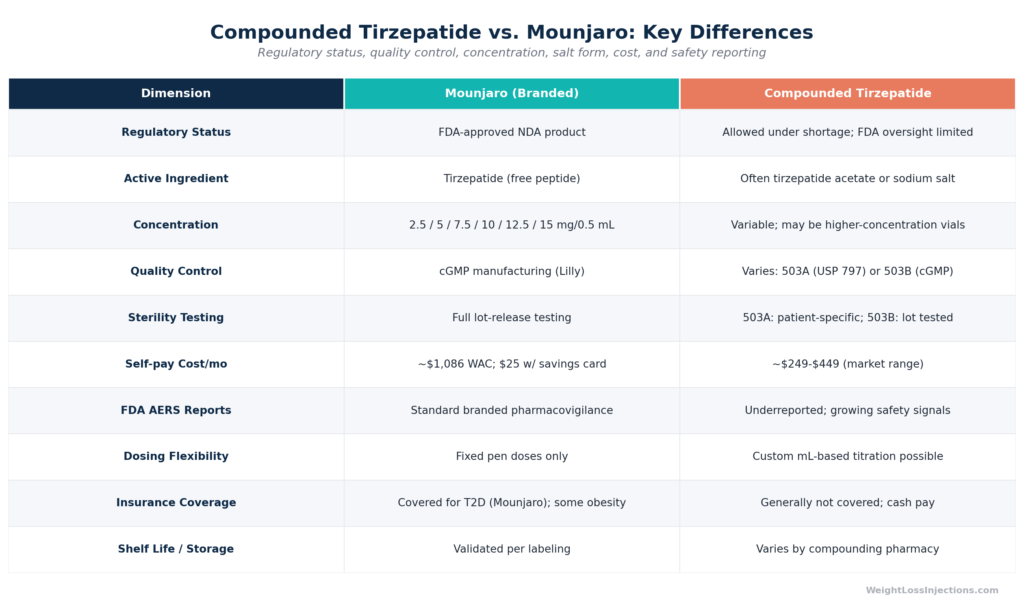
Mounjaro®
Compounded Tirzepatide
Active molecule
Tirzepatide
Tirzepatide (API)
FDA-approved
Yes (T2D, May 2022)
No
Manufacturer
Eli Lilly (CGMP)
503A compounding pharmacy
Delivery device
KwikPen autoinjector
Vial + syringe (typically)
Manufacturing oversight
FDA-inspected CGMP facility
State pharmacy board, USP <797>
Legal status (June 2026)
Always legal with valid Rx
Narrow personalized exception only
Insurance coverage (T2D)
Often covered for T2D Rx
Cash-pay only
The SURPASS-2 trial — a Phase 3, 40-week, head-to-head comparison of tirzepatide versus semaglutide 1.0 mg in 1,879 adults with T2D on metformin — demonstrated what this molecule can do. All three tirzepatide doses were noninferior and superior to semaglutide in A1c reduction: −2.01% at 5 mg, −2.24% at 10 mg, and −2.30% at 15 mg versus −1.86% for semaglutide 1 mg, per SURPASS-2 published in the NEJM. Weight loss accompanied glycemic improvement: −7.6 kg (5 mg), −9.3 kg (10 mg), and −11.2 kg (15 mg) versus −5.7 kg for semaglutide. This is the clinical evidence behind Mounjaro — and it applies to the molecule, regardless of source, as long as the patient is receiving accurately dosed tirzepatide.
2. Why People Search for a “Compounded Alternative” to Mounjaro
The cost-driven question behind this search query is entirely valid, and it deserves an honest answer.
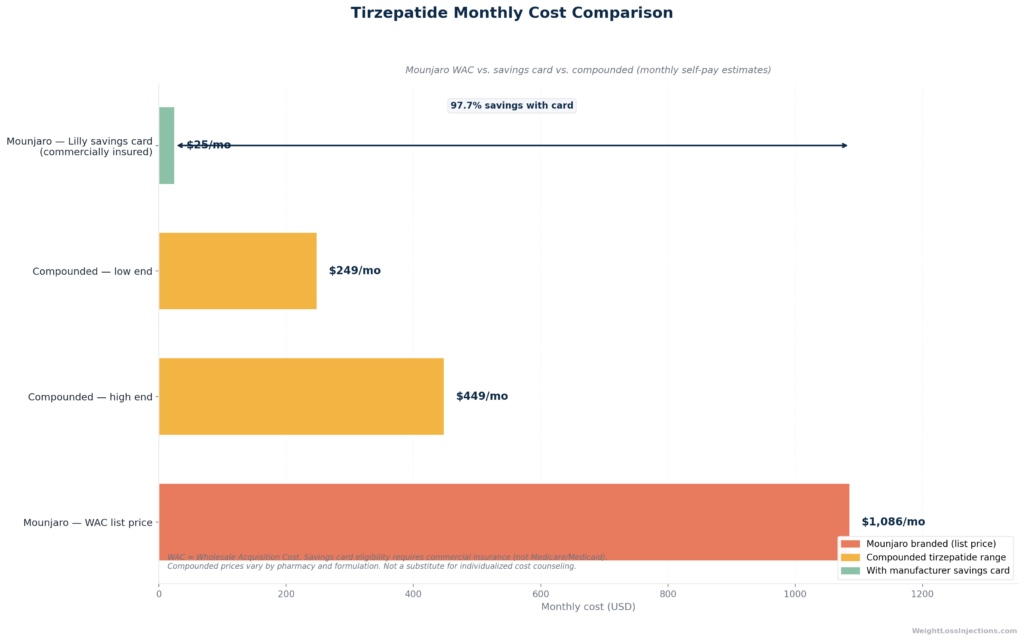
Mounjaro’s list price without insurance is approximately $1,086 per 28-day supply, according to Healthy Meals Incentives’ April 2026 tirzepatide cost analysis. For patients paying cash — or those whose insurance does not cover Mounjaro — that is a substantial financial burden for what may be a long-term or indefinite therapy.
Between December 2022 and early 2025, compounded tirzepatide offered a genuine cost alternative. During that period, the FDA had listed tirzepatide on its Drug Shortage List (first added December 15, 2022), and under federal law, 503A and 503B compounding pharmacies were legally permitted to produce compounded versions of drugs on the shortage list. Telehealth platforms and compounding pharmacies took advantage of this window, offering compounded tirzepatide for roughly $349–$699 per month — a meaningful discount from Mounjaro’s retail price. For patients without insurance coverage or with high cost-sharing obligations, this pathway seemed attractive.
That period is over. The compounding landscape changed fundamentally between late 2024 and early 2025, and patients searching for “compounded Mounjaro” or “cheap tirzepatide” in 2026 need to understand the current reality before making any decisions.
What changed? In October 2024, the FDA determined that the tirzepatide shortage had resolved. After litigation and a subsequent Declaratory Order on December 19, 2024, the FDA reaffirmed the shortage resolution. Grace periods for 503A pharmacies (state-licensed compounders) ended February 18, 2025, and a federal judge denied a legal challenge on March 10, 2025, per the Alliance for Pharmacy Compounding. The 503B outsourcing facility grace period ended March 19, 2025.
What options exist for Mounjaro patients facing cost barriers in 2026?
Lilly Mounjaro savings card: For commercially insured patients, Lilly’s savings program can substantially reduce out-of-pocket costs. Eligibility depends on your insurance type.
LillyDirect Zepbound vials: Zepbound is the same molecule as Mounjaro (obesity indication), available as single-dose vials through LillyDirect starting at $299/month self-pay. Some T2D patients who also meet the obesity/overweight indication may find this pathway accessible with a Zepbound prescription.
Lilly patient assistance programs: Eli Lilly operates patient assistance programs for uninsured and underinsured patients. Ask your prescriber or call Lilly’s patient support line directly.
Narrow 503A personalized compounding exception: Described in detail in Section 4 — this applies only to specific clinical situations, not general cost reduction.
The important framing here is that cost alone is no longer a sufficient basis for accessing compounded tirzepatide. The rest of this article explains why, and what the legitimate alternatives look like.
3. What Mounjaro Has That Compounded Tirzepatide Doesn’t
Being honest about Mounjaro’s genuine advantages is essential to building credibility — and these advantages are real. They do not stem from the molecule (which is identical) but from the manufacturing pathway, delivery infrastructure, and regulatory standing.
FDA Approval and Pre-Market Review
Mounjaro was approved by the FDA in May 2022 under NDA 215866 following the SURPASS clinical trial program — six Phase 3 trials involving thousands of patients with type 2 diabetes, reviewed in full by FDA scientific reviewers before a single pen reached a patient. That approval means Eli Lilly submitted complete chemistry, manufacturing, and clinical safety data; the FDA evaluated all of it; and the agency determined that Mounjaro’s benefits outweigh its risks for the labeled population, per the FDA Mounjaro label NDA 215866.
Compounded tirzepatide has never undergone pre-market FDA review. No compounding pharmacy has submitted clinical trial data. The molecule is the same, but the specific formulation, concentration, excipients, and manufacturing process have not been reviewed.
CGMP Manufacturing and Lot-Release Testing
Eli Lilly manufactures Mounjaro under FDA’s Current Good Manufacturing Practice (CGMP) regulations — the federal standards that govern pharmaceutical manufacturing. CGMP means validated manufacturing processes, standardized sterility testing, potency verification on every production lot before shipment, complete supply chain traceability, and regular FDA facility inspections. Every Mounjaro pen that reaches a patient has been verified for identity, purity, sterility, and potency against documented specifications. Per the FDA Mounjaro label NDA 215866, the dose labeled on the pen is the dose in the pen, within documented tolerance ranges.
503A compounding pharmacies are not CGMP facilities. They operate under USP <797> sterile compounding standards, inspected by state pharmacy boards — not the FDA, for routine inspections. USP <797> provides sterility requirements for compounded sterile preparations, but it does not encompass the full scope of CGMP lot release testing and potency verification that applies to Lilly’s manufacturing.
The KwikPen Autoinjector
Mounjaro’s single-use, prefilled KwikPen autoinjector is a clinical advantage for many patients. The device is color-coded by dose, pre-set, auto-locking after use, and requires no reconstitution, no syringe drawing, and no dose calculation. For patients who are new to self-injection, anxious about syringes, or prone to dosing calculation errors, this delivery format reduces a meaningful source of risk. Compounded tirzepatide is typically supplied as a multi-dose glass vial requiring the patient to draw doses with an insulin syringe — a skill that requires training, the right supplies, and careful technique.
Lot Traceability and Pharmacovigilance
Mounjaro’s CGMP supply chain means that any adverse event can be traced to a specific manufacturing lot. The FDA’s Adverse Event Reporting System (FAERS) captures Mounjaro-related events as part of Lilly’s post-market pharmacovigilance obligations. This means the safety profile of Mounjaro improves over time as real-world data accumulates and any safety signals can be acted upon.
Compounded tirzepatide has no equivalent tracking infrastructure. Adverse events may go unreported, and there is no systematic lot-traceability mechanism for most 503A-compounded products.
Savings Programs
Lilly’s own commercial programs have substantially closed the cost gap that once drove patients toward compounding. According to Healthy Meals Incentives:
Mounjaro savings card (commercial insurance): Eligible commercially insured patients can access significant cost reductions through Lilly’s savings card program.
LillyDirect Zepbound vials (self-pay): $299/month (2.5 mg) through $699/month (higher doses) — the same API, FDA-approved, vial-format.
Lilly patient assistance: For qualifying uninsured or underinsured patients, Lilly’s program may provide Mounjaro at reduced or no cost.
Prescriber Familiarity and Support
Healthcare providers who prescribe Mounjaro operate within a well-established framework: an FDA-approved label with clear dosing instructions, a boxed warning they know to counsel patients on, and a manufacturer’s medical affairs team for clinical questions. Prescribing compounded tirzepatide under the narrow 503A exception requires documenting a specific clinical need in the prescription — a step that many prescribers are unfamiliar with, and that creates additional administrative burden and liability considerations.
4. What the Law Says About Compounded Tirzepatide in 2026 — The Full Picture
This section is the most consequential in the article. Understanding the current legal status of compounded tirzepatide is essential for any patient, caregiver, or prescriber making decisions about access.
The Timeline: From Shortage to Narrow Exception
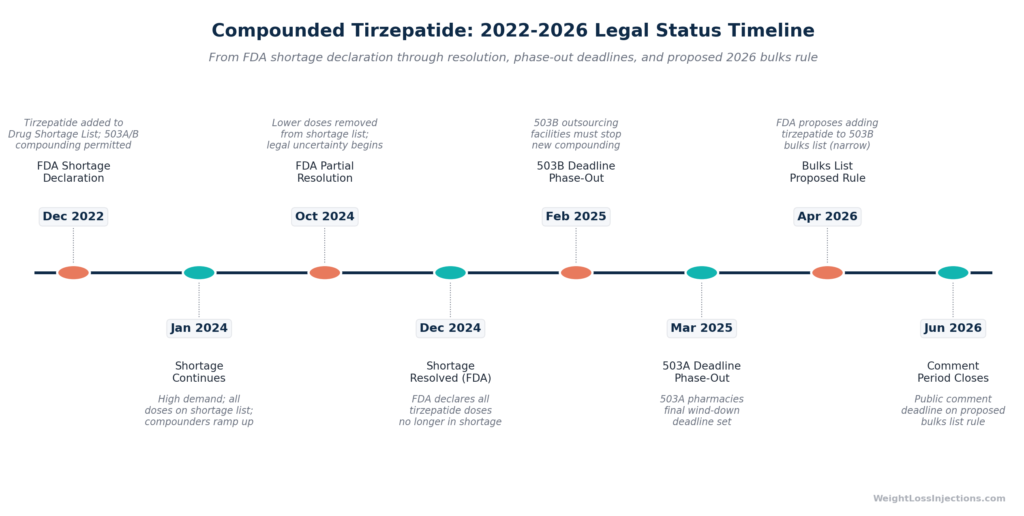
The legal status of compounded tirzepatide has gone through three distinct phases since 2022:
Date
Event
December 15, 2022
Tirzepatide added to FDA Drug Shortage List due to demand surge following approval. Compounding legally permitted.
October 2, 2024
FDA initially determines shortage resolved. Compounding legally ends.
October 8, 2024
Outsourcing Facilities Association (OFA) sues FDA; FDA agrees to reconsider temporarily.
December 19, 2024
FDA issues Declaratory Order reaffirming shortage resolved; supply meets and exceeds demand.
February 18, 2025
503A enforcement discretion ends for state-licensed pharmacies.
FDA proposes to exclude tirzepatide from the 503B Bulks List, finding no clinical need for outsourcing-facility bulk compounding.
The practical result of this timeline: the compounding era for tirzepatide is over for the vast majority of patients and use cases. The window that existed from December 2022 through early 2025 was explicitly tied to the FDA shortage designation. Once the shortage was declared resolved, the legal basis for broad compounding evaporated.
What 503A and 503B Mean — And Why They Matter
503A pharmacies are state-licensed traditional compounding pharmacies. They are legally permitted to compound patient-specific prescriptions for individual patients. They are exempt from FDA’s CGMP requirements and drug approval requirements — but only if they do not regularly produce drugs that are “essentially copies” of commercially available products. Under this framework, a 503A pharmacy cannot simply produce mass quantities of tirzepatide vials and dispense them to hundreds of patients at lower cost. That is not what patient-specific compounding means under federal law, per FDA’s compounding clarification guidance.
503B outsourcing facilities are FDA-registered facilities that can compound without patient-specific prescriptions for “office stock” distribution. They are FDA-inspected and must comply with CGMP. They may compound using bulk API only if the substance is on the FDA’s 503B Bulks List, or if the drug is on the FDA shortage list. Tirzepatide is on neither list as of June 2026.
What Is Still Legal: The Narrow 503A Exception
The April 2026 FDA guidance clarified that one pathway still exists for compounded tirzepatide: the 503A personalized-medicine exception. Under this exception, a 503A pharmacy may compound tirzepatide for an individual patient if:
The prescriber documents a clinically significant difference for that specific patient — meaning a clinical need that the commercially available Mounjaro product cannot meet. Documented examples include:
A confirmed allergy or hypersensitivity to cresol (a preservative in Mounjaro’s inactive ingredients) or another branded-product excipient.
A documented need for a dose strength not commercially available — for example, an intermediate titration dose (such as 3 mg or 6 mg) for a patient who cannot tolerate standard escalation steps.
A route of administration difference not available from the branded manufacturer.
The prescription includes the prescriber’s documented determination of significant clinical difference — not a general patient preference, and explicitly not cost as the sole reason.
This is narrow. It is not a “workaround” for cost. It is a genuine clinical exception for patients with specific, documented, individual needs.
What Is NOT Legal in 2026
The following practices do not comply with current FDA guidance:
General cost-reduction compounding of tirzepatide for any patient who prefers it to be cheaper.
Subscription-model telehealth platforms dispensing compounded tirzepatide to large patient populations without documented individualized clinical justification.
Combination products (tirzepatide + B12, or tirzepatide + lipotropics) at strengths within 10% of commercially available Mounjaro doses, without documented clinical justification for the combination.
Any 503B outsourcing facility compounding tirzepatide — the shortage is resolved and tirzepatide is not on the 503B Bulks List.
Products marketed as “research chemical tirzepatide” or sourced internationally.
According to Potere Health MD’s 2026 compounding legal overview, patients should be particularly cautious about online platforms that continue to market compounded tirzepatide subscriptions at scale — these almost certainly do not meet the narrow legal requirements.
For T2D patients on Mounjaro specifically: Mounjaro remains fully lawful and is the primary, appropriate pathway. If cost is the barrier, discuss LillyDirect Zepbound vials ($299–$699/month self-pay), Lilly patient assistance programs, and whether any insurance pathway applies to your specific T2D diagnosis. The narrow compounding exception is not a cost-reduction strategy — it is a clinical-need exception.
FDA tirzepatide compounding status timeline: the December 2022 shortage opened legal compounding; the December 2024 shortage resolution closed it; 503A and 503B grace periods ended in March 2025; the April 2026 FDA guidance clarified the narrow remaining 503A exception for documented individual clinical need.
Still legal vs. not legal — quick reference:
Scenario
Legal in 2026?
Mounjaro with a valid T2D prescription
✓ Yes
503A compounding with documented cresol allergy and ≤4 Rx/month
✓ Yes (narrow exception)
503A compounding for documented non-standard dose need and ≤4 Rx/month
✓ Yes (narrow exception)
Mass-market compounded tirzepatide for cost savings
✗ No
503B outsourcing facility compounding tirzepatide
✗ No
Tirzepatide subscription from telehealth platform without documented clinical need
✗ No
Compounded tirzepatide + B12 without documented clinical justification
✗ No
Internationally sourced tirzepatide peptide
✗ No
Our Top 3 · October 2026
The best GLP-1 providers right now
Independently reviewed. Ranked by price, medication access, provider quality, and patient outcomes.
5. Formulation and Delivery — How the Products Actually Differ at the Pharmacy
Beyond the regulatory and legal differences, patients evaluating these two pathways should understand what they would actually receive at the pharmacy — because the practical experience of using Mounjaro versus compounded tirzepatide is meaningfully different.
Mounjaro: The KwikPen Experience
Mounjaro is dispensed as a single-use, prefilled autoinjector pen — the KwikPen. Available in six dose strengths: 2.5 mg, 5 mg, 7.5 mg, 10 mg, 12.5 mg, and 15 mg (with the 2.5 mg pen used exclusively for initiation, not as a maintenance dose). The pen is color-coded by dose, pre-set, and auto-locking — you inject, and the device mechanically prevents reuse and needlestick. No reconstitution, no syringe drawing, no dose calculation. Per the FDA Mounjaro label NDA 215866, pens are injected subcutaneously into the abdomen, thigh, or upper arm once weekly, rotating injection sites.
Storage requirements for Mounjaro are straightforward: refrigerate between 2°C and 8°C (36°F and 46°F). An unopened pen kept at room temperature (below 30°C / 86°F) may be used within 21 days. The labeled titration schedule per the FDA Mounjaro prescribing information:
Weeks
Dose
1–4
2.5 mg once weekly (initiation only — not a therapeutic dose)
5–8
5.0 mg once weekly
9–12
7.5 mg once weekly
13–16
10 mg once weekly
17–20
12.5 mg once weekly
21+
15 mg once weekly (maximum)
Compounded Tirzepatide: The Vial Experience
Compounded tirzepatide, when lawfully prepared under the 503A exception, is typically dispensed as a multi-dose glass vial. The patient draws doses using an insulin syringe (or pen needle adapter in some configurations). This requires:
Correct syringe calibration and understanding of unit markings.
Accurate dose calculation from the vial concentration — for example, if the vial contains 5 mg/mL and the target dose is 2.5 mg, the patient draws 0.5 mL. A calculation error can result in a two- to ten-fold dosing mistake.
Proper sterile technique: cleaning the vial stopper with an alcohol wipe, handling the syringe without contaminating the needle, and appropriate sharps disposal.
Adequate supplies: insulin syringes (typically 1 mL, 29–31 gauge), alcohol wipes, and a sharps container — none of which are included with the vial.
Lyophilized (freeze-dried powder) formulations require reconstitution — adding a specific volume of sterile water or bacteriostatic water to the vial, then gently swirling (never shaking) to dissolve. Incorrect reconstitution volume directly affects the concentration and therefore every subsequent dose drawn from that vial. The FDA has documented adverse events resulting from dosing errors with reconstituted compounded products, per the FDA GLP-1 Compounding Clarification Page.
Concentration Variability and Non-Standard Doses
Unlike Mounjaro’s fixed dose strengths (2.5/5/7.5/10/12.5/15 mg per injection), compounded formulations can contain any concentration chosen by the prescribing physician and compounding pharmacy. Common compounded concentrations have included 2.5 mg/mL, 5 mg/mL, and 10 mg/mL. Under the narrow personalized exception, a prescriber might document a need for 3 mg or 6 mg per week — intermediate steps not available from Lilly — for a patient who cannot tolerate standard titration increments.
The dose flexibility can be a genuine clinical tool in the right circumstances. But it also means the patient must correctly calculate the draw volume for each dose, and verify that the vial concentration matches the prescription. Mistakes are more likely than with a pre-set pen.
The Salt Form Issue
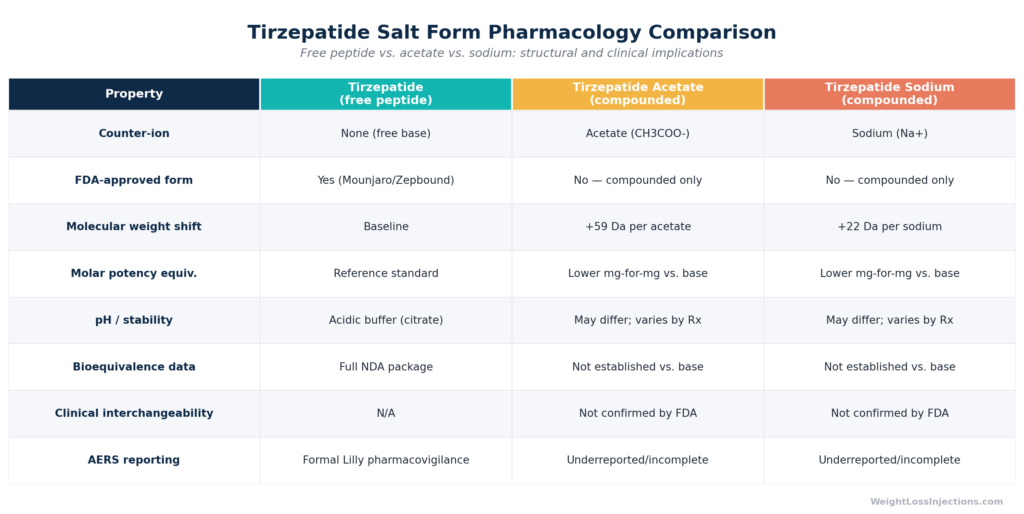
This is a quality concern that deserves explicit attention. Mounjaro contains tirzepatide (the base form of the molecule) as its active pharmaceutical ingredient. Some compounding pharmacies have historically used tirzepatide acetate or tirzepatide hydrochloride — salt forms of tirzepatide that are chemically distinct from the base.
The bioavailability, potency, and clinical equivalence of these salt forms relative to tirzepatide base has not been established. The FDA has specifically flagged the use of non-base salt forms as a safety and quality concern, per the FDA GLP-1 Compounding Clarification Page. A patient receiving tirzepatide acetate is not receiving the same chemical entity as a patient receiving Mounjaro — even if the label says “tirzepatide.”
If you encounter compounded tirzepatide in any context, ask explicitly which salt form is being used. Only tirzepatide base matches the branded product’s active pharmaceutical ingredient.
Storage Comparison
Mounjaro (KwikPen)
Compounded Tirzepatide (Vial)
Unopened storage
Refrigerate 2–8°C
Refrigerate 2–8°C
In-use / room temp
Up to 21 days below 30°C
Varies by formulation; ask pharmacy
Lyophilized / reconstituted
N/A
More stringent; use within pharmacy-specified window
Freeze
Do not freeze
Do not freeze
Supplies included
Complete (pen, cap, needle)
Vial only; patient must source syringes, wipes, sharps container
6. Insurance Implications — Mounjaro vs. Compounded Tirzepatide for Diabetes Patients
For type 2 diabetes patients, insurance coverage is often the most practically important dimension of this comparison.
Mounjaro and Insurance Coverage
Mounjaro’s FDA approval for type 2 diabetes means it sits in the antidiabetic medication category for most insurance formulary purposes — a meaningful distinction from Zepbound, which is categorized as an anti-obesity medication and often excluded from coverage.
Commercial insurance: Many commercial plans cover Mounjaro for T2D patients with a prior authorization (PA) requirement. Common PA criteria include documented HbA1c ≥7.0% (or ≥7.5% on some plans), confirmed T2D diagnosis (typically ICD-10 code E11.x), and failure or contraindication to first-line metformin therapy. If your HbA1c and diagnosis meet these criteria, approval is often achievable.
Medicare Part D: Medicare Part D generally covers Mounjaro for its T2D indication. Unlike anti-obesity medications (which Part D is prohibited from covering under most circumstances), Mounjaro’s T2D label qualifies it as a covered antidiabetic agent under most Part D formularies. However, cost-sharing tiers, prior authorization rules, and annual deductible structures vary by plan — check your specific formulary.
Medicaid: Coverage varies significantly by state. Some states cover tirzepatide for T2D; others have not added it to formularies. Your prescriber’s office can submit a prior authorization or appeal on your behalf.
Lilly savings programs for insured patients: Eligible commercially insured patients may use Lilly’s Mounjaro savings card to reduce their out-of-pocket cost substantially. The savings card does not apply to Medicare or Medicaid patients.
Compounded Tirzepatide and Insurance
Compounded prescription medications are not covered by insurance — commercial, Medicare, or Medicaid. Compounded tirzepatide is a cash-pay product under any circumstances, because insurance plans do not reimburse for compounded drugs that have commercially available equivalents, especially non-FDA-approved preparations.
Estimated cost for compounded tirzepatide under the lawful 503A personalized exception in 2026: approximately $150–$600 per month, depending on dose, pharmacy markup, and any associated telehealth consultation fees, per Healthy Meals Incentives. Note that this represents the narrow exception pathway — not a widely available consumer offering.
FSA and HSA Eligibility
Compounded tirzepatide dispensed pursuant to a valid prescription is generally eligible for payment with Flexible Spending Account (FSA) or Health Savings Account (HSA) funds, as it qualifies as a prescription medication expense under IRS Publication 502. Mounjaro is similarly FSA/HSA-eligible. If you are a self-pay patient with an HSA-compatible high-deductible health plan, both options can be paid with pre-tax dollars.
WeightLossInjections.com Pricing and Services
WeightLossInjections.com offers [service detail] starting at [$X/month]. [STATE-SPECIFIC DISCLAIMER]. Our licensed clinical team helps patients evaluate their coverage options and navigate both branded and — where clinically appropriate under the narrow 503A exception — compounded pathways. Speak with a provider to determine what makes sense for your specific situation.
7. Safety Comparison — Mounjaro and Compounded Tirzepatide
Safety is where the comparison matters most. There are two categories of risk to consider: molecule-level risks that apply to any tirzepatide product, and formulation-specific risks that apply specifically to compounded products.
Molecule-Level Risks (Apply to Both Mounjaro and Compounded Tirzepatide)
Because the active pharmaceutical ingredient is identical, the safety profile derived from clinical trials applies to both options — assuming the compounded product is accurately and precisely dosed.
Boxed Warning — Thyroid C-Cell Tumors: Tirzepatide caused dose- and duration-dependent thyroid C-cell adenomas and carcinomas in animal studies. Human relevance is undetermined. Tirzepatide is contraindicated in patients with a personal or family history of medullary thyroid carcinoma (MTC) or multiple endocrine neoplasia syndrome type 2 (MEN 2). This warning applies regardless of whether the tirzepatide is from Mounjaro or a compounded source, per the FDA Mounjaro label NDA 215866.
GI adverse effects: Nausea (12–18% in T2D trials), diarrhea (12–17%), vomiting (6–10%), and constipation (6–11%) are the most common adverse events for Mounjaro. These are dose-dependent and typically attenuate after the dose-escalation period, per StatPearls on NCBI Bookshelf. The same GI profile applies to properly dosed compounded tirzepatide.
Pancreatitis: Acute pancreatitis was observed in SURPASS clinical trials at a rate of 0.23 per 100 patient-years versus 0.11 in the comparator arm, per StatPearls. Tirzepatide is not studied in patients with prior pancreatitis; use with caution in patients with a history of pancreatitis or gallbladder disease.
Hypoglycemia: As monotherapy, the risk is low due to tirzepatide’s glucose-dependent insulin secretion mechanism. Significant risk exists when combined with insulin or sulfonylureas — dose reduction of these agents is recommended at tirzepatide initiation, per StatPearls.
Gallbladder disease: Cholelithiasis and cholecystitis have been reported, likely related to rapid weight loss.
Drug interactions of note: Tirzepatide slows gastric emptying, which can reduce absorption of oral medications. Oral contraceptives may have reduced efficacy — use barrier contraception for four weeks after initiation and after each dose increase. Levothyroxine absorption may decrease by 10–15%; take levothyroxine at least 30–60 minutes before the injection day.
Compounding-Specific Risks (Apply Only to Compounded Tirzepatide)
Beyond the molecule-level side effects, compounded tirzepatide carries additional risks that do not apply to Mounjaro:
Dosing errors from vial reconstitution: Lyophilized compounded products require reconstitution before use. Errors in the reconstitution volume directly affect the concentration of every dose drawn from that vial. FDA adverse event reports through February 2025 included cases of patients receiving five to ten times the intended dose from improperly reconstituted compounded products, resulting in severe GI symptoms, hypoglycemia, and hospitalizations, per the FDA GLP-1 Compounding Clarification Page.
Subpotent batches: Other adverse event reports involved patients receiving no therapeutic effect after weeks of injections — consistent with subpotent or inactive product. A vial that contains little or no tirzepatide delivers no benefit while the patient believes they are being treated.
Sterility failures: Non-sterile compounding creates the risk of bacterial contamination in injectable products — a potentially life-threatening complication. USP <797> standards require sterile compounding environments, but compliance and enforcement vary across state-licensed pharmacies.
Salt form bioavailability: As discussed in Section 5, compounded products containing tirzepatide acetate or other non-base salts may not deliver equivalent bioavailability. The extent of this difference has not been clinically studied.
Combination products (tirzepatide + B12): Some compounders have historically offered tirzepatide combined with vitamin B12. The FDA has warned that such combinations do not have an evidence base for added clinical benefit, and may be considered “essentially copies” of the branded product without the combination being clinically justified. At high doses, B12 (particularly cyanocobalamin) carries risk of toxicity in patients with renal impairment, per the FDA GLP-1 Compounding Clarification Page.
How to mitigate compounding-specific risks (if you are in the narrow legal exception pathway): Ask the compounding pharmacy for their most recent state pharmacy board inspection report, confirm they comply with USP <797> sterile compounding standards, request a third-party Certificate of Analysis (CoA) from an accredited laboratory confirming API identity, potency, and sterility, and verify that the salt form used is tirzepatide base — not tirzepatide acetate or hydrochloride.
8. Decision Framework — Who Should Consider Each Option in 2026
This section brings the comparison together into a practical guide for the most common patient scenarios.
Choose Mounjaro If:
You have type 2 diabetes and commercial insurance or Medicare Part D that covers Mounjaro for the T2D indication. This is the most common, most straightforward pathway.
Your prescriber has filed a prior authorization based on your HbA1c and T2D diagnosis, and coverage has been approved.
You prefer an FDA-approved, pen-based autoinjector with lot-traceable quality control, manufacturer pharmacovigilance, and full prescriber and payer support.
Lilly’s savings programs reduce your out-of-pocket cost to an acceptable level.
You have a personal or family history of MTC or MEN 2 — in which case any tirzepatide is contraindicated regardless of source, but established prescriber oversight through the Mounjaro framework is important for managing this risk.
You are on insulin or a sulfonylurea — the dose adjustment guidance for starting Mounjaro is well-established; the risk management infrastructure is strongest with the branded product.
Consider LillyDirect Zepbound Vials If:
Cost is your primary driver and you want an FDA-approved product but cannot access Mounjaro insurance coverage.
You meet the Zepbound indication (obesity or overweight with comorbidity).
You are comfortable with vial self-injection — LillyDirect vials offer the same tirzepatide molecule in the same vial format that compounded products once used, at a self-pay starting price of $299/month, per Healthy Meals Incentives.
You are not a T2D patient, or your T2D insurance does not cover Mounjaro, and you want to explore whether Zepbound’s obesity indication can be accessed affordably.
Lawfully Compounded Tirzepatide (Narrow 503A Exception) May Apply If:
Your prescriber has documented a specific, individual clinical need that Mounjaro cannot meet — such as a confirmed allergy to cresol (an inactive ingredient in the branded KwikPen), or a documented requirement for a non-commercially available dose strength.
A licensed 503A compounding pharmacy in your state will prepare the product under the documented clinical justification, with no more than four such prescriptions per month.
You understand and accept that you are receiving a non-FDA-approved product, that insurance will not cover it, and that quality verification steps (CoA, PCAB accreditation, salt form confirmation) are your responsibility to request.
Your prescriber is willing to document the clinical justification in the prescription and assume the corresponding prescriber responsibility.
This pathway is genuinely narrow. If the reason you want compounded tirzepatide is cost reduction without a specific clinical need, that pathway is not lawful in 2026.
the WeightLossInjections.com Staff: “For most of my type 2 diabetes patients, Mounjaro remains the first-line option. When insurance barriers exist, we explore the LillyDirect self-pay pathway or documented compounding exceptions together — there is no single right answer, but the decision has to be grounded in documented clinical need, not cost alone.”
Explore our [service detail] program at WeightLossInjections.com — [service detail] — starting at [$X/month]. [STATE-SPECIFIC DISCLAIMER].
Decision pathway guide for patients evaluating tirzepatide access options in 2026: the three primary options (Mounjaro for T2D, LillyDirect Zepbound vials for cost-sensitive patients, narrow 503A compounding for documented clinical need), with the key qualifying criteria for each.
Frequently Asked Questions
Is compounded tirzepatide the same as Mounjaro?
Yes — both contain tirzepatide as the active ingredient. Mounjaro is Eli Lilly’s FDA-approved branded version for type 2 diabetes; compounded tirzepatide is a pharmacist-made version using the same API. They differ in manufacturing oversight, regulatory status, delivery device, and current legal availability. If the compounded product contains accurately dosed tirzepatide base (not an alternative salt form), the molecular mechanism is identical to Mounjaro.
Can I still get compounded tirzepatide instead of Mounjaro in 2026?
Only in very narrow circumstances. Mass-market compounding of tirzepatide ended in March 2025, following the FDA’s December 2024 determination that the drug shortage was resolved, per the FDA Declaratory Order. A 503A compounding pharmacy may still produce it if your prescriber documents a specific clinical need — such as an allergy to an inactive ingredient in the branded pen — and the pharmacy compounds four or fewer such prescriptions per month, per the FDA GLP-1 Compounding Clarification Page.
Is Mounjaro cheaper than compounded tirzepatide?
Not at retail cash price. Mounjaro’s list price is approximately $1,086 per month without insurance, per Healthy Meals Incentives. However, Lilly savings programs and the LillyDirect Zepbound vial pathway ($299–$699 per month self-pay) can make the branded option cost-competitive with what compounding once offered. For commercially insured T2D patients using the Mounjaro savings card, the out-of-pocket cost can be considerably lower.
Does Mounjaro come in a vial like compounded tirzepatide?
Not directly — Mounjaro uses autoinjector pens. However, Zepbound (the same molecule, obesity indication) is available as single-dose vials through LillyDirect, which provides a vial-based self-injection experience similar to compounded tirzepatide at a competitive self-pay price.
Are the side effects of Mounjaro and compounded tirzepatide the same?
The molecule-level side effects are identical — same API, same mechanism, same warnings including the boxed warning for thyroid C-cell tumors. Compounded tirzepatide carries additional quality-related risks (potency variation from dosing errors, sterility concerns, non-standard salt forms) that do not apply to the FDA-approved product, per the FDA GLP-1 Compounding Clarification Page.
Can a type 2 diabetes patient use compounded tirzepatide instead of Mounjaro?
Only under the narrow personalized-medicine exception described in this article. Cost alone is not a legally sufficient reason for a 503A pharmacy to compound tirzepatide after March 2025. T2D patients facing cost barriers should first discuss Mounjaro insurance coverage, the Mounjaro savings card, LillyDirect Zepbound vials, and Lilly patient assistance programs with their prescriber.
Key Takeaways
Mounjaro and compounded tirzepatide contain the same active molecule — tirzepatide, a dual GIP + GLP-1 receptor agonist. The clinical evidence from SURPASS and SURMOUNT trials reflects the molecule, and applies to both products if accurately dosed.
Mounjaro’s advantages are manufacturing-based, not molecular: CGMP quality control, FDA approval and pre-market review, lot traceability, KwikPen autoinjector usability, savings programs, and full insurance billing infrastructure for T2D.
The compounding era for tirzepatide is over for most patients. Mass-market compounding ended in March 2025. The surviving legal pathway is narrow: documented individual clinical need (allergy or non-standard dose), prescriber documentation in the Rx, ≤4 prescriptions per month from the pharmacy.
Legitimate cost alternatives to Mounjaro retail: LillyDirect Zepbound vials ($299/month), Mounjaro savings card (commercially insured), and Lilly patient assistance programs for qualifying patients.
Patients pursuing any compounded tirzepatide pathway should request a Certificate of Analysis, confirm tirzepatide base (not acetate/hydrochloride) is used, verify 503A pharmacy licensure, and ensure their prescriber has documented a specific individualized clinical need.
This content is for informational purposes only and does not constitute medical advice. Consult a licensed healthcare provider before starting, stopping, or changing any medication or treatment plan.
WeightLossInjections.com | Tirzepatide Pillar — Article 21 | Last verified June 2026

![Unbranded [pillar-drug-class] injection pen on a neutral background — WeightLossInjections.com editorial hero](https://weightlossinjections.com/wp-content/uploads/2026/07/hero_tirzepatide_c4_compare-1200x675.png)