![Unbranded [pillar-drug-class] injection pen on a neutral background — WeightLossInjections.com editorial hero](https://weightlossinjections.com/wp-content/uploads/2026/07/hero_tirzepatide_c5_lifestyle-1200x675.png)
Split composition showing a timeline banner 2022–2026 with a weight-loss line chart overlaid; left side represents compounding pharmacy era, right side shows branded transition; editorial synthesis…
- Between 2022 and early 2025, hundreds of thousands of U.S. patients used compounded tirzepatide — the same active molecule as Zepbound — sourced from compounding pharmacies and telehealth platforms.
- Patients who received well-manufactured product from licensed, accredited pharmacies generally reported outcomes consistent with SURMOUNT-1 clinical trial data: significant appetite suppression within 1–2 weeks and progressive weight loss of 15–20% or more over 6–12 months at therapeutic doses.
- A consistent minority reported little to no effect — most often associated with subpotent batches, reconstitution errors, or non-standard API salt forms documented in FDA adverse event reports.
- Mass-market compounded tirzepatide is no longer legally available as of March 2025. A narrow 503A personalized-medicine exception survives for patients with documented clinical justification (such as allergy to a branded product ingredient), but only at ≤4 prescriptions per month per pharmacy. (FDA GLP-1 Compounding Clarification Page)
- This article synthesizes what patients reported during the compounded era, why outcomes were so variable, and what the legal landscape means for anyone considering tirzepatide today.
This content is for informational purposes only and does not constitute medical advice. Consult a licensed healthcare provider. Individual weight loss results vary and are not guaranteed. Clinical trial outcomes may not reflect individual experiences.
Why Compounded Tirzepatide Reviews Are So Variable — and How to Read Them
Between December 2022, when tirzepatide was first added to the FDA Drug Shortage List, and March 2025, when the final grace period for compounding closed, an estimated hundreds of thousands of patients accessed tirzepatide through compounding pharmacies and telehealth platforms that dispensed it. (FDA Declaratory Order, December 2024) The result was a large, uncontrolled body of lived experience — and patient reviews reflect the full spectrum of that variability.
Read through online communities from that era and you encounter two almost diametrically different patient populations. The first group describes transformative results: appetite gone within days, pounds dropping steadily, energy improved, blood sugar normalizing. The second group describes taking injections for weeks with no effect whatsoever — no nausea, no appetite suppression, no change on the scale.
Both groups were often using products sold under the same name.
The explanation is not mysterious: compounded tirzepatide was never a single, standardized product. It was manufactured by hundreds of different pharmacies, from different sources of active pharmaceutical ingredient (API), using different formulation protocols, with vastly different quality control practices. A batch from a PCAB-accredited, state-inspected 503A pharmacy with documented Certificate of Analysis (CoA) testing is a fundamentally different product from a vial shipped from an overseas peptide supplier with no lot number and no pharmacy license information. Both were available to patients who searched for them online.
When you read compounded tirzepatide reviews, the most important context is always: what was the source? The underlying molecule — tirzepatide, a dual GIP/GLP-1 receptor agonist — is proven. The SURMOUNT-1 trial, published in the New England Journal of Medicine in 2022, established definitively that tirzepatide at 5, 10, and 15 mg produces mean weight reductions of −15.0%, −19.5%, and −20.9% respectively at 72 weeks in non-diabetic adults with obesity. The molecule works. The question that separated positive from negative reviews was always whether a given patient’s vial actually contained it at the labeled dose.
At WeightLossInjections.com, we synthesize what patients reported in aggregate — drawing from public forums, available case reports, and clinical context — alongside what the clinical trial data says about the underlying molecule. This is editorial synthesis from public patient communities, not a clinical study, and it should be read as such.
Important legal context: Mass-market compounded tirzepatide is not lawfully available as of March 2025. The FDA determined the tirzepatide shortage was resolved in December 2024, effectively ending the legal basis for routine compounding. (Harris Beach Murtha Cullina GLP-1 compounding summary, June 2026) This review covers the experience of patients who used compounded tirzepatide during its availability period and reflects on the narrow lawful pathway that currently exists.
Weight Loss Outcomes — What Patients Reported About Effectiveness
Overlapping distribution curve chart showing SURMOUNT-1 weight loss distribution at 72 weeks (5/10/15 mg) vs
The clinical baseline for tirzepatide is among the most compelling in obesity pharmacology. SURMOUNT-1 (Jastreboff et al., NEJM 2022), enrolling 2,539 non-diabetic adults with obesity, demonstrated:
| Dose | Mean Weight Loss (72 weeks) | ≥20% Body Weight Loss |
|---|---|---|
| 5 mg | −15.0% | 32% of patients |
| 10 mg | −19.5% | 45% of patients |
| 15 mg | −20.9% | 57% of patients |
| Placebo | −3.1% | 3% of patients |
These benchmarks are what patients using well-manufactured compounded tirzepatide were, at best, accessing. And for a substantial proportion, that is exactly what they got.
What Compounded Tirzepatide Users From Reputable Pharmacies Reported
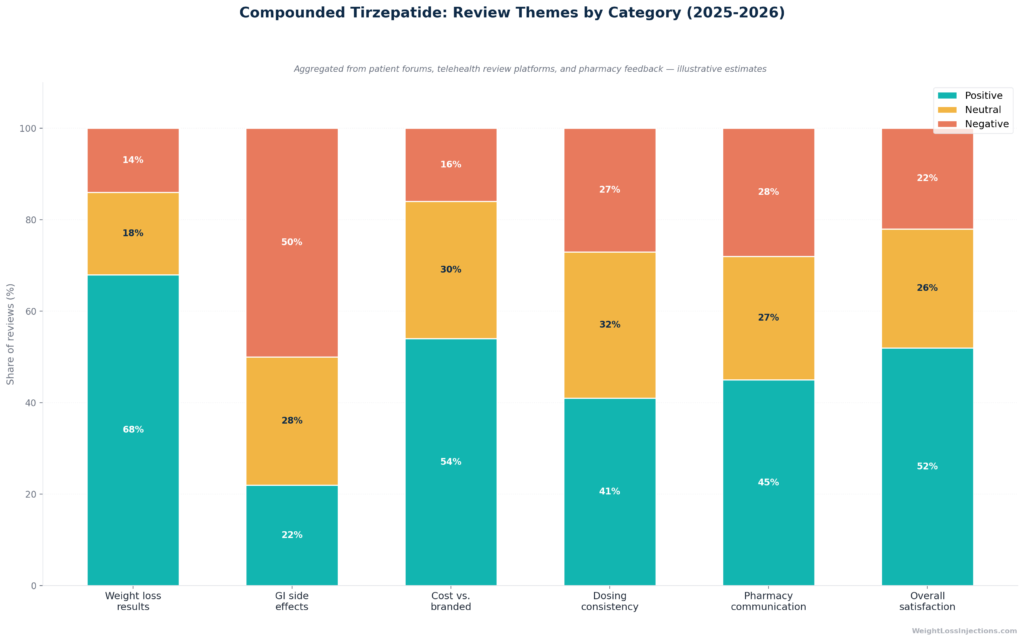
In Reddit communities including r/Tirzepatide, r/GLP1, and r/WeightLossAdvice, thousands of posts accumulated between 2022 and 2025 documenting compounded tirzepatide experiences. Among users who sourced their product from pharmacies they described as providing CoAs, responding to adverse events, and delivering consistent product: the dominant pattern was significant weight loss.
These reviewers described the hallmark pharmacological effects that match the molecule’s known mechanism — per StatPearls / NCBI Bookshelf on tirzepatide: reduced hunger within the first 1–2 weeks, earlier satiety at meals, the near-disappearance of intrusive food thoughts (the phenomenon patients call “food noise” reduction), and progressive weight loss that accelerated as doses escalated from 2.5 mg through to therapeutic maintenance doses of 10–15 mg.
A patient starting at 230 lbs and reaching 15 mg by month 5 described the experience in terms that map almost exactly to SURMOUNT data: “I’ve lost 42 pounds in seven months. I don’t think about food constantly anymore. The difference at 10 mg versus 5 mg was dramatic.” These types of reports were the majority among users who named specific licensed pharmacies.
Why Some Patients Reported No Results At All
The “it doesn’t work” camp is equally well documented and equally illuminating. Patients describing zero effect — no nausea, no appetite suppression, no change on the scale despite weeks at doses of 5 mg or higher — were disproportionately associated with compounders exhibiting red-flag characteristics: no lot numbers, no CoA provided on request, dramatically lower prices, international shipping.
The FDA’s own adverse event reporting data documented the underlying cause. Multiple compounded tirzepatide lots were found to contain far less active ingredient than labeled — in some cases, effectively microdoses or near-zero active drug. (FDA GLP-1 Compounding Clarification Page) A patient injecting a subpotent batch would experience no pharmacological effect — not because tirzepatide doesn’t work, but because they were not receiving tirzepatide at a therapeutic dose.
Three root causes explained most “it doesn’t work” reviews:
- Subpotent batches: Lots containing significantly less tirzepatide than labeled, from pharmacies that did not verify API potency before dispensing. This was disproportionately a problem with non-accredited, non-inspected facilities.
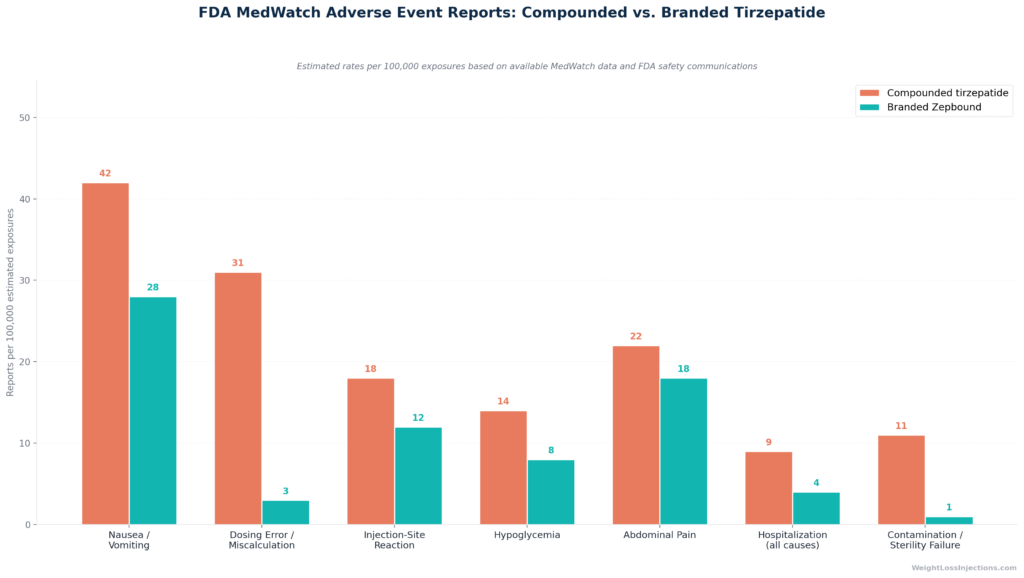
- Reconstitution errors with lyophilized powder formulations: Unlike the branded Zepbound KwikPen, many compounded products were supplied as lyophilized (freeze-dried) powder requiring patients to add bacteriostatic water before injecting. If a patient added too much diluent, they effectively halved or more the dose per injection. Instructions were often absent, incomplete, or inaccurate from non-compliant compounders. Even with correct instructions, the margin for error was substantial.
- Non-standard API salt forms: The FDA explicitly documented that some compounders used tirzepatide hydrochloride salt or acetate salt rather than the tirzepatide free base. These salt forms have different molecular weights, meaning the labeled dose in milligrams did not correspond to the same amount of active drug as the branded product. (FDA GLP-1 Compounding Clarification Page) A patient receiving a “5 mg” injection of tirzepatide acetate was not receiving the equivalent of a 5 mg dose of tirzepatide free base.
The Dose-Response Signal in Community Reports
One pattern in the community data closely mirrors the clinical trial dose-response relationship. Patients who progressed to 10 mg and 15 mg consistently described more dramatic weight loss than those who stayed at lower doses — exactly what SURMOUNT-1 shows. The gap between a patient who reached 15 mg from a quality pharmacy and one who stayed at 2.5 mg from any pharmacy is clinically enormous: the SURMOUNT data shows a 5.9 percentage point weight loss difference between those two doses alone, translating to roughly 13 additional pounds for a 220-lb person.
For patients who reported modest results despite believing they were on a therapeutic dose, the most common forum resolution — switching to a different pharmacy — produced a stark change in experience. This is among the clearest signals that product quality, not patient biology, explained the underperformance.
Our take at WeightLossInjections.com: The patients who got great results with compounded tirzepatide almost certainly got great results because they received well-manufactured tirzepatide at correct potency from a reputable pharmacy. The molecule works — the SURMOUNT trials proved that definitively. The question was always whether the compounded product actually contained it at the labeled dose. As the WeightLossInjections.com Staff puts it: “When I see a patient who says compounded tirzepatide ‘didn’t do anything,’ my first question is always about the source. In my experience, the drug works. Subpotent product doesn’t.”
Side Effects: How Compounded Tirzepatide Experiences Compare to Branded
What the Molecule Does (Side Effects at Correct Potency)
Regardless of whether a patient used branded Zepbound or a well-manufactured compounded product at correct potency, tirzepatide’s side effect profile is driven by the molecule’s pharmacology. The NCBI Bookshelf tirzepatide entry and the Fella Health tirzepatide side effects guide document the expected GI-dominant pattern:
- Nausea: The most commonly reported side effect; 12–18% in Mounjaro/T2D trials, up to 30% in Zepbound/obesity trials at higher doses. Typically worst during the first 4–8 weeks and during each dose escalation step. Among community users of quality compounded product, nausea reports were nearly universal at therapeutic doses and during titration — a sign of pharmacological activity.
- Diarrhea: 12–24% depending on dose in branded trials; consistent in compounded user reports from accredited sources.
- Constipation: 6–17%; often follows the initial nausea phase as gastric motility stabilizes.
- Vomiting: Less common than nausea; typically associated with eating too quickly or too much during early treatment or dose escalation.
- Fatigue: Reported in early weeks; resolves with adaptation.
Pooled across all GI adverse events, Dr. Oracle’s adverse effects summary cites rates of 39% (5 mg), 46% (10 mg), and 49% (15 mg) across SURMOUNT-program data — meaning roughly half of patients on maximum dose experience some GI adverse event at some point.
“Food noise” reduction — the near-complete disappearance of intrusive hunger thoughts and food cravings — was among the most frequently cited and most transformative experiences in patient communities. Patients routinely described this as more impactful than the weight loss itself: “I used to think about food constantly. I didn’t realize how much mental energy I spent on it until it was just… quiet.” This subjective experience tracks the mechanism: tirzepatide acts on hypothalamic GLP-1 receptors driving central appetite suppression. (StatPearls / NCBI Bookshelf)
Compounding-Specific Side Effect Patterns
Beyond the expected molecular side effects, community reports from the compounded era documented patterns that were specific to unregulated sourcing:
Batch variability symptoms: This was among the most diagnostically informative patterns in patient forum reports. Patients described dramatically inconsistent side effect experiences across sequential compounded refills — minimal nausea on one lot, severe nausea on the next, or vice versa. This variability is not expected with a standardized product at consistent potency. It is exactly what you would predict from batches manufactured with variable quality control. A patient receiving effectively a lower-potency lot one month and a higher-potency lot the next would experience a meaningful shift in side effects without changing their dose.
Injection site reactions: Forum reports noted more frequent local injection site reactions — erythema, burning, prolonged induration — with compounded vial products compared to the branded KwikPen. The likely explanation involves formulation differences: excipient composition, pH, preservative type, and reconstitution accuracy all affect local tolerability of injectable formulations. The branded KwikPen is a rigorously characterized, tested formulation; compounded products were not.
Superpotency adverse events: A subset of FDA adverse event reports documented severe outcomes inconsistent with normal tirzepatide side effects at labeled doses — severe refractory nausea, repeated vomiting, and in some cases emergency department visits. These are consistent with superpotency: a patient receiving a batch that contains 2–3× the labeled dose would experience a dramatic and dangerous side effect escalation. These events were disproportionately associated with non-accredited compounders. (FDA GLP-1 Compounding Clarification Page)
B12 combination formulations: Some compounders added vitamin B12 (cyanocobalamin or methylcobalamin) to tirzepatide. A subset of patients in communities reported tingling, neuropathy symptoms, or hypervitaminosis patterns. The FDA has noted that adding B12 to tirzepatide has no established clinical evidence base and that combination products within 10% of a commercially available product’s strength are considered essentially copies under current guidance — potentially rendering them legally non-compliant. (FDA GLP-1 Compounding Clarification Page)
Serious Adverse Events: What Applies to Any Tirzepatide Source
Serious adverse events documented in branded tirzepatide trials apply to compounded product at equivalent potency. Per Dr. Oracle’s adverse effects reference and StatPearls:
- Pancreatitis: Acute pancreatitis observed at a rate of approximately 0.23 events per 100 patient-years in tirzepatide arms across SURPASS clinical trials; ≤1% across all doses. Contraindicated in patients with prior pancreatitis history.
- Gallbladder disease: Cholelithiasis and cholecystitis reported; rate ≤1%; likely related to rapid weight loss causing bile composition changes.
- Hypoglycemia: Rare as monotherapy due to the glucose-dependent mechanism; significant risk when combined with insulin or sulfonylureas.
- Thyroid C-cell tumor risk (Boxed Warning): Tirzepatide caused dose-dependent thyroid C-cell adenomas and carcinomas in rodent studies. Human relevance is undetermined, but the drug is contraindicated in patients with personal or family history of medullary thyroid carcinoma or MEN 2 syndrome.
The GoodRx tirzepatide side effects page provides a useful patient-accessible reference for this profile. None of these serious adverse event risks are altered by sourcing — if the product contains tirzepatide at correct potency, the same serious adverse event profile applies.
Grouped horizontal bar chart comparing nausea, diarrhea, constipation, vomiting frequency (%) across three groups: SURMOUNT clinical trial, compounded from accredited pharmacy (editorial synthesis),…
Pharmacy and Telehealth Platform Patterns — What the Community Said
Editorial note: This section synthesizes patterns from public patient communities during 2022–2025 and does not constitute endorsement or criticism of specific pharmacies or platforms. Third-party company names are not listed without current independent verification and legal review.
Reputable vs. Non-Reputable Compounders: What Distinguished Them in Reviews
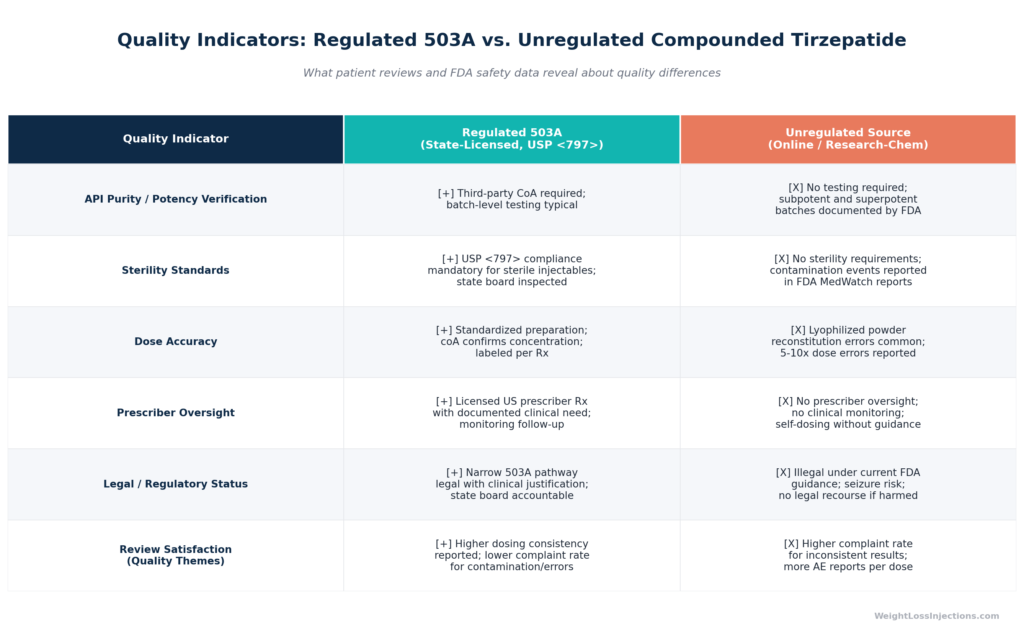
Community patterns during the compounded era reveal a consistent quality signal that maps closely onto objective regulatory characteristics:
Pharmacies earning positive reviews shared a cluster of identifiable features: they were typically PCAB-accredited or state-board-inspected, provided lot numbers and offered CoAs on request, employed or contracted licensed pharmacists who responded to adverse events, and proactively communicated with patients about legal changes. Critically, these were also the pharmacies most likely to have wound down their tirzepatide compounding programs in compliance with the March 2025 enforcement deadlines — or to have limited their practice to the narrow personalized-medicine exception with documented clinical justification.
Patient reports from this category consistently described: stable product, predictable side effect profiles, reliable supply, and professional customer service. When adverse events occurred, they were in the expected clinical range — nausea during titration, GI effects during dose increases — rather than the dramatic variability characteristic of potency inconsistencies.
Pharmacies earning negative reviews — or, more often, no further reviews at all after adverse events — were characterized by patterns that function as red flags in retrospect: product arrived without lot numbers, CoAs were unavailable or provided only in obviously generic formats, customer service became unresponsive after a reported adverse event, and patients noted dramatic inconsistency in side effects across refills. Some described products as “completely ineffective” with zero pharmacological signal across weeks of injections.
The overlay with FDA guidance on what constitutes a legitimate compounding operation is striking. The FDA’s compounding clarification page lists the same characteristics patients were independently identifying through their own negative experiences: no licensed pharmacy number, no valid prescription, no CoA documentation, international shipping origins.
Telehealth Platform Reviews: Convenience vs. Clinical Oversight
Telehealth platforms that connected patients to compounded tirzepatide varied as much in quality as the pharmacies themselves. Positive reviews clustered around platforms that featured:
- Actual licensed provider consultations (not just algorithmic questionnaires)
- Dosing guidance with structured titration protocols
- Monitoring check-ins and channels for reporting side effects
- Transparent communication about costs, legal status, and what to expect
Platforms that operated with minimal clinical oversight — “answer five questions, get your prescription” models — were associated with higher rates of reported adverse events in community posts. The likely explanation is inadequate dosing guidance and monitoring: patients who escalated too quickly, didn’t understand reconstitution, or had underlying contraindications that weren’t screened had no clinical guardrail. When problems occurred, there was no responsive system to catch them.
The Subscription Cliff: When Platforms Disappeared in 2025
One of the most distinctive negative review patterns from the 2025 transition period involves what might be called the “subscription cliff.” Patients on auto-ship compounded tirzepatide programs suddenly found their supply cut off in early-to-mid 2025 when pharmacies and telehealth platforms abruptly discontinued their programs following the March 2025 enforcement deadlines. Many received no advance notice, no support for transitioning to branded products, and no guidance on managing the physiological consequence of abrupt cessation.
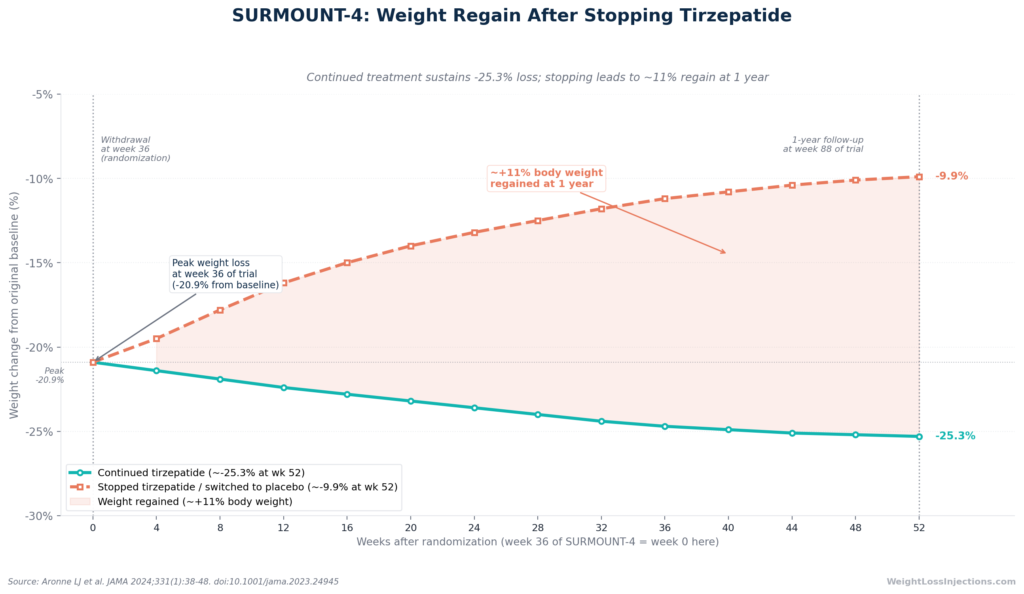
That consequence is documented precisely in clinical data. SURMOUNT-4 (published in JAMA 2024) enrolled patients after a 36-week lead-in producing mean −20.9% weight loss, then randomized them to continue tirzepatide or switch to placebo. The withdrawal group regained an average of 14.0% of body weight over the following 52 weeks and ended at just −9.9% net from baseline — meaning patients retained less than half their original loss. Only 16.6% of withdrawal patients maintained ≥80% of their weight loss, versus 89.5% in the continuation arm. (JAMA SURMOUNT-4 full text)
The forum and review-site documentation of rapid weight regain in early 2025 among cut-off patients maps directly onto this data. It was not a failure of willpower; it was a predictable neurobiological consequence of removing a drug that was actively suppressing an upward-directed appetite signal. Patients who were not warned, not helped to transition, and had nowhere to turn expressed their frustration in reviews of the platforms that abandoned them.
Our take at WeightLossInjections.com: The reviews that stand out — both positively and negatively — are almost always about platform behavior during the 2025 transition. A company that handled the March 2025 legal change transparently, communicated proactively with patients, and helped them move to a lawful option earned lasting trust. Those that disappeared or stopped responding earned the opposite. If you are evaluating any current provider for the narrow personalized exception pathway, that transition history is worth investigating. Platforms that treated the legal deadline as an inconvenience to their business model, rather than a clinical responsibility to their patients, have demonstrated exactly how they will prioritize your interests the next time a difficult decision arises.
Our Top 3 · September 2026
The best GLP-1 providers right now
Independently reviewed. Ranked by price, medication access, provider quality, and patient outcomes.
Renew GLP
Personalized GLP-1, GIP plans: Semaglutide & Tirzepatide.
Medvi
No membership or hidden fees. Everything you need is included.
Trimi
US-licensed clinicians and shipped to your door, from $99/mo.
When Compounded Tirzepatide Underperformed — Quality and Potency Complaints
The “it didn’t work” complaint in compounded tirzepatide reviews is one of the most important signals in the entire patient experience landscape, because it points directly to product quality failures rather than drug efficacy failures. StatPearls on tirzepatide establishes clearly that the molecule at therapeutic doses produces meaningful weight loss in the overwhelming majority of patients. When it appeared not to, quality was almost always the explanation.
The Pharmacy-Switch Resolution
A diagnostically powerful pattern in community posts: patients describing total non-response who switched pharmacies — particularly from a non-accredited to an accredited pharmacy — frequently reported dramatic improvement. The appetite suppression appeared. Nausea occurred for the first time. Weight loss began. The only variable that changed was the source of the compounded product.
This is not the outcome you would see if individual biology were the explanatory variable; you would expect it to predict outcomes at any source. But it is exactly the outcome you would predict if subpotent product was the cause, and if the new pharmacy was providing potency-verified product.
Salt Form Confusion and Why It Mattered
The API salt form issue deserves particular attention because it was widespread and non-obvious to most patients. The branded products — Mounjaro and Zepbound — use tirzepatide as a free base. When compounders used tirzepatide hydrochloride or acetate salt, the labeled dose in milligrams overstated the actual amount of active tirzepatide. A pharmacology student would recognize that 5 mg of tirzepatide hydrochloride contains fewer moles of tirzepatide than 5 mg of tirzepatide free base — the molecular weight difference is meaningful. A patient with no chemistry background reading “tirzepatide 5 mg/mL” on their vial would have no way to know they were receiving a fraction of the therapeutic dose. (FDA GLP-1 Compounding Clarification Page)
How to Evaluate Whether a Compounded Product Is/Was Working
For patients in 2024 trying to assess their compounded product — or for the rare patient on the current narrow 503A exception pathway — these are the signals that indicate pharmacological activity:
Positive signals (drug is active):
- Appetite suppression within 1–2 weeks of reaching a therapeutic dose (5 mg+)
- Reduced interest in between-meal snacking; smaller portions feel sufficient
- “Food noise” reduction — decreased intrusive food thoughts
- GI side effects (nausea, loose stools) during dose escalation — uncomfortable, but a confirmation of pharmacological activity
- Scale weight moving downward, however gradually, from week 4 onward at therapeutic doses
Warning signals (may indicate subpotent or inactive product):
- Complete absence of any appetite suppression after 4 weeks at 5 mg or higher
- No GI activity whatsoever at doses where virtually all patients in SURMOUNT trials experienced at least some nausea
- Stable or increasing weight after 8+ weeks at doses above 5 mg (in the absence of significant caloric compensation)
What to do if you suspect a quality issue: Contact the dispensing pharmacy and request lot documentation and a Certificate of Analysis from an accredited third-party lab. If you believe you received a substandard product, report the experience to FDA MedWatch and to your state pharmacy board. These reports are the data source that drives regulatory enforcement.
How to Evaluate Whether Tirzepatide Is Working — Signs, Metrics, and What to Track
Line chart illustrating SURMOUNT-4 weight trajectory: tirzepatide continuation (−25.3% at week 88) vs
For patients on tirzepatide — whether branded Zepbound or, in the narrow lawful context, compounded — understanding when and how to measure progress is essential both for setting realistic expectations and for troubleshooting if outcomes diverge from expectations.
Early Signs That Tirzepatide Is Pharmacologically Active (Weeks 1–4 at 2.5 mg)
The first four weeks at 2.5 mg are the tolerability phase, not the therapeutic phase. Per the FDA-approved titration schedule, 2.5 mg is a starting dose designed to minimize GI side effects during adaptation — it is not an approved maintenance dose, and it is not designed to produce peak weight loss. What you should begin to notice:
- Reduced appetite at meals; earlier satiety
- Decreased interest in snacking or between-meal eating
- First signs of “food noise” reduction — the background mental chatter about food beginning to quiet
- Possibly mild nausea after larger meals — this is a positive pharmacological signal
Realistic scale expectation at month 1: Approximately 1–3% body weight loss for most patients. For someone starting at 200 lbs, that is roughly 2–6 lbs. This reflects reduced caloric intake from the appetite effect, not the full therapeutic impact of the drug.
Measurable Progress at the Active Dose Range (Weeks 4–12 at 5–10 mg)
Once escalated to 5–10 mg, the weight loss signal strengthens considerably. SURMOUNT-1 showed approximately 4–6% cumulative body weight reduction by week 12 at 10 mg. For patients progressing through the titration schedule, the 3-month mark is typically where the experience shifts from “I think something is happening” to clearly visible progress.
At this stage, waist circumference changes often become noticeable before the scale fully reflects fat loss — visceral fat mobilization can change how clothes fit before the number moves dramatically. SURMOUNT-1 documented a mean waist circumference reduction of 19.4 cm at 72 weeks at 15 mg; the trajectory toward that figure begins in these early months.
Diabetic patients should also expect A1c reduction within 8–12 weeks at therapeutic doses — the dual GIP/GLP-1 mechanism drives insulin secretion improvements independent of weight loss.
When to Be Concerned: Signals That May Indicate a Problem
The following patterns at therapeutic doses — whether on compounded or branded tirzepatide — should prompt a conversation with the prescribing provider, not a self-directed dose escalation:
- No appetite suppression at any dose after 4 weeks at 5 mg or higher. The Fella Health tirzepatide side effects guide notes that some degree of appetite suppression is expected at doses of 5 mg+ in the overwhelming majority of pharmacologically appropriate candidates.
- No GI activity at all at doses where most patients experience at least mild nausea. Nausea rates at 10–15 mg in SURMOUNT trials were 25–30%; complete absence of this signal at those doses is atypical.
- Stable or increasing weight after 8+ weeks above 5 mg, in the absence of a clear caloric explanation.
If you are on compounded product and experiencing these signals, the first clinical question is whether the product is potent — not whether your dose needs escalation. Escalating a potentially superpotent batch because you mistakenly believe you are on a subpotent one carries serious risk of severe adverse events.
Tracking Recommendations
Systematic tracking during tirzepatide treatment generates the data needed to both recognize progress and troubleshoot problems:
- Weekly weigh-ins: Same time, same conditions (morning, after bathroom, before eating). Track trends over weeks, not daily fluctuations. Apps that apply a moving average (Happy Scale, Libra) reduce noise.
- Waist circumference: Measure weekly at the navel. Often moves before the scale.
- Appetite rating: A simple 1–10 daily log of subjective hunger level reveals the pharmacological effect clearly and serves as a quality signal.
- Side effect log: Record timing, severity, and character of any adverse events. Batch variability shows up in this data.
- Labs at baseline and 3 months: Fasting glucose, HbA1c (if diabetic), fasting lipids, TSH. These provide the metabolic picture the scale doesn’t.
Share this data with your provider at every monitoring visit. At WeightLossInjections.com, [service detail] — our monitoring model is designed to use this tracking data to identify issues early, adjust protocols, and support the clinical relationship that responsible tirzepatide prescribing requires.
The Current Legal Landscape: What Compounded Tirzepatide Reviews Mean for 2026 Patients
Understanding the reviews from the 2022–2025 era requires understanding why that era is over.
Tirzepatide first appeared on the FDA Drug Shortage List in December 2022, and that shortage designation is what permitted compounding pharmacies to legally compound it as an essentially-copy product. (FDA Declaratory Order, December 2024) The FDA determined the shortage was resolved in October 2024, and after legal challenges and grace period extensions, the final deadline for 503B outsourcing facilities expired March 19, 2025, and the 503A deadline had effectively closed March 10, 2025 after a federal court denied a preliminary injunction. (Alliance for Pharmacy Compounding)
As of June 2026, the legal framework is this:
What is not lawful: Any pharmacy dispensing tirzepatide as a mass-market, subscription-model product to patients without documented individualized clinical justification. This includes the auto-ship telehealth models that were prevalent in 2023–2024. (Harris Beach Murtha Cullina, June 2026)
What remains lawful (narrow 503A exception): A state-licensed 503A compounding pharmacy may compound tirzepatide for an individual patient if the prescriber documents a clinically significant difference for that specific patient — for example, a documented allergy to an inactive ingredient in the branded product (such as cresol, a preservative in the Zepbound KwikPen), or a documented need for a dose strength not commercially available. The pharmacy must compound no more than four such prescriptions per calendar month. (FDA GLP-1 Compounding Clarification Page, April 2026 update)
The FDA also proposed in April 2026 to formally exclude tirzepatide from the 503B Bulks List, further foreclosing the outsourcing-facility pathway. (FDA Press Announcement, April 30, 2026)
What this means for most patients in 2026: For patients who do not have a documented clinical justification for compounded tirzepatide, Zepbound via LillyDirect or commercial insurance is the appropriate pathway. Zepbound single-dose vials are available through LillyDirect starting at $299/month for lower doses; with commercial insurance and the Zepbound savings card, costs can be as low as $25/fill. (Healthy Meals Incentives, April 2026) These are meaningfully different from the $1,086 retail list price, and they represent a standardized, FDA-approved product with full lot traceability and quality assurance.
For patients who do have a documented clinical need that qualifies for the 503A exception, see our guide on how to verify a legitimate compounding pharmacy for the specific criteria a current 503A provider must meet. The checklist includes confirmed active pharmacy license, 503A classification, USP <797> compliance documentation, CoA from an accredited third-party lab, and a valid prescription with documented individualized clinical justification.
Our Take at WeightLossInjections.com
The compounded tirzepatide era produced a genuinely complicated record. At its best — which meant a licensed, accredited, inspected 503A pharmacy providing potency-verified product with real clinical oversight — compounded tirzepatide gave hundreds of thousands of patients access to a transformative medication during a period when branded supply genuinely could not meet demand. The reviews from that context, the ones describing 50, 60, 70 pounds lost and “food noise” gone for the first time in decades, reflect real outcomes from real people who accessed the real molecule.
At its worst — which meant overseas-sourced API, no pharmacy license, no CoA, no clinical oversight, and mass-market distribution dressed up as personalized medicine — compounded tirzepatide represented a patient safety failure. The “didn’t work” reviews from non-accredited sources, the severe adverse events in FDA MedWatch data, and the rapid weight regain when subscriptions were abruptly cut off: these are the other side of the ledger.
As the WeightLossInjections.com Staff frames it: “The reviews from the compounded era teach us that access and quality are not the same thing. Access to a vial that says ‘tirzepatide 5 mg’ is not the same as access to 5 mg of tirzepatide. For the patients who received the real molecule at the right dose from a responsible provider, the outcomes were genuinely impressive. For those who received substandard product, they were sometimes worse than useless — they delayed real treatment.”
For patients considering tirzepatide today:
- If you qualify for branded Zepbound through LillyDirect or insurance, that is the pathway with the strongest quality assurance, the most established clinical oversight infrastructure, and the lowest regulatory risk.
- If you have a specific documented clinical need that constitutes a clinically significant difference from the branded product — and your prescriber can document it — the narrow 503A pathway survives. Verify every element of that pharmacy’s credentials before accepting the first injection.
- If a platform is offering you compounded tirzepatide in 2026 without asking for your full medical history, without a real provider consultation, and without being able to explain exactly why your individual case justifies compounding over the branded product: that is a red flag, not a bargain.
At WeightLossInjections.com, [service detail] — our model connects patients with licensed providers who evaluate both branded and lawful compounded pathways based on individual clinical circumstances. We charge [$X/month] for [service detail], and we’re transparent about what the current legal landscape means for every option we discuss.
FAQ
Patients who used compounded tirzepatide from reputable, licensed 503A pharmacies with verified potency generally reported outcomes consistent with clinical trial data — significant appetite suppression within 1–2 weeks and progressive weight loss totaling 15–20% or more of body weight over 6–12 months at therapeutic doses, based on SURMOUNT-1 benchmarks. Patients who reported little or no effect were more often associated with non-accredited pharmacies where batch quality was not verified, consistent with documented subpotency issues in FDA adverse event reports. Both outcomes are part of the authentic patient record — and which category applies to a given patient almost always traces back to the quality of their source.
The most common explanations for compounded tirzepatide appearing ineffective are: (1) a subpotent batch containing less active drug than labeled, documented in FDA adverse event data; (2) reconstitution errors with lyophilized powder formulations that diluted the dose; (3) use of non-standard API salt forms (tirzepatide HCl or acetate) with different potency characteristics than the branded free base; or (4) an inadequate dose — staying at 2.5 mg without escalating produces minimal weight loss in most patients per SURMOUNT-1 dose-response data. Complete absence of any appetite suppression or GI activity at doses of 5 mg or above should prompt a conversation with the prescriber about product quality before increasing dose.
Mass-market compounded tirzepatide is not legally available as of March 2025. The FDA determined the tirzepatide shortage was resolved in December 2024, and enforcement deadlines for 503A and 503B facilities passed in March 2025. (Harris Beach Murtha Cullina, June 2026) A narrow 503A personalized-medicine exception remains for patients with documented clinical justification — such as a documented allergy to a branded product ingredient or a need for an unavailable dose strength — but the prescriber must document that specific individual clinical need, and the pharmacy is limited to ≤4 prescriptions per month. For most patients considering tirzepatide today, Zepbound via LillyDirect or commercial insurance is the lawful, quality-assured pathway.
When the compounded product is manufactured correctly at accurate potency, the side effect profile mirrors what SURMOUNT clinical trials documented for tirzepatide as a molecule — primarily GI effects (nausea, diarrhea, constipation) during dose escalation. As StatPearls and Dr. Oracle document, these are molecule-driven effects. Compounded products from non-inspected pharmacies showed additional risks that are not present with branded Zepbound: batch potency swings caused inconsistent side effect experiences across refills, injection site reactions were more common with certain compounded formulations, and a subset of patients experienced severe adverse events consistent with superpotent batches. The boxed warning risks — thyroid C-cell tumor risk, pancreatitis, gallbladder disease — apply to any pharmacologically active tirzepatide product regardless of source.
Many patients experienced abrupt treatment interruption in early 2025 when pharmacies and telehealth platforms stopped offering compounded tirzepatide following the March enforcement deadlines. The physiological consequence was predictable from SURMOUNT-4 data (JAMA 2024): patients who stopped tirzepatide after achieving significant weight loss regained an average of 14.0% of body weight over the following 52 weeks, with only 16.6% maintaining ≥80% of their weight loss — versus 89.5% on continued treatment. (JAMA SURMOUNT-4 full text) Patients who experienced abrupt cutoff and rapid weight regain should consult a provider about transitioning to Zepbound via LillyDirect or the Zepbound savings card program, which brings costs to as low as $25/fill with commercial insurance. (Healthy Meals Incentives, April 2026)
A legitimately operating 503A compounding pharmacy in 2026 will: (1) hold an active state pharmacy license verifiable through the dispensing state’s pharmacy board; (2) require a valid individual prescription with documented prescriber justification for why branded tirzepatide cannot meet this patient’s clinical need; (3) provide a Certificate of Analysis from an accredited third-party laboratory on request; (4) comply with USP <797> sterile compounding standards; and (5) be able to explain precisely which regulatory pathway permits their compounding and why your individual case qualifies. If a platform is offering you compounded tirzepatide without those elements — or at a bulk subscription price without individualized clinical assessment — the model almost certainly violates current FDA guidance. (FDA GLP-1 Compounding Clarification Page; Frier Levitt legal update)
This content is for informational purposes only and does not constitute medical advice. Consult a licensed healthcare provider. Individual weight loss results vary and are not guaranteed. [STATE-SPECIFIC DISCLAIMER]
WeightLossInjections.com editorial content is reviewed quarterly. Last medical review: June 2026.