After March 19, 2025, mass-market compounded tirzepatide became illegal. The internet is still full of offers that violate this rule.
A narrow 503A personalized-medicine exception survives: a state-licensed compounding pharmacy may dispense tirzepatide for an individual patient if the prescriber documents a specific, individualized clinical justification — such as a cresol allergy or a medically necessary non-standard dose — and the pharmacy compounds no more than four such prescriptions per calendar month.
503B outsourcing facilities have zero legal pathway to compound tirzepatide, regardless of the claimed justification.
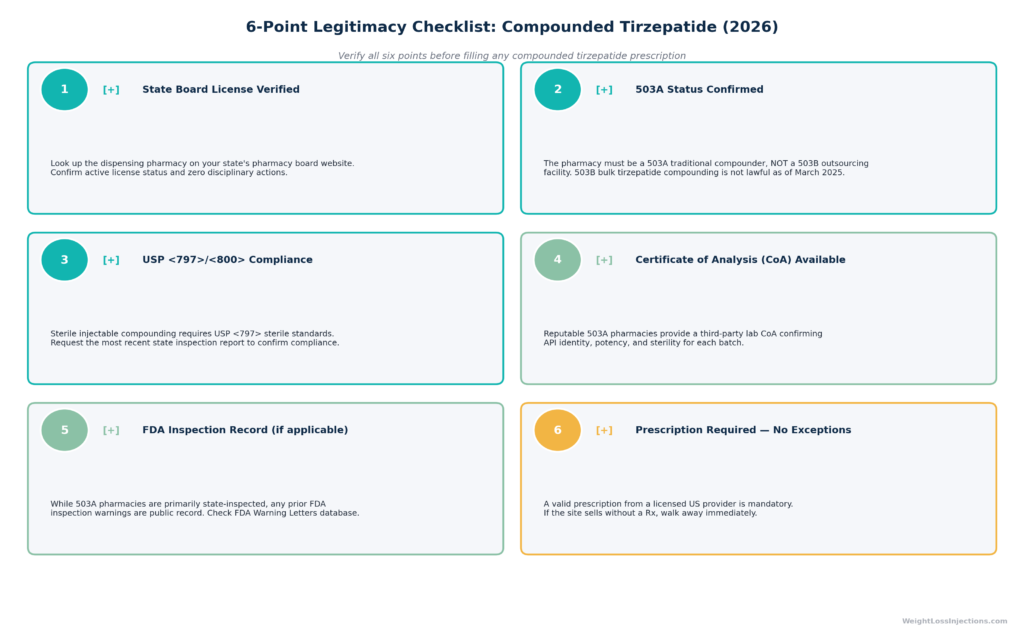
Verifying a pharmacy’s legitimacy requires six independent checks: state license status, PCAB/ACHC accreditation, USP \<797> compliance, third-party Certificate of Analysis, prescription documentation of clinical need, and confirmation that the pharmacy is not a 503B facility.
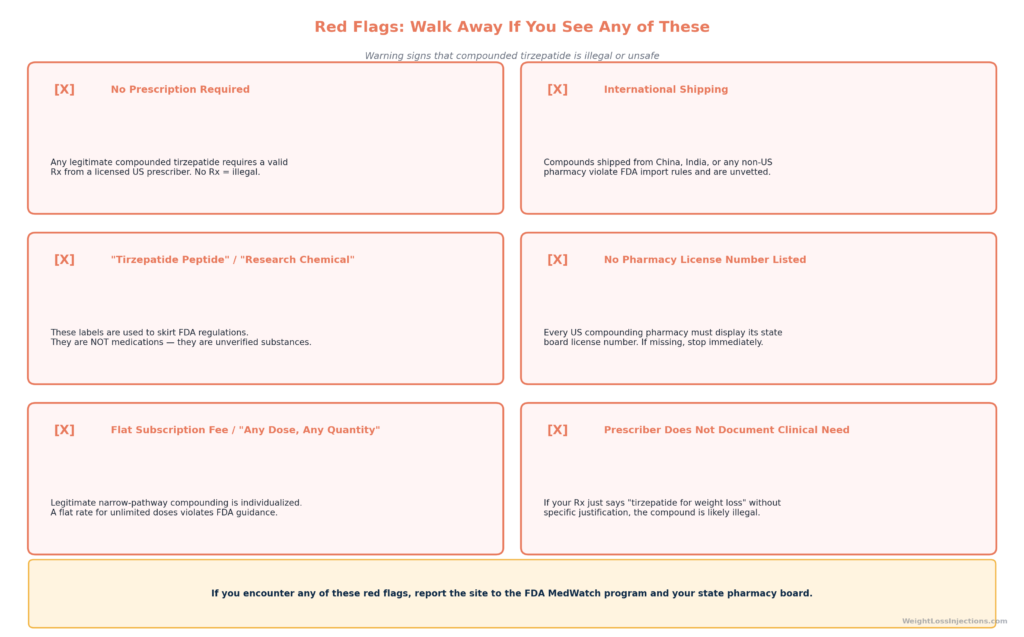
Red flags include no-prescription sales, international shipping, “peptide” or “research chemical” labeling, suspiciously low pricing, and inability to produce a lot-specific Certificate of Analysis.
This guide does not promote or facilitate access to illegal compounded tirzepatide sources. It is a consumer-protection resource for patients who may qualify for the narrow lawful exception — and for patients who want to recognize an illegal source before being harmed by one.
This content is for informational purposes only and does not constitute medical advice. Consult a licensed healthcare provider before starting or changing any medication.
The Legal Landscape in One Place: What Changed in 2025 and What Survives
If you’ve been searching online for compounded tirzepatide in 2026, you’ve already noticed that the search results look the same as they did two years ago: dozens of websites offering what appear to be affordable alternatives to branded Zepbound, at $200, $150, even less per month. What most of those websites don’t tell you — prominently, anyway — is that the legal landscape that made those products temporarily permissible no longer exists.
Here is the factual timeline.
Tirzepatide was first added to the FDA Drug Shortage List in December 2022 when demand surged following its initial approval and Eli Lilly’s manufacturing capacity could not keep pace. Under the Federal Food, Drug, and Cosmetic Act, that shortage status created a statutory window for compounding pharmacies to produce essentially-copy tirzepatide products — meaning products that are the same drug at the same or similar strength — without running afoul of the prohibition on compounding copies of commercially available drugs. Telehealth platforms and compounding pharmacies built entire business models around that window.
The window closed in sequence. On December 19, 2024, the FDA issued a declaratory order reaffirming that the tirzepatide shortage was resolved — that supply met or exceeded demand across the United States. An earlier October 2024 resolution had been remanded following industry litigation; the December order held. With the shortage resolved, the statutory basis for essentially-copy compounding disappeared. The FDA gave compounders a structured wind-down period:
February 18, 2025: The 503A window — for state-licensed traditional compounding pharmacies — closed. A federal court in the Northern District of Texas denied the Outsourcing Facilities Association’s request for a preliminary injunction on March 10, 2025, confirming the closure, per the Alliance for Pharmacy Compounding.
April 30, 2026: FDA proposed to formally exclude tirzepatide from the 503B Bulks List, finding no clinical need for outsourcing-facility bulk compounding, per the FDA’s April 30, 2026 press announcement. The comment period closes June 29, 2026.
What survives this timeline is narrow. Under long-standing 503A compounding law — separate from the shortage exception — a state-licensed pharmacy may compound a drug that is otherwise commercially available if the prescriber determines that the compounded product is necessary to meet the patient’s specific, individualized clinical need. Per the FDA’s April 2026 updated guidance, a 503A pharmacy may compound tirzepatide for an individual patient if: the prescriber documents a clinically significant difference between the compounded product and the branded alternative (for example, a documented allergy to cresol, the preservative in branded Zepbound injection devices, or a medically necessary dose strength not commercially available); and the pharmacy does not regularly or inordinately compound essentially-copy tirzepatide, with the FDA interpreting this as no more than approximately four such prescriptions per calendar month.
503B outsourcing facilities have no equivalent exception. Since they operate under a different section of federal law — one that requires compounded drugs to be made from substances on the 503B Bulks List or from drugs on the shortage list — and tirzepatide is on neither list, any 503B facility compounding tirzepatide is operating unlawfully, period. The Harris Beach Murtha regulatory summary from June 2026 confirms that enforcement actions under this framework are ongoing.
The practical result: “legitimate compounded tirzepatide” in 2026 is exceptionally rare. It exists only for patients with a genuine, documented individual clinical need, obtained from a 503A pharmacy that has independently verified its own compliance. Everything else that is being offered online — every bulk subscription, every flat-fee monthly program without individualized clinical evaluation, every product shipped from overseas — falls outside the law.
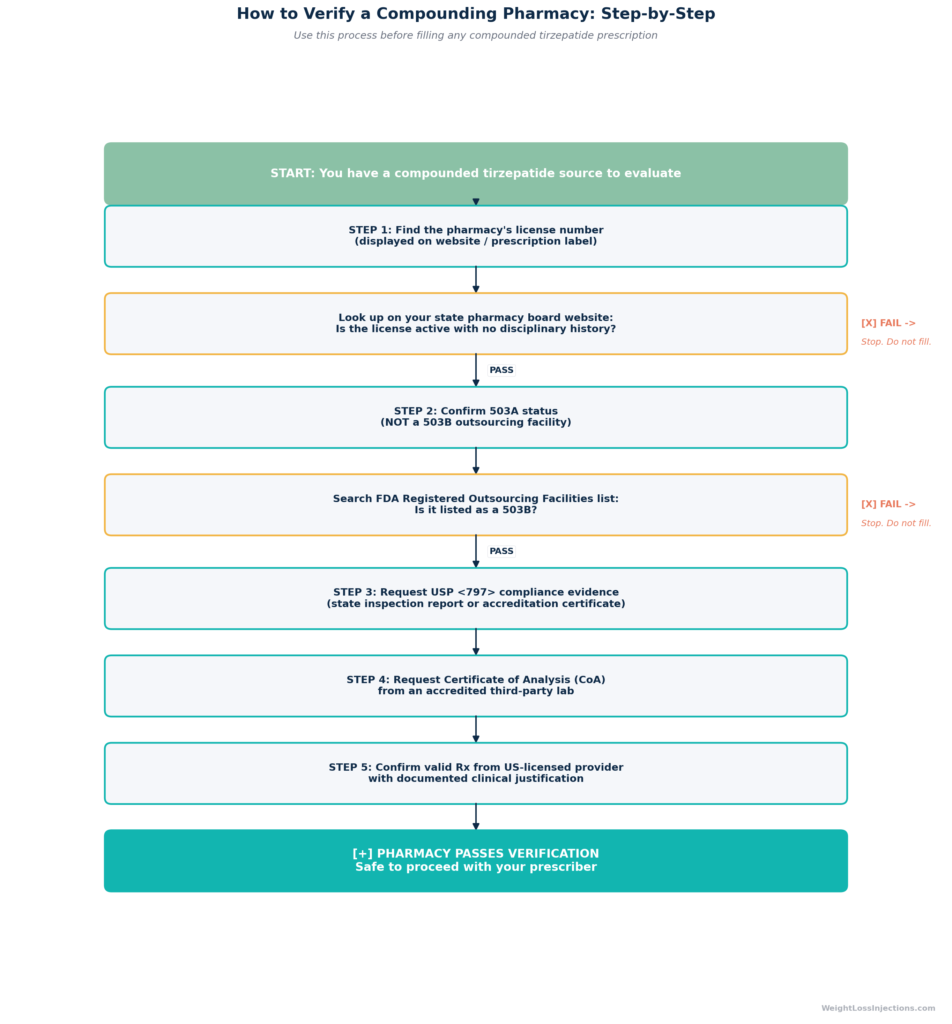
Step-by-Step: How to Verify a 503A Compounding Pharmacy’s Legitimacy
This section was developed in consultation with the WeightLossInjections.com Staff, and structured as a six-step verification process. It maps to the HowTo schema used in the article’s structured data. Complete every step before filling any compounded tirzepatide prescription.
Step 1 — Confirm the Pharmacy Is Licensed in Its Dispensing State
Every 503A compounding pharmacy must hold an active state pharmacy license in the state where it compounds. Most states also require an active non-resident pharmacy license in the patient’s state before they can ship a prescription across state lines. An inactive, expired, or suspended license is a categorical disqualifier — regardless of anything else the pharmacy tells you.
How to verify: Visit the National Association of Boards of Pharmacy (NABP) state board directory at nabp.pharmacy/boards-of-pharmacy/ to find your state’s pharmacy board website. Use its online license lookup tool — search by the pharmacy’s legal name and physical street address. Confirm “Active” status. Review any disciplinary actions on record; even resolved disciplinary history in a patient safety context is worth knowing about.
If a pharmacy cannot or will not provide its state license number — the specific number that lets you complete this lookup — treat that as an immediate red flag.
The Pharmacy Compounding Accreditation Board (PCAB) is the leading voluntary accreditation body for compounding pharmacies. PCAB-accredited pharmacies have undergone rigorous on-site assessment against compounding quality standards, including sterile technique, equipment calibration, personnel training, and beyond-use dating practices. The Accreditation Commission for Health Care (ACHC) offers a parallel accreditation program for compounding pharmacies that carries similar credibility.
PCAB accreditation is not legally required. A pharmacy can operate lawfully as a 503A compounder without it. But its presence is a meaningful quality signal because it means an independent third party has physically inspected the facility and confirmed it meets established compounding standards — inspection that the FDA does not routinely perform for 503A pharmacies (which are overseen primarily by state boards).
Step 3 — Confirm USP \<797> Compliance for Sterile Compounding
Tirzepatide is an injectable medication — administered subcutaneously once weekly. Any compounded tirzepatide product is a sterile injectable preparation. That classification requires the pharmacy to compound it under the conditions specified in USP \<797> (Pharmaceutical Compounding — Sterile Preparations), the nationally recognized standard for sterile compounding environments, equipment, personnel competency, and quality testing.
USP \<797> requires, among other things: a properly classified clean room or laminar airflow workbench; personnel garbing and aseptic technique validation; environmental monitoring for viable and nonviable particles; defined beyond-use dating based on sterility risk level; and sterility and endotoxin testing for high-risk preparations.
A patient receiving a sterile injectable from a 503A pharmacy that does not comply with USP \<797> is being exposed to contamination risks that can be serious — systemic infection, endotoxin-mediated sepsis, or product that is not what the label says.
How to verify: Ask the pharmacy directly: “Can you provide your most recent state board inspection report confirming USP \<797> compliance?” Reputable pharmacies will have this documentation. A pharmacy that deflects, refuses, or claims compliance without offering documentation should not be filling your injectable prescriptions.
Step 4 — Request a Lot-Specific Certificate of Analysis from an Accredited Third-Party Lab
A Certificate of Analysis (CoA) is a document issued by an independent, accredited analytical laboratory confirming that a specific production lot of a compounded product meets its labeled specifications. For compounded tirzepatide, a complete CoA should include:
API identity — confirmation that the active pharmaceutical ingredient is tirzepatide (not a different peptide or a substituted molecule)
Potency — confirmation that the labeled dose is within an acceptable variance range (typically ±10% of label claim)
Sterility — no microbial contamination (bacteria, fungi, yeast)
Endotoxin testing — bacterial endotoxins within FDA-specified limits for injectable preparations
Lab identification — the name and accreditation status of the third-party laboratory that performed the testing (not the pharmacy’s own internal QC)
The CoA matters because FDA adverse event reports have documented compounded tirzepatide batches that were subpotent — meaning the product contained far less tirzepatide than labeled, rendering it therapeutically useless — and superpotent batches, where the patient received significantly more than the intended dose, posing a genuine overdose risk, per Potere Health MD’s 2026 regulatory overview. Both failure modes have been documented from compounders whose quality controls were inadequate.
How to verify: Before your first fill, ask: “Can you provide a lot-specific Certificate of Analysis from an accredited third-party laboratory for the tirzepatide product you will be dispensing to me?” A reputable pharmacy will provide this without hesitation. A pharmacy that cannot produce a CoA, or that offers only internal quality documents rather than third-party testing, does not provide an adequate safety guarantee for an injectable medication.
Step 5 — Confirm Your Prescription Documents a Specific Clinical Need
This step is frequently overlooked by patients — and it is the one that determines whether the prescription is legally valid under current FDA guidance.
Per the FDA’s April 2026 clarification, a compounded tirzepatide prescription must include the prescriber’s determination of a specific, individualized clinical reason why the compounded product is necessary for that patient over the commercially available branded alternative. Acceptable documented justifications include:
A documented allergy or confirmed hypersensitivity to an inactive ingredient in branded Zepbound pens — such as cresol, the preservative used in the branded injection device — confirmed by clinical evaluation
A medically necessary dose strength not available in the current commercial product line (currently 2.5, 5, 7.5, 10, 12.5, and 15 mg autoinjector pens and single-dose vials)
A route of administration or formulation not available commercially, where there is a documented clinical need
What does not qualify as a sufficient clinical justification: cost, general preference for compounded products, or a desire to avoid the branded product without a specific clinical rationale. A prescription that cites only cost or preference as the reason for compounding does not meet the legal standard and does not protect the pharmacy or the prescriber — or the patient.
Ask your prescriber directly: “Does my prescription include a specific, documented clinical reason why the compounded version is necessary for me over branded Zepbound?” If the prescriber cannot answer this, or if the only answer is cost, the prescription does not meet current FDA requirements.
Step 6 — Confirm the Pharmacy Is NOT a 503B Outsourcing Facility
This step is quick but non-negotiable. 503B outsourcing facilities — which are FDA-registered and may compound drugs in bulk without patient-specific prescriptions — have zero legal pathway to compound tirzepatide as of March 19, 2025. If the pharmacy you are considering is a 503B facility, you should not fill a compounded tirzepatide prescription there, regardless of what the pharmacy or any associated telehealth platform tells you.
Some operations blur the line between 503A and 503B — maintaining both a 503A pharmacy license and a 503B registration — or operate as 503B facilities under a different name than they market to patients. Verify by facility name and address, not just the branded trade name the company uses in its patient-facing communications.
Our take at WeightLossInjections.com: These six steps are non-negotiable consumer protections for anyone considering compounded tirzepatide in 2026. A pharmacy that resists any of them — particularly Steps 4 and 6 — should not be trusted with an injectable medication that goes directly into your body. the WeightLossInjections.com Staff recommends every patient use this checklist before filling any compounded tirzepatide prescription, without exception.
Compounded Tirzepatide: Red Flags vs. Green Flags
Red Flags: Signs a Source Is Illegal or Unsafe
In a post-enforcement landscape, the supply of illegal compounded tirzepatide has not disappeared — it has gone underground, rebranded, or shifted its language while continuing the same practices. Here is what to watch for.
No prescription required. This is the clearest and most unambiguous indicator of an illegal operation. No compounding pharmacy — 503A or 503B — may dispense tirzepatide without a valid prescription from a licensed U.S. physician, nurse practitioner, or physician assistant. Any website, telehealth platform, or vendor that offers tirzepatide for purchase without routing through a prescription-issuing licensed provider is operating unlawfully, full stop. The product may arrive in a vial labeled “tirzepatide,” but it has not been compounded under any lawful regulatory framework.
“Research chemical” or “peptide” labeling. Legitimate 503A compounding pharmacies are licensed pharmaceutical businesses. They do not label prescription medications as “research chemicals,” “peptide compounds,” or “not for human use.” These labels are used by suppliers — primarily overseas chemical manufacturers — to circumvent FDA prescription requirements and evade customs scrutiny. Tirzepatide marketed as a “research peptide” has not been produced under USP \<797> sterile compounding conditions, has not been tested by an accredited lab, and is not subject to any pharmaceutical quality standard. The FDA has explicitly stated that peptide research chemical suppliers are not operating within any lawful pharmaceutical framework, per the FDA Warning Letters database.
International or overseas shipment. Products shipped from China, India, Mexico, or any non-U.S. manufacturer are not subject to FDA oversight and cannot be verified for potency, sterility, API authenticity, or freedom from contamination. Using overseas-sourced tirzepatide is not only illegal — it bypasses every quality safeguard that a legitimate compounding pharmacy is required to maintain. There is no mechanism by which a U.S. patient can verify the identity or purity of a pharmaceutical product manufactured in an unregistered overseas facility.
503B facility offering compounded tirzepatide. As discussed in Step 6 above, any outsourcing facility offering compounded tirzepatide is categorically operating unlawfully since March 19, 2025, per the FDA GLP-1 compounding clarification page. Some of these facilities have attempted to continue operations by claiming a different legal basis; the FDA’s April 30, 2026 proposed formal exclusion from the 503B Bulks List forecloses any such argument going forward.
“Any dose, any quantity” flat subscription pricing. A business model that offers tirzepatide in any dose to any patient who pays a monthly subscription fee — without an individualized clinical assessment and without a documented clinical justification for compounding — does not meet the ≤4 Rx/month personalized-medicine exception. The exception exists for genuinely individualized patients. It does not exist as a business model for operating a mass-market compounding subscription service under a different name.
No Certificate of Analysis available. A compounding pharmacy that cannot or will not provide a lot-specific CoA from an independent, accredited laboratory is operating without adequate quality oversight. This is a patient-safety concern independent of legality. As documented in FDA adverse event reports cited by Potere Health MD’s 2026 overview, batches from non-inspected compounders have been both subpotent (ineffective treatment) and superpotent (potentially dangerous dosing error). You have no way to know which you are receiving without a CoA.
Suspiciously low pricing. For context: legitimate 503A compounded tirzepatide for a genuine personalized-medicine patient runs approximately $150–$600/month when produced by a compliant pharmacy that conducts proper quality testing, per Healthy Meals Incentives’ 2026 tirzepatide cost analysis. Products offered far below this floor are either cutting corners on quality testing, sourcing API from unverified overseas suppliers, or both. Branded Zepbound through LillyDirect’s self-pay pathway starts at $299/month for 2.5 mg, with higher doses at $449/month. Any compounded product priced at a significant discount to these figures warrants serious scrutiny.
Vague or unverifiable pharmacy identity. A legitimate compounding pharmacy has a state license number, a physical address, and a verifiable presence in the relevant state pharmacy board database. A vendor that provides only a website, a PO box, or general contact information — with no state-specific pharmacy license number — is not a legitimate compounding pharmacy. Period.
Tirzepatide + B12 or “booster” combination formulations marketed as superior. The FDA has specifically noted that combination products — such as tirzepatide combined with cyanocobalamin (vitamin B12) or other additives — with strengths within 10% of commercially available Zepbound strengths are considered “essentially copies” and generally do not qualify for the 503A exception without specific, individualized clinical documentation, per the FDA’s April 2026 guidance. Platforms marketing B12-combination tirzepatide as a premium or enhanced product are typically doing so to create the appearance of clinical differentiation where none substantive exists. There is also no published clinical evidence supporting the addition of B12 to tirzepatide as a therapeutic benefit.
FDA or FTC warning letter history. Before engaging with any pharmacy or telehealth platform offering compounded tirzepatide, search the FDA Warning Letters database for the company name. Also search the FTC’s action and enforcement page at ftc.gov/enforcement for the platform name. The FDA issued multiple warning letters to non-compliant compounders following the March 2025 enforcement deadline; FTC issued coordinated letters to telehealth platforms marketing compounded GLP-1s without adequate disclosure. A warning letter is not automatically disqualifying — context matters — but it is information every patient deserves to have before filling a prescription.
Telehealth Platforms That Work With Licensed Compounders — What a Compliant Model Looks Like
Not every telehealth platform that offers compounded tirzepatide is operating illegally — though the vast majority are. A narrow category of platforms serve the genuine personalized-medicine population: patients with a documented cresol allergy, patients requiring a specific non-standard dose, or patients with another individualized clinical need confirmed by a licensed provider. Identifying a compliant platform from an illegal one requires asking specific questions.
The Elements of a Compliant 503A Telehealth Model
A telehealth platform operating within the narrow lawful exception has five observable characteristics:
1. Full individualized clinical evaluation. The platform requires a synchronous (live video) or thorough asynchronous consultation that specifically evaluates whether the patient has a documented clinical justification for compounding — not just weight-loss eligibility. The evaluation should assess allergy history, current medications, and the specific clinical reason the compounded product is necessary over branded Zepbound.
2. Prescription documenting the specific clinical need. The prescription sent to the compounding pharmacy must explicitly state the individualized clinical reason for compounding — for example, “Patient has documented hypersensitivity to cresol preservative in branded tirzepatide injection devices” or “Patient requires intermediate dose of X mg not available in commercial formulation per prescriber determination.” A prescription that states only “patient preference for compounded formulation” or “cost” is not compliant.
3. A named, verifiable, state-licensed 503A pharmacy. The platform dispenses through a specific named compounding pharmacy — one the patient can independently verify through the state board lookup described in Step 1. Not a “partner network.” Not a “licensed compounding pharmacy.” A specific pharmacy with a specific license number in a specific state.
4. Patient can independently verify the dispensing pharmacy. A compliant platform is transparent about who is compounding the product. If a platform cannot or will not name the specific dispensing pharmacy, that opacity is itself a warning sign.
5. The platform does not broadly market compounded tirzepatide as a cost alternative for the general patient population. A compliant platform’s compounded tirzepatide program is narrow by design — it serves patients with specific documented clinical needs, not any patient who wants a cheaper alternative to Zepbound.
Questions to Ask a Telehealth Platform Before Enrolling
If you believe you may have a genuine clinical justification for compounded tirzepatide and are evaluating a telehealth platform, ask these questions before providing payment or personal health information:
“Which specific pharmacy — name and state license number — dispenses the compounded tirzepatide?”
“Will my prescription include a specific, documented clinical reason for the compounded product over branded Zepbound?”
“Can I receive a lot-specific Certificate of Analysis from an accredited third-party laboratory for each lot dispensed to me?”
“How many compounded tirzepatide prescriptions does your partnered pharmacy fill per month?” (Anything substantially above four should prompt follow-up questions about legal compliance.)
“Is your pharmacy partner a 503A or 503B facility?” (If 503B, stop.)
A platform that cannot or will not answer these questions clearly is not operating transparently. A platform that answers them well — with verifiable information — may be one of the narrow compliant operators. Verify independently regardless.
WeightLossInjections.com service note: [service detail] — insert description of our platform’s compliance approach, pharmacy partnerships, individualized clinical consultation model, and state availability.
Our take at WeightLossInjections.com: We built our service model around exactly these compliance requirements. Every patient who accesses compounded tirzepatide through WeightLossInjections.com has a documented clinical justification on file, dispensed through a named state-licensed 503A pharmacy that provides lot-specific Certificates of Analysis. We do not operate a general weight-loss subscription for compounded tirzepatide — because that model is not legal in 2026, and because patients deserve better than a product they cannot verify. [service detail]
503A legitimate use case flow diagram — annotated boxes showing valid clinical scenarios (cresol allergy; non-standard dose; route unavailable) vs When Is Compounded Tirzepatide Legal? 503A Exception Scenarios 2026
Our Top 3 · October 2026
The best GLP-1 providers right now
Independently reviewed. Ranked by price, medication access, provider quality, and patient outcomes.
Patient Safety Vignettes: Why Verification Matters in Practice
Consider two patient scenarios that illustrate why this checklist exists.
Patient A — a 44-year-old woman who signed up for a telehealth platform offering compounded tirzepatide at $189/month — reported that her weight loss stalled after six weeks despite strict dietary adherence. She requested a Certificate of Analysis from her pharmacy. The pharmacy told her it did not provide CoAs. After switching to branded Zepbound through LillyDirect at $399/month for the 5 mg dose, she experienced clear response within three weeks. The most likely explanation: her original compounded product was subpotent — a failure mode documented in FDA adverse event reports from non-inspected compounders, per Potere Health MD’s 2026 overview. Six weeks of exposure to an ineffective product is six weeks of forgone treatment benefit, and in her case, a $189 monthly expenditure on something that likely contained less tirzepatide than its label stated.
Patient B — a 58-year-old man — received what was sold as 5 mg/week compounded tirzepatide and experienced severe nausea, vomiting, and tachycardia after his first injection. His emergency department workup was consistent with GLP-1 hyperstimulation at a dose substantially above the labeled amount. The product he received was likely from a batch that was superpotent — again, a documented failure mode from non-inspected compounders. Had he requested and received a CoA before filling, the potency deviation would have been identified before it entered his body.
These scenarios are illustrative representations of documented adverse event patterns, not identified individuals. They reflect the real-world consequence of filling compounded injectable prescriptions without verification.
Before You Fill: A Full Patient Safety Checklist for Compounded Tirzepatide Prescriptions
Use this checklist as a printable or saveable reference before filling any compounded tirzepatide prescription. Every “No” answer is a reason to pause — and most are reasons to walk away.
Is the pharmacy PCAB-accredited or ACHC-accredited? Check pcab.org or the ACHC directory. ☐ Yes / ☐ No / ☐ Not required but check anyway
Is the pharmacy a 503A (traditional) or 503B (outsourcing facility)? If 503B, do not fill. Check the FDA Registered Outsourcing Facilities database. ☐ 503A (proceed) / ☐ 503B (stop) / ☐ Not verified
Can the pharmacy provide a lot-specific Certificate of Analysis from an accredited third-party lab? Ask before your first fill. ☐ Yes / ☐ No — do not fill
Can the pharmacy provide documentation of USP \<797> compliance for sterile compounding? Ask for the most recent state inspection report. ☐ Yes / ☐ No — serious red flag
Does the pharmacy ship from within the United States? If international, do not fill. ☐ Yes / ☐ No — do not fill
Does the pharmacy provide a specific pharmacy name, license number, and physical address? ☐ Yes / ☐ No — do not fill
About the prescription:
Does my prescription document a specific, individualized clinical reason for compounding over branded Zepbound? Ask your prescriber. If the only reason is cost or preference, the prescription is not compliant. ☐ Yes / ☐ No — prescription is not legally compliant
Is the reason for compounding documented on the prescription itself — not just conveyed verbally? ☐ Yes / ☐ No — ask prescriber to amend
About the product:
What does the product label say? A legitimate compounded injectable label should include: drug name (tirzepatide), dose strength, lot number, beyond-use date, pharmacy name, prescriber name, and patient name. It should NOT say “research chemical,” “peptide,” or “not for human use.” ☐ Label is appropriate / ☐ Label raises concerns — do not use
Is there a clear ongoing clinical consultation and monitoring process? Dose titration and adverse effect management require follow-up care. ☐ Yes / ☐ No — incomplete care model
Sample Certificate of Analysis annotated mockup — sections labeled with API identity, potency with acceptable variance range, sterility result, endotoxin result, third-party lab name, lot number,… Sample Certificate of Analysis for Compounded Tirzepatide: What to Look For
Branded Alternatives Worth Knowing About
Understanding the landscape of legitimate access options is essential for any patient navigating this decision. If a patient cannot meet the ≤4 Rx/month 503A exception — because they do not have a documented clinical justification that survives scrutiny — the relevant question is not “where can I find cheaper compounded tirzepatide anyway?” It is: “what are my legitimate options for accessing tirzepatide?”
Branded Zepbound through LillyDirect’s Self Pay Journey Program starts at $299/month for the 2.5 mg dose and $449/month for all doses above 5 mg, per the Healthy Meals Incentives 2026 tirzepatide cost guide. These are FDA-manufactured, FDA-approved vials with complete lot traceability. For patients with commercial insurance, the Zepbound savings card brings co-pays as low as $25/month for covered patients.
These prices are higher than what many compounded tirzepatide operations were charging during the shortage — but the product is verifiable, legally obtained, and manufactured to CGMP standards with full lot testing. For patients whose cost concern is genuine and significant, the right pathway is prior authorization support and insurance advocacy, not a potentially unsafe illegal source. For a detailed comparison, see Compounded Tirzepatide vs. Zepbound: Which Is Right for You?.
Our Take at WeightLossInjections.com
The post-enforcement compounded tirzepatide landscape in 2026 presents patients with a genuine information asymmetry problem. The illegal market looks almost identical to the legal one, at least superficially. Both involve telehealth consultations and pharmacy shipments. Both arrive in vials with labels. The critical differences — pharmacy license status, CoA availability, prescription documentation, 503A vs. 503B classification — are not things a patient would know to check without guidance.
This article exists to close that information gap.
The narrow lawful 503A exception is real, and we take it seriously. There are patients — documented cresol allergy, genuinely necessary non-standard dose — for whom compounded tirzepatide through a properly verified 503A pharmacy is a legitimate clinical option. Those patients deserve accurate information about how to access that option safely.
There are also far more patients who have been told they qualify for this exception when they do not — patients whose “documented clinical need” amounts to a prescriber checking a box rather than conducting a genuine evaluation, whose pharmacy has never provided a CoA, whose product has arrived from a facility that is not verifiable through any state board lookup. Those patients are not receiving compounded tirzepatide through a legal pathway. They are receiving an unverified product from an illegal source, and they deserve to know that.
the WeightLossInjections.com Staff has reviewed this checklist and these verification standards. Our recommendation is unambiguous: do not fill a compounded tirzepatide prescription without completing all six verification steps. And if the source you are considering fails any of those steps, the appropriate response is to stop — not to rationalize around the failure.
A Certificate of Analysis (CoA) is a document from an independent, accredited laboratory confirming that a specific production lot of a compounded medication contains the correct active ingredient, at the labeled potency, and is sterile and free of bacterial endotoxins. It matters for compounded tirzepatide specifically because FDA adverse event reports — cited in the FDA’s GLP-1 compounding clarification page and documented in independent clinical overviews — have documented batches that were subpotent (not therapeutically effective) and superpotent (potentially delivering a dose many times the label claim). Without a lot-specific CoA from a third-party accredited lab, you have no evidence that what is in the vial matches what is on the label. For an injectable medication administered weekly, that uncertainty carries real clinical stakes.
Potentially, yes — but the allergy must be genuine and clinically documented, not simply stated. Cresol (m-cresol) is a preservative used in branded Zepbound injection devices. A documented allergy or confirmed hypersensitivity to cresol — assessed by your physician through allergy history, testing if appropriate, and documented specifically in the prescription — is one of the recognized clinical justifications for the 503A personalized-medicine exception, per the FDA’s GLP-1 compounding clarification. A stated preference for cresol-free formulations, or a general preference for compounded medications, does not qualify. This determination requires a genuine clinical evaluation by a licensed provider, not a checkbox on a telehealth intake form. Consult your prescriber for evaluation. For the full legal framework, see 503A vs. 503B Compounding Pharmacies: Plain-Language Guide.
Stop using the product and consult your healthcare provider. If you experienced any adverse effects — including unexpected symptoms, inadequate response suggesting subpotency, or symptoms of overdose — report them to the FDA MedWatch program at fda.gov/safety/medwatch. Your provider can help you transition to a legal pathway: branded Zepbound via LillyDirect at $299–$449/month self-pay, or via insurance coverage if your plan covers anti-obesity medications. If you have a genuine documented clinical need that may qualify for the narrow 503A exception, your provider can initiate a proper evaluation and prescription documentation. Do not attempt to continue using an unverified illegal source while investigating alternatives.
A 503A traditional compounding pharmacy is a state-licensed pharmacy that compounds patient-specific prescriptions under state board oversight. It may compound tirzepatide only for an individual patient with a documented, individualized clinical need, in amounts that do not constitute regular or inordinate essentially-copy compounding (interpreted as approximately ≤4 prescriptions per month). A 503B outsourcing facility is FDA-registered, may compound without patient-specific prescriptions for office stock distribution, and must comply with CGMP — but may only compound using substances on the FDA’s 503B Bulks List or drugs on the shortage list. Tirzepatide is on neither list. 503B compounding of tirzepatide is prohibited without exception as of March 19, 2025, per the FDA GLP-1 compounding clarification page and the FDA’s April 30, 2026 proposed formal exclusion.
This article is for informational purposes only and does not constitute medical advice. All regulatory information reflects verified primary sources as of June 2026; regulatory positions and enforcement may evolve. WeightLossInjections.com editorial team reviews content quarterly; last verified June 2026. Consult a licensed healthcare provider before starting or changing any medication.

![Unbranded [pillar-drug-class] injection pen on a neutral background — WeightLossInjections.com editorial hero](https://weightlossinjections.com/wp-content/uploads/2026/07/hero_tirzepatide_c3_safety-1200x675.png)