![Unbranded [pillar-drug-class] injection pen on a neutral background — WeightLossInjections.com editorial hero](https://weightlossinjections.com/wp-content/uploads/2026/07/hero_tirzepatide_c3_safety-1200x675.png)
This content is for informational purposes only and does not constitute medical advice. Consult a licensed healthcare provider before starting or changing any medication.
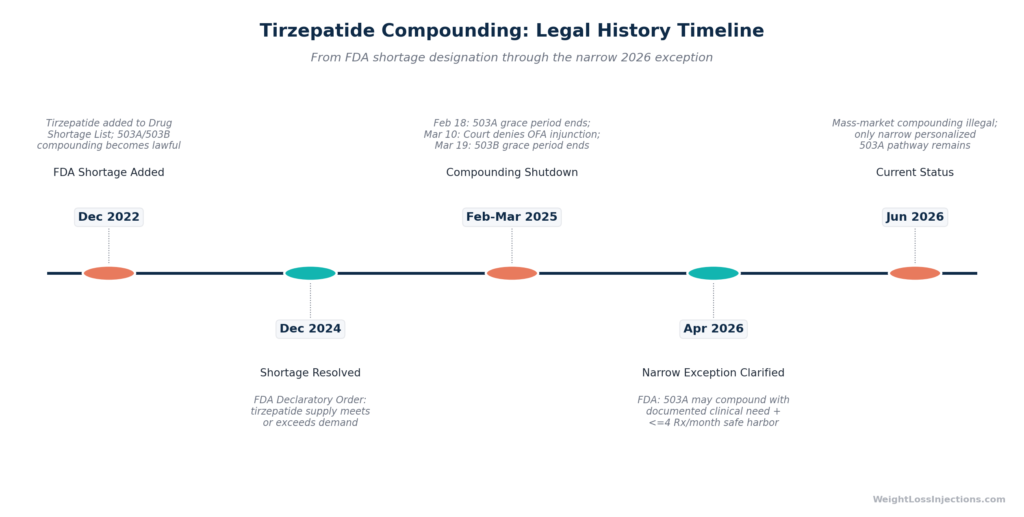
Horizontal Gantt-style regulatory timeline chart showing key FDA tirzepatide compounding milestones from December 2022 (shortage begins) through April 2026 (FDA clarification and 503B exclusion…
- A narrow legal pathway for compounded tirzepatide still exists in 2026 — but it applies to very few patients and is nothing like the broad, affordable market that existed in 2023–2024.
- The FDA removed tirzepatide from its drug shortage list on December 19, 2024, which ended the legal basis for mass-market compounding. (FDA Declaratory Order, Dec 19, 2024 — PDF)
- 503A compounding pharmacies (traditional, state-licensed) had until February 18, 2025 to wind down. A federal court denied the industry’s last injunction attempt on March 10, 2025. (Alliance for Pharmacy Compounding — a4pc.org)
- 503B outsourcing facilities lost all authority to compound tirzepatide on March 19, 2025 — with no exceptions remaining whatsoever. (FDA GLP-1 Compounding Clarification Page)
- The sole surviving legal pathway: a 503A pharmacy may compound tirzepatide for an individual patient if a licensed prescriber documents a clinically significant difference on the Rx — such as a cresol allergy or an intermediate dose not commercially available — and the pharmacy fills ≤4 prescriptions per calendar month of that essentially-copy formulation. (FDA GLP-1 Compounding Clarification Page — April 1, 2026 update)
- “It’s cheaper” and “I prefer vials” are not qualifying clinical reasons — they never were.
- On April 30, 2026, the FDA proposed formally excluding tirzepatide from the 503B Bulks List, cementing the prohibition for outsourcing facilities permanently. (FDA Press Announcement, April 30, 2026)
- Affordable legal alternatives exist: Eli Lilly’s LillyDirect self-pay program offers Zepbound vials starting at $299/month for the 2.5 mg starting dose. (Healthy Meals Incentives — Tirzepatide cost 2026)
Introduction: You’ve Heard Compounded Tirzepatide Is Illegal; But It’s Still Being Offered Online. What’s Actually True?
If you’ve spent any time searching for tirzepatide options in 2026, you’ve probably encountered two contradictory signals: articles telling you that compounded tirzepatide was banned in early 2025, and telehealth platforms that still appear to be offering it. The confusion is real, and it’s costing patients money — and in some cases, their health.
Here is the direct answer: mass-market compounded tirzepatide is not legal in 2026. The window that allowed compounders to produce and sell it widely — the FDA’s drug shortage exemption — closed on December 19, 2024, when the FDA formally declared the tirzepatide shortage resolved. (FDA Declaratory Order — PDF) Enforcement grace periods for pharmacies ended in February and March 2025. Any platform offering compounded tirzepatide to the general patient population after those dates is not operating within current FDA guidance.
A narrow exception does survive, and understanding it precisely is the purpose of this article. A state-licensed 503A compounding pharmacy can still fill a tirzepatide prescription in 2026, but only under very specific conditions tied to a documented, individual clinical need. The ≤4 prescriptions-per-month cap on the pharmacy side means this pathway is designed for genuine edge cases, not a population-level alternative to branded Zepbound.
The editorial team at WeightLossInjections.com has reviewed all FDA guidance documents, court filings, the April 2026 FDA clarification update, and legal analyses from specialist pharmacy law firms to bring you the most accurate current picture. What follows is a complete walkthrough of how the legal landscape changed, what survives in 2026, what is definitively illegal, and what your actual affordable options are as a patient trying to navigate this space.
What the FDA Actually Said: The December 2024 Shortage Resolution Explained
To understand why compounded tirzepatide is no longer broadly legal, you need to understand the mechanism that made it legal in the first place: the FDA drug shortage exemption.
How the Shortage Exemption Worked
Under the Federal Food, Drug, and Cosmetic Act (FDCA), compounding pharmacies are normally prohibited from producing drugs that are “essentially copies” of commercially available FDA-approved products. The logic is straightforward: if Eli Lilly makes an FDA-inspected, clinically validated tirzepatide product, a pharmacy shouldn’t be able to replicate it in bulk without the same regulatory scrutiny.
But the law contains an important exception: when a drug appears on the FDA’s official Drug Shortage List, both 503A compounding pharmacies and 503B outsourcing facilities gain temporary authority to compound that drug, even if it results in an essentially-copy product. The shortage exemption is meant as a bridge: when patients genuinely cannot access a drug through normal channels, allowing compounders to fill the gap serves the public interest.
Tirzepatide was added to the FDA Drug Shortage List on December 15, 2022, shortly after Mounjaro’s explosive post-approval launch. (FDA Declaratory Order, Dec 19, 2024 — PDF) Demand from patients with type 2 diabetes and, later, the weight management population, outpaced Eli Lilly’s manufacturing capacity. The shortage was genuine. The legal compounding market that emerged from 2022 through 2024, which brought tirzepatide to hundreds of thousands of patients at a fraction of the branded price, was a direct consequence of that shortage listing.
The October and December 2024 Determinations
Lilly spent 2024 aggressively expanding its manufacturing capacity. By early fall, the supply picture had fundamentally changed. On October 2, 2024, the FDA made its first formal determination that the tirzepatide shortage had been resolved — meaning supply now met or exceeded demand. (FDA GLP-1 Compounding Clarification Page) Under the exemption’s terms, compounding authority based on shortage status would end with that determination.
The compounding industry responded immediately. On October 8, 2024, the Outsourcing Facilities Association (OFA) filed suit in federal court (Outsourcing Facilities Association v. FDA, No. 4:24-cv-953, N.D. Tex.), arguing the FDA’s shortage determination was premature. The FDA agreed to reconsider, temporarily pausing the enforcement timeline. (Frier Levitt — Tirzepatide shortage/compounding legal update)
That reconsideration did not change the outcome. On December 19, 2024, the FDA issued a formal Declaratory Order reaffirming its prior determination: the tirzepatide shortage was resolved. Supply met or exceeded demand across the national distribution system. (FDA Declaratory Order — PDF) The shortage-exemption basis for compounding tirzepatide was gone.
The December 2024 ruling was upheld despite continued litigation. The shortage list removal is the precise legal trigger that ended the authority for mass-market tirzepatide compounding. Without an active shortage listing, the exemption that had allowed compounders to produce essentially-copy tirzepatide since 2022 no longer applied.
Our take at WeightLossInjections.com: The December 2024 ruling wasn’t a surprise to anyone watching the supply chain closely — Lilly had been expanding capacity aggressively throughout 2024, and multiple distribution channels confirmed product was available. What caught patients off guard was the speed of enforcement that followed. If you were using compounded tirzepatide through a telehealth platform and suddenly found your supply cut off in early 2025, this timeline explains why. The shortage was genuinely resolved. The compounding that depended on it was genuinely over.
The Shutdown Deadlines — 503A (February 2025) and 503B (March 2025)
The December 2024 Declaratory Order didn’t immediately shut off all compounding. Recognizing that patients mid-treatment needed transition time, the FDA set grace-period deadlines before enforcement discretion ended. Those deadlines have now passed.
The Two Regulatory Categories
To understand the shutdown, you need to understand the two types of facilities involved:
503A compounding pharmacies are traditional state-licensed pharmacies that compound patient-specific prescriptions for individual patients. They operate primarily under state pharmacy board oversight, though they must comply with certain federal standards. They were the backbone of the direct-to-patient compounded tirzepatide market that emerged in 2022.
503B outsourcing facilities are federally registered, FDA-inspected facilities that can compound without a patient-specific prescription for “office stock” distribution. They operate under Current Good Manufacturing Practice (CGMP) requirements — the same manufacturing standards that apply to pharmaceutical companies. They served the wholesale side of the compounded GLP-1 market, supplying product to clinics and telehealth platforms in bulk.
What the Deadlines Mean
Following the December 2024 Declaratory Order:
- 503A (state-licensed compounding pharmacies): Enforcement discretion ended February 18, 2025. After this date, pharmacies that continued producing essentially-copy tirzepatide were subject to FDA warning letters, state pharmacy board enforcement actions, and potential criminal liability. (FDA GLP-1 Compounding Clarification Page)
- 503B (outsourcing facilities): Enforcement discretion ended March 19, 2025. After this date, 503B compounding of tirzepatide became categorically prohibited — with no exceptions of any kind. (FDA GLP-1 Compounding Clarification Page)
The industry’s final legal effort to stop the 503A deadline collapsed on March 10, 2025, when a federal judge denied the OFA’s motion for a preliminary injunction. (Alliance for Pharmacy Compounding — a4pc.org) With that denial, any legal pathway to continue mass-market compounding through 503A pharmacies effectively closed.
On April 30, 2026, the FDA formalized the 503B position by proposing to officially exclude tirzepatide (along with semaglutide and liraglutide) from the 503B Bulks List — the list of substances that outsourcing facilities are authorized to use as bulk APIs for compounding. (FDA Press Announcement, April 30, 2026) The comment period for that proposed rule closes June 29, 2026. The proposal essentially cements in writing what had already been true in practice since March 2025: 503B facilities have no legal authority to compound tirzepatide.
Full Regulatory Timeline
| Date | Event |
|---|---|
| Dec 15, 2022 | Tirzepatide added to FDA Drug Shortage List; 503A/503B compounding authority begins |
| Oct 2, 2024 | FDA initially determines shortage resolved; compounding authority legally ends |
| Oct 8, 2024 | OFA lawsuit filed (OFA v. FDA, No. 4:24-cv-953, N.D. Tex.); FDA agrees to reconsider |
| Dec 19, 2024 | FDA issues Declaratory Order reaffirming shortage resolved; shortage exemption ends (FDA Declaratory Order — PDF) |
| Feb 18, 2025 | 503A enforcement discretion ends; mass compounding by state pharmacies becomes subject to enforcement |
| Mar 10, 2025 | Federal court denies OFA preliminary injunction; 503A legal pathway closes (Alliance for Pharmacy Compounding) |
| Mar 19, 2025 | 503B enforcement discretion ends; outsourcing facility compounding categorically prohibited |
| Apr 1, 2026 | FDA issues updated clarification on ≤4 Rx/month 503A personalized-medicine exception (FDA GLP-1 Compounding Clarification Page) |
| Apr 30, 2026 | FDA proposes formal exclusion of tirzepatide from 503B Bulks List; comment period closes June 29, 2026 (FDA Press Announcement) |
What “enforcement discretion ends” means in practical terms: pharmacies that continued bulk compounding essentially-copy tirzepatide after these dates were not operating in a gray zone — they were in violation of FDA guidance, subject to warning letters and potential referral to state boards and the Department of Justice. The legal and financial consequences are real. (Harris Beach Murtha Cullina — GLP-1 shortage/compounding summary, June 2026)
What’s Still Legal in 2026 — The Narrow Personalized-Medicine Exception
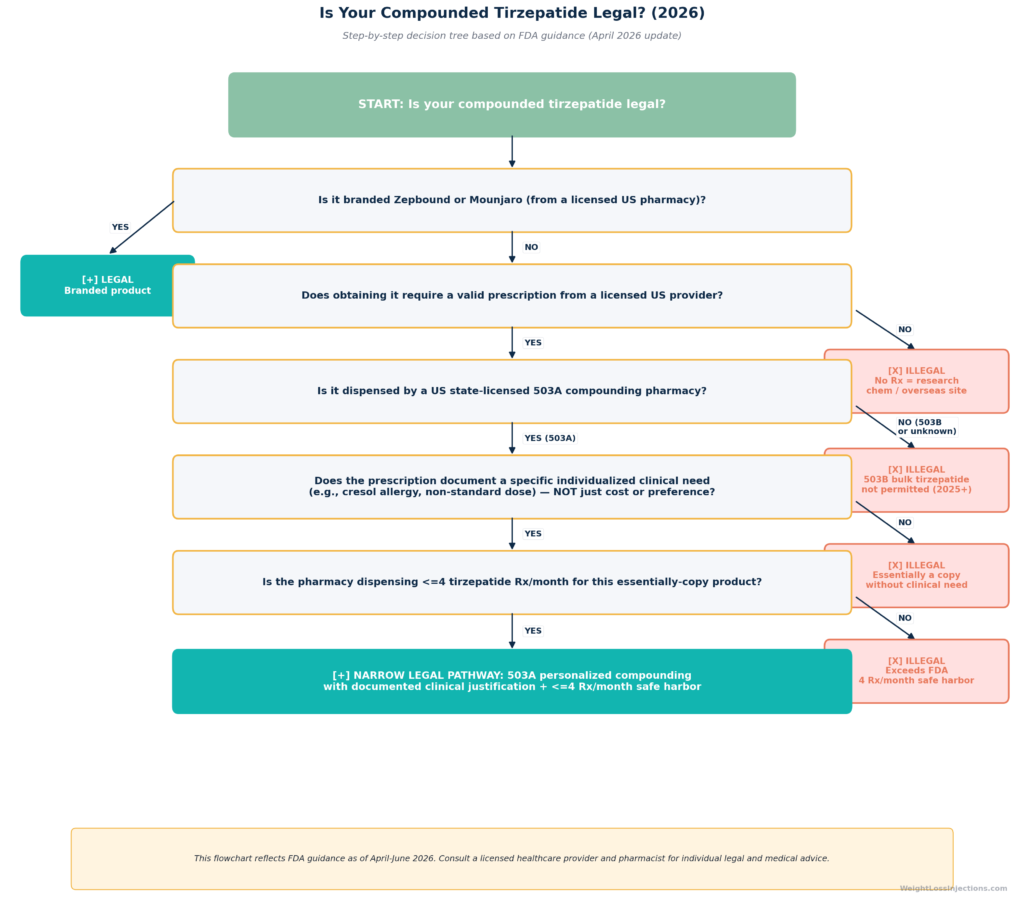
Decision flowchart — logic tree with clean boxes and arrows: “Is tirzepatide on the FDA shortage list? → No → Does the prescriber document a specific clinical need (allergy or unavailable dose…
Not all compounding authority for tirzepatide was eliminated by the shortage list removal. A narrow pathway survives within 503A — but it is narrow in a way that matters legally, and it is emphatically not the population-scale alternative that many patients were hoping to preserve.
The Conditions That Must Be Simultaneously Met
Under the FDCA’s 503A framework, a traditional compounding pharmacy is permitted to compound a drug that is “essentially a copy” of a commercially available product only if a licensed prescriber makes a documented determination that the compounded version provides a “clinically significant difference” for that specific patient. (FDA GLP-1 Compounding Clarification Page — April 1, 2026 update)
Per the FDA’s April 1, 2026 updated guidance, two conditions must be simultaneously met for a 503A tirzepatide compounding arrangement to be lawful:
- A licensed prescriber documents a clinically significant difference for the individual patient — and this documentation must appear on the prescription itself, not just in a physician’s note. A generic statement that “compounded is preferred” does not satisfy this requirement.
- The dispensing pharmacy fills ≤4 prescriptions per calendar month of that essentially-copy formulation. This cap is per pharmacy, not per patient — and it applies across all patients receiving that formulation at that facility. When the pharmacy hits four for the month, it stops, regardless of individual patient circumstances.
What Actually Qualifies as a Clinical Difference
The FDA has been specific about what rises to the level of a “clinically significant difference.” As of the April 2026 clarification, recognized bases include:
- Documented allergy or hypersensitivity to an inactive ingredient in the branded product. The most commonly cited example in the tirzepatide context is cresol — the preservative used in branded Mounjaro and Zepbound pens. Some patients have a documented sensitivity to cresol or related phenol compounds. If this is documented in the medical record and on the prescription, it can constitute a legitimate clinical basis. (FDA GLP-1 Compounding Clarification Page)
- A dose strength not commercially available. Eli Lilly offers tirzepatide in 2.5, 5, 7.5, 10, 12.5, and 15 mg — a well-graduated titration schedule. But some patients genuinely cannot tolerate the standard escalation pace and require intermediate doses (for example, 3 mg or 6 mg) that Lilly does not manufacture. If a prescriber documents that the standard increments cause clinically unmanageable GI adverse events and that an intermediate dose is medically necessary, this can serve as a basis. (FDA GLP-1 Compounding Clarification Page)
- A route of administration not commercially available. Branded tirzepatide is only available as a subcutaneous injection. This basis is uncommon in practice.
What Does NOT Qualify — And Why This Matters
The FDA has also been explicit about what does not constitute a clinically significant difference:
- Patient preference for vials over pens. Wanting to draw from a vial rather than use a pen is a convenience preference, not a clinical need. It does not qualify.
- Cost. The desire for a less expensive alternative to branded Zepbound is not a clinical reason. It is exactly what the essentially-copy prohibition is designed to prevent — compounders competing with branded drugs on price under the guise of personalization.
- Convenience or lifestyle preference. Similar to the above. A patient who “just prefers” a compounded product has not articulated a clinical need.
- A generic “compounded is more personalized” statement. Telehealth platforms that use boilerplate language about personalization — without tying it to a specific, documented clinical characteristic of the individual patient — are not meeting the legal standard.
- Combination products within 10% of a commercially available strength. A tirzepatide + B12 product formulated at a strength within 10% of a commercially available Zepbound dose is considered an essentially-copy product under the FDA’s definition, regardless of the added ingredient. (FDA GLP-1 Compounding Clarification Page)
The ≤4 Rx/month cap on the pharmacy side deserves particular emphasis. This is not a guideline or a recommendation — it is the threshold above which the FDA considers a pharmacy to be “regularly compounding” an essentially-copy product, which triggers the prohibition. A pharmacy that fills five, ten, or a hundred tirzepatide prescriptions per month under the guise of the personalized-medicine exception is not compliant. (Potere Health MD overview, 2026)
As the WeightLossInjections.com Staff explains, the personalized-medicine exception requires genuine documented clinical differentiation — not just a cost preference. Prescribers who sign off on compounded tirzepatide for patients who don’t have a documentable clinical need are putting themselves and their patients at risk.
Our take at WeightLossInjections.com: We want to be direct here, because patients deserve clarity: the ≤4 Rx/month personalized exception is not a loophole for the telehealth model that became popular in 2023–2024. If a platform is offering compounded tirzepatide to hundreds or thousands of patients without documented individual clinical justifications, it is not operating legally under current FDA guidance. Patients who are paying for compounded tirzepatide through one of these platforms should ask — in writing — for the specific clinical basis documented on their prescription and the name and license number of the 503A pharmacy filling it. If that documentation doesn’t exist, the arrangement is not protected by the personalized-medicine exception.
Our Top 3 · October 2026
The best GLP-1 providers right now
Independently reviewed. Ranked by price, medication access, provider quality, and patient outcomes.
Renew GLP
Personalized GLP-1, GIP plans: Semaglutide & Tirzepatide.
Medvi
No membership or hidden fees. Everything you need is included.
Trimi
US-licensed clinicians and shipped to your door, from $99/mo.
What Legal Compounded Tirzepatide Looks Like Today (If It Exists)
Given how narrow the remaining pathway is, it’s worth spelling out exactly what a legitimately lawful compounded tirzepatide arrangement looks like in 2026. If you believe you may qualify for the 503A exception, here is what the lawful version of this looks like in practice.
The Documentation Chain
A patient who legitimately qualifies for compounded tirzepatide in 2026 will have all of the following:
A valid, individualized prescription. The Rx must come from a licensed U.S. prescriber — a physician, nurse practitioner, or physician assistant with prescriptive authority — who has evaluated the patient, documented the specific clinical basis for compounding (e.g., “patient has documented cresol allergy confirmed via allergy testing dated [date]”), and included that documentation on the prescription itself. The clinical basis must be genuine and documented in the patient’s medical record. A checkbox or boilerplate note does not satisfy this standard.
A state-licensed 503A pharmacy. The prescription must be filled by a traditional compounding pharmacy that is actively licensed by its state board of pharmacy. You can verify any pharmacy’s license through the relevant state board’s online lookup tool — a service available in every state. If the pharmacy cannot provide its state board license number, that is an immediate disqualifying red flag.
Confirmation the pharmacy is within the ≤4 Rx/month cap. This is harder for a patient to verify independently, but you can and should ask the pharmacy directly: “How many essentially-copy tirzepatide prescriptions has this pharmacy filled this calendar month?” A compliant pharmacy will know the answer and will be able to confirm it is within the limit.
Certificate of Analysis (CoA) from an accredited third-party lab. Reputable 503A compounding pharmacies for sterile injectables provide a CoA confirming the identity, potency, and sterility of each batch. This CoA should come from an accredited, independent analytical laboratory — not from in-house testing by the pharmacy itself. No CoA is a significant red flag. (StatPearls — Tirzepatide (NCBI Bookshelf))
What the Product Must Be
The compounded product must be tirzepatide as the base molecule or an approved salt form. Products labeled as “tirzepatide peptide,” “research-grade tirzepatide,” or “tirzepatide research chemical” are not legitimate pharmaceutical compounding products — they are illegal circumventions of the prescription drug system and should be avoided entirely.
What About USP <797>?
Any compounded sterile injectable — which tirzepatide is, as a subcutaneous injection — must be prepared in compliance with USP <797>, the U.S. Pharmacopeia’s sterile compounding standards. USP <797> governs the clean-room conditions, personnel training, environmental monitoring, beyond-use dating, and quality testing required for sterile injectables. For 503A pharmacies, compliance with USP <797> is enforced through state pharmacy board inspections.
If you are obtaining compounded tirzepatide from a 503A pharmacy, you can ask for their most recent state board inspection report and USP <797> compliance documentation. A pharmacy operating a legitimate sterile compounding operation will have these available.
What’s Categorically Off the Table
There are two source types that are illegal under any circumstances, regardless of what a prescriber may have written:
503B outsourcing facilities cannot compound tirzepatide. Period. Their grace period ended March 19, 2025, and the April 2026 proposed exclusion from the 503B Bulks List will formalize this prohibition permanently once the rule is finalized. (FDA Press Announcement, April 30, 2026) Any outsourcing facility claiming to offer tirzepatide should be reported to the FDA.
Overseas and international suppliers — whether from China, India, or any other country — cannot legally supply tirzepatide to U.S. patients. Imported product is not FDA-regulated, has unknown potency, sterility, and API authenticity, and cannot be legally dispensed. No prescription, regardless of how it is written, authorizes use of imported pharmaceutical product.
What’s Definitely Illegal — Red Flags and What to Avoid
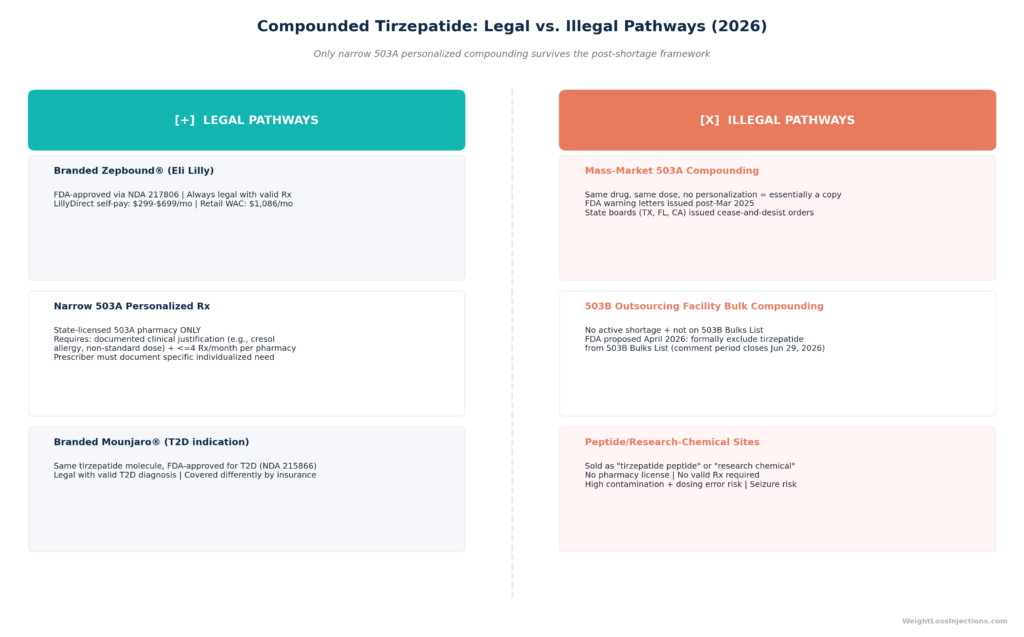
Two-column comparison infographic/table — left column “503A Compounding Pharmacy” with green/permitted details (≤4 Rx/month, documented clinical need, state-licensed, sterile compounding, CoA…
The confusion in the marketplace right now creates real risk for patients. Because some platforms still appear to be offering compounded tirzepatide — and because the nuances of 503A vs. 503B and “personalized” vs. “mass-market” compounding are not obvious to non-specialists — patients can inadvertently place themselves with illegal suppliers. Here is a plain-language guide to the red flags.
Red Flag 1: No Prescription Required
Any source that offers tirzepatide without requiring a valid prescription from a licensed U.S. prescriber is operating outside the law. Full stop. Tirzepatide — compounded or branded — is a Schedule-free prescription drug in the United States. There is no legal mechanism that permits its dispensing without an Rx. If a website, app, or vendor offers tirzepatide subscription plans where you skip the physician evaluation step, walk away.
Red Flag 2: “Research Chemical” or “Peptide” Labeling
Some vendors attempt to circumvent prescription requirements by marketing tirzepatide as a “research chemical” or “peptide” not intended for human use. This is a federal law violation. The FDA does not recognize a research-chemical carve-out for compounds that are approved prescription drugs. Tirzepatide sold under any such labeling is an illegal drug product. The “research use only” label is a legal fiction designed to avoid prosecution — it provides no protection to the buyer and no legitimacy to the seller.
Red Flag 3: Overseas or International Suppliers
Tirzepatide from international sources — China, India, Southeast Asia, or elsewhere — is not FDA-regulated, has not been evaluated for potency, sterility, or API authenticity, and cannot be legally imported for personal use. The FDA’s adverse event system has documented cases of serious harm from international peptide suppliers, including contamination, superpotency (doses 5–10× the intended level), and subpotency (no clinical effect). Purchasing from these sources is both illegal and medically dangerous. (Harris Beach Murtha Cullina — GLP-1 shortage/compounding summary, June 2026)
Red Flag 4: 503B Facilities Claiming to Offer Tirzepatide Stock
Any outsourcing facility that claims to have tirzepatide available for compounding — whether as office stock for clinics or for individual patient prescriptions — is not compliant with current FDA law. Their authority ended March 19, 2025. If a clinic or telehealth platform is sourcing its compounded tirzepatide from an outsourcing facility after that date, the arrangement is unlawful at the source level regardless of how the prescription is written. (FDA GLP-1 Compounding Clarification Page)
Red Flag 5: Telehealth Platforms That Don’t Ask About Clinical Justification
If a telehealth platform processes your request for compounded tirzepatide without asking you about specific allergies to branded inactive ingredients, your ability to tolerate standard dose strengths, or any other individualized clinical factor — it is not going through the steps required to establish the personalized-medicine exception. A compliant 503A compounding arrangement begins with a genuine clinical evaluation of whether you have a specific, documentable clinical need. Platforms that bypass this are not operating within the narrow legal pathway. (Potere Health MD overview, 2026)
Red Flag 6: No Certificate of Analysis or Lot Testing
Any reputable 503A pharmacy compounding sterile injectables will provide a Certificate of Analysis from a third-party accredited lab with each batch. If the source you’re considering cannot or will not provide this documentation, the quality of what you’re receiving is entirely unverifiable. FDA adverse event reports have documented subpotent compounded batches (patients receiving essentially no drug effect) and superpotent batches (patients experiencing severe overdose-type nausea, vomiting, and cardiovascular symptoms) from non-inspected operations. (FDA GLP-1 Compounding Clarification Page)
Red Flag 7: Flat-Rate “Any Dose, Any Quantity” Subscriptions
If a platform is offering a tirzepatide compounding subscription at a flat monthly fee — without individualized prescriber assessment and without any stated connection to a licensed 503A pharmacy’s ≤4 Rx/month compliance — the model itself is a red flag. The personalized-medicine exception cannot legally support a subscription model that applies to hundreds or thousands of patients simultaneously.
Your Options in 2026 — Affordable Legal Alternatives to Compounded Tirzepatide
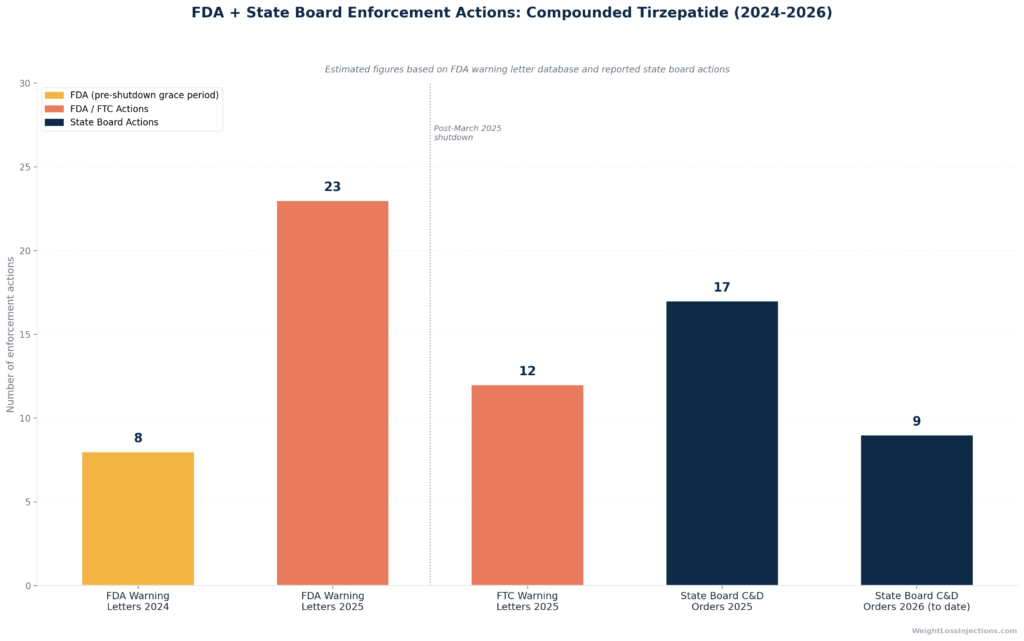
Grouped vertical bar chart comparing tirzepatide monthly costs across legal access paths in 2026: $150–$600 estimated range for lawful personalized 503A compounded (narrow exception); $299–$449/month…
The closure of mass-market compounded tirzepatide was a painful disruption for patients who had found an affordable access path. For many, compounded tirzepatide at $150–$400/month was the difference between being able to afford GLP-1 therapy and not. That gap is real and deserves acknowledgment before pivoting to alternatives. But the alternatives are more accessible in 2026 than they were in early 2025, when LillyDirect pricing was significantly higher.
LillyDirect Self-Pay Vials and KwikPen: $299–$449/month
Eli Lilly launched a direct-to-patient self-pay program through LillyDirect, and as of December 2025, pricing for the Self Pay Journey Program is substantially lower than the retail list price. Patients who enroll directly pay $299/month for the 2.5 mg starting dose, $399/month for the 5 mg dose, and $449/month for all doses from 7.5 mg through 15 mg. (Healthy Meals Incentives — Tirzepatide cost 2026)
This is the official, legal, FDA-approved self-pay pathway for patients without insurance coverage. No prescription from a specialty source is required — any licensed prescriber can write a Zepbound or Mounjaro prescription, and the LillyDirect system handles fulfillment. Both single-dose vials (requiring a separate syringe) and the multi-dose KwikPen format are available at these prices.
The retail list price (WAC) of $1,086/month for all dose strengths remains the default at traditional pharmacies without program enrollment. LillyDirect is not automatic — you must actively enroll in the Self Pay Journey Program to access the reduced pricing.
Zepbound Savings Card: As Low as $25/Fill
Patients with commercial insurance that covers Zepbound for weight management can access the Zepbound savings card, which brings out-of-pocket cost to as little as $25/fill for a 1-, 2-, or 3-month supply. (Healthy Meals Incentives — Tirzepatide cost 2026) This is the cheapest available path for insured patients — but it requires that your commercial plan has added Zepbound to its formulary, and approximately 45% of commercial plans have done so as of 2026. Patients on Medicare, Medicaid, VA, or TRICARE are not eligible for the savings card.
Mounjaro for Patients with Type 2 Diabetes
Tirzepatide’s T2D formulation, Mounjaro, may have different insurance coverage dynamics than Zepbound. If you have a T2D diagnosis, your prescriber may be able to obtain Mounjaro coverage through your plan’s standard diabetes formulary even when Zepbound (the obesity indication) is excluded. The molecule and dosing are identical; the difference is the indication and the insurance pathway. Discuss this option with your prescriber if cost is a primary concern.
Other GLP-1 Medications
Semaglutide (Wegovy for weight management, Ozempic for T2D) and liraglutide (Saxenda) offer established alternatives with strong clinical data. Semaglutide generics entered the market in early 2026, which has changed the access landscape for semaglutide-based treatment. The clinical profile differs from tirzepatide — tirzepatide’s dual GIP/GLP-1 mechanism produced approximately 47% greater weight loss than semaglutide at maximum tolerated doses in the head-to-head SURMOUNT-5 trial (SURMOUNT-5, NEJM 2025) — but semaglutide remains a clinically effective option, and the generic entry has meaningfully reduced its cost. Discuss with your provider whether semaglutide or another GLP-1 might be appropriate for your situation.
WeightLossInjections.com: Legitimate Pathways for the Right Patients
Some telehealth platforms connected to licensed prescribers and compliant 503A pharmacies may still serve the narrow personalized-medicine population — those with a documented clinical basis for compounding. WeightLossInjections.com can connect you with [service detail], licensed providers who understand today’s legal landscape and can evaluate whether you qualify for the narrow 503A exception or guide you to the most appropriate legal pathway for your specific situation. Our program starts at [$X/month].
For patients who do not have a documented clinical basis for compounded tirzepatide — which is the majority of patients — WeightLossInjections.com’s providers can guide you through LillyDirect enrollment, savings card eligibility assessment, and ongoing clinical management. Access to effective, legal GLP-1 therapy is the goal; compounded tirzepatide at scale is no longer a legal path to that goal.
Our take at WeightLossInjections.com: The closure of mass-market compounding was painful for patients who had finally found an affordable path to GLP-1 therapy. We understand the financial reality. Lilly’s LillyDirect vial program and emerging generics for other GLP-1s are filling some of that gap, and the $299–$449/month self-pay tier, while not trivial, represents a significant reduction from the $1,086 retail price. WeightLossInjections.com’s job is to connect you with licensed providers who understand today’s legal landscape and can help you access effective treatment through a compliant pathway. [service detail]
Our Take at WeightLossInjections.com
The tirzepatide compounding story is, in a real sense, a story about what happens when pharmaceutical innovation outpaces access infrastructure. Tirzepatide is an exceptional drug — the SURMOUNT-1 trial data showing up to 20.9% mean weight loss at 72 weeks (SURMOUNT-1, NEJM 2022) represented a genuine breakthrough for patients with obesity, and the 2023–2024 compounding market brought those results within financial reach for a much larger population than branded pricing would have allowed. The patients who benefited from that access period were not acting irrationally. They were finding a legal pathway to a drug that meaningfully improved their health.
The FDA’s enforcement position is also defensible. The shortage exemption is a specific, bounded mechanism — it exists to address genuine supply failures, not to create a permanent parallel market for branded drugs. When Lilly solved the supply problem, the legal basis for that parallel market ended. The law worked as designed.
What’s frustrating — and where we think patients deserve more honesty from the industry — is the persistence of non-compliant actors in the marketplace. In June 2026, more than a year after the 503A and 503B deadlines passed, there are still platforms marketing compounded tirzepatide without the legal basis to do so. Patients who use these platforms are not protected by the personalized-medicine exception. They are receiving an unverified product from a non-compliant source and paying for the privilege.
WeightLossInjections.com’s position is simple: we will not help patients access illegal or non-compliant compounded tirzepatide. We will help patients understand whether they qualify for the narrow lawful exception, navigate LillyDirect enrollment, evaluate insurance coverage and savings card eligibility, and access other legal GLP-1 pathways. The goal is effective, legal treatment — and in 2026, that path exists. It just requires knowing where it is.
FAQ
Q1: Is compounded tirzepatide still available in 2026?
Mass-market compounded tirzepatide is not legal in 2026. A very narrow exception exists for 503A pharmacies that can document a specific clinical need — such as a documented allergy to cresol (a preservative in branded tirzepatide pens) or an intermediate dose strength not commercially available — for an individual patient, and only up to 4 prescriptions per calendar month per pharmacy. This is emphatically not the broad, affordable compounding market that existed in 2023–2024. The vast majority of patients who were using compounded tirzepatide for cost reasons do not qualify for this exception. (FDA GLP-1 Compounding Clarification Page — April 1, 2026 update)
Q2: What ended the legal sale of compounded tirzepatide?
The FDA removed tirzepatide from its official Drug Shortage List on December 19, 2024, via a formal Declaratory Order. (FDA Declaratory Order — PDF) Compounding under the shortage exemption is only lawful while a drug is actively on the shortage list — that exemption is what had allowed 503A and 503B compounders to produce tirzepatide since December 2022. After the shortage was declared resolved, grace-period deadlines were set: 503A pharmacies had until February 18, 2025, and 503B outsourcing facilities had until March 19, 2025, to wind down mass compounding. A federal court denied the industry’s last legal challenge on March 10, 2025. (Alliance for Pharmacy Compounding — a4pc.org)
Q3: Can I still get compounded tirzepatide if I have a cresol allergy?
Potentially, yes. A documented allergy to cresol, a preservative in branded Mounjaro and Zepbound pens, is one of the recognized clinical justifications for the 503A personalized-medicine exception. (FDA GLP-1 Compounding Clarification Page) For this to be a valid basis: the allergy must be documented in your medical record (not merely self-reported), your prescriber must specifically document it on the prescription as the clinical rationale, and the 503A pharmacy filling the prescription must be within its ≤4 Rx/month limit for that formulation. This is not a self-serve pathway, it requires a genuine clinical evaluation by a licensed provider who will stake their license on the documented clinical need. Consult your provider for an individualized assessment.
Q4: Are there telehealth companies still legally prescribing compounded tirzepatide?
Some platforms may legitimately facilitate prescriptions for the narrow personalized-medicine population. The compliance markers to look for: the platform requires a physician consultation that specifically evaluates and documents an individual clinical reason (not just cost or preference), they use a named, state-licensed 503A pharmacy you can verify through the state board database, and they do not advertise compounded tirzepatide as broadly available to all patients indiscriminately. If the intake process does not ask about clinical justification — allergies, tolerance issues with standard doses, specific documented needs — and the platform markets compounded tirzepatide as a general affordable alternative to Zepbound, it is not operating within the narrow legal exception. (Potere Health MD overview, 2026)
Q5: What are my affordable options now that compounded tirzepatide isn’t broadly available?
Eli Lilly’s LillyDirect Self Pay Journey Program offers Zepbound single-dose vials and KwikPen starting at $299/month for the 2.5 mg starting dose, $399/month for 5 mg, and $449/month for all higher doses. (Healthy Meals Incentives — Tirzepatide cost 2026) Commercially insured patients whose plan covers Zepbound may qualify for a savings card at as little as $25/fill. Patients with type 2 diabetes may have coverage options through Mounjaro’s T2D indication. Semaglutide generics launched in 2026 and may be an option if your provider determines semaglutide is clinically appropriate for you.
Q6: What happens if I keep buying compounded tirzepatide from a non-compliant source?
You may receive a product of unknown potency, sterility, or authenticity. FDA adverse event reports have documented cases of subpotent batches — where patients received essentially no drug effect — and superpotent batches delivering severe nausea, vomiting, and cardiovascular symptoms consistent with dangerous overdose-level dosing. Contamination events from non-sterile compounding environments have also been documented. Additionally, while patients themselves face limited direct legal exposure, purchasing from unlicensed sources supports illegal distribution networks that the FDA, FTC, and state pharmacy boards are actively working to shut down. The risk-benefit calculus here is unfavorable: paying for an unverified product from an illegal source, when legal alternatives at $299–$449/month exist, does not serve your health or financial interests. (FDA GLP-1 Compounding Clarification Page)
This article is for informational purposes only and does not constitute medical advice. All regulatory information reflects verified primary sources as of June 2026. WeightLossInjections.com editorial team reviews content quarterly. Consult a licensed healthcare provider before starting, changing, or stopping any medication. [STATE-SPECIFIC DISCLAIMER]