![Unbranded [pillar-drug-class] injection pen on a neutral background — WeightLossInjections.com editorial hero](https://weightlossinjections.com/wp-content/uploads/2026/05/hero_zepbound_c3_safety-1200x675.png)
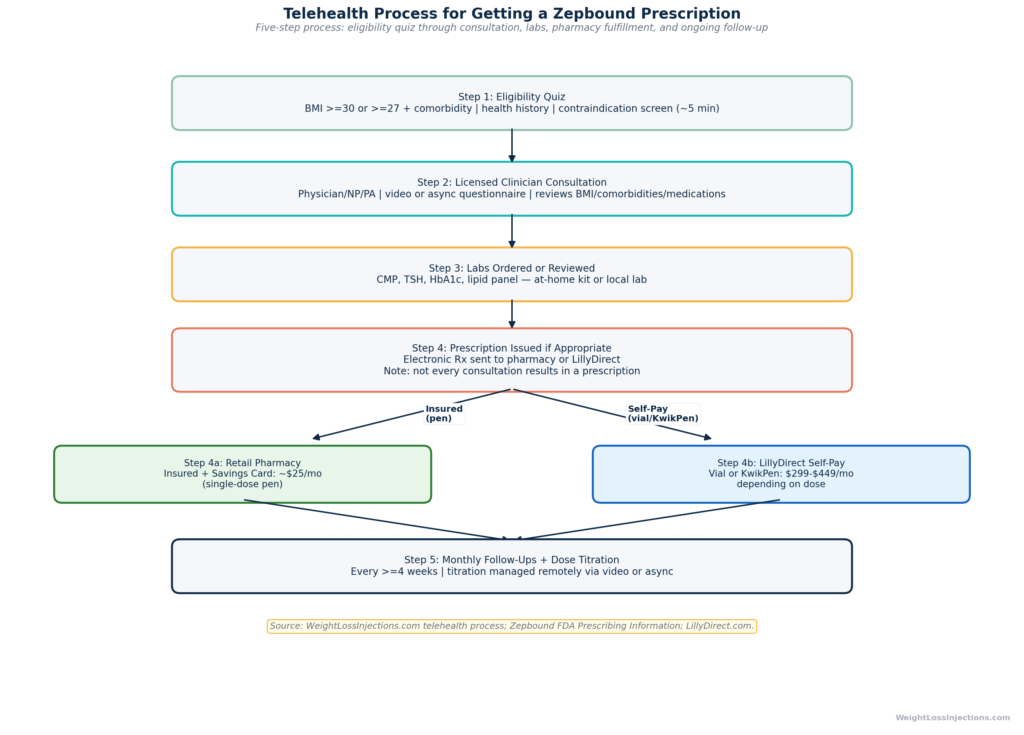
Telehealth Process Flowchart
Zepbound is a prescription-only medication; telehealth allows you to complete the entire process, consultation, prescription, and pharmacy fulfillment, without an in-person visit. In 2026, the only legal telehealth Zepbound prescription is for branded Zepbound (tirzepatide, NDA 217806); compounded tirzepatide is no longer permissible for general patients following the closure of both the 503A window (February 18, 2025) and the 503B window (March 19, 2025).
Self-pay patients can access Zepbound through LillyDirect’s Self Pay Journey Program starting at $299/mo for 2.5 mg. Commercially insured patients with coverage pay as little as $25/mo with a savings card.
What Telehealth Prescribing for Zepbound Actually Means
Telehealth prescribing means that a licensed U.S. healthcare provider, a physician, nurse practitioner, or physician assistant, evaluates you, determines clinical appropriateness, and issues a legal electronic prescription for Zepbound without an in-person office visit.
The prescription itself is identical to one written in a clinic. It carries the prescriber’s DEA and state license numbers and is sent electronically to a licensed pharmacy. The medication you receive is the same FDA-approved Zepbound that a patient walking out of an endocrinologist’s office would pick up at CVS.
What telehealth changes is the access point, not the product. You complete the intake forms, health history questionnaire, and clinical review online. Most platforms use either a live video appointment or an asynchronous review, where the provider evaluates your uploaded information and responds within 24 to 48 hours. Either format satisfies federal prescribing standards for non-controlled medications like Zepbound.
The FDA approved Zepbound (tirzepatide) on November 8, 2023, for chronic weight management in adults with obesity (BMI ≥30 kg/m²) or overweight (BMI ≥27 kg/m²) with at least one weight-related comorbidity such as hypertension, type 2 diabetes, or dyslipidemia. On December 20, 2024, the FDA approved a second indication: moderate-to-severe obstructive sleep apnea (OSA) in adults with obesity, per the Eli Lilly OSA approval press release. Both indications are prescribable via telehealth.
For patients outside metro areas, for those with limited mobility, and for anyone whose schedule makes in-person weight management appointments logistically difficult, telehealth is often the only realistic path to supervised GLP-1 therapy. It is also faster: most telehealth platforms issue prescriptions within 24 to 48 hours of a completed consultation for eligible patients.
Am I Eligible for Zepbound? FDA Criteria Explained
Eligibility is not discretionary, it is governed by the FDA-approved indication language in the Zepbound prescribing information. Any legitimate telehealth provider applies these criteria. Any provider that does not is either cutting corners or unqualified to prescribe it.
BMI and Comorbidity Requirements
The exact FDA indication language for the weight management approval is: “adjunct to a reduced-calorie diet and increased physical activity for chronic weight management in adults with obesity (BMI ≥30 kg/m²) or overweight (BMI ≥27 kg/m²) with at least one weight-related comorbid condition (such as hypertension, type 2 diabetes, or dyslipidemia).”
What this means in practice:
- BMI ≥30 kg/m² with no additional condition required. A BMI of 30 alone satisfies the obesity indication.
- BMI 27–29.9 kg/m² requires a qualifying comorbidity. Hypertension, type 2 diabetes, and dyslipidemia are the three listed examples. The word “such as” in the label allows for other weight-related conditions with prescriber documentation, though these three are the most commonly cited.
- BMI ≥30 with moderate-to-severe OSA. This second indication, approved December 20, 2024, allows a different clinical pathway — particularly relevant for patients with sleep apnea who may also benefit from significant weight reduction. In SURMOUNT-OSA Trial 1, tirzepatide reduced the apnea-hypopnea index (AHI) by 25.3 events per hour versus 5.3 events per hour on placebo.
Who Cannot Use Zepbound
The Zepbound prescribing information lists three formal contraindications:
- Personal or family history of medullary thyroid carcinoma (MTC)
- Multiple Endocrine Neoplasia syndrome type 2 (MEN 2)
- Known serious hypersensitivity to tirzepatide or any excipient in Zepbound, including anaphylaxis and angioedema
Additionally, a telehealth provider will discuss several disqualifying or complicating factors per prescribing information and clinical practice standards:
- Pregnancy or planned pregnancy — Zepbound may cause fetal harm. Patients should discontinue if pregnancy is confirmed.
- Currently taking another GLP-1 agonist or Mounjaro — Combining any two tirzepatide-containing products, or tirzepatide with any GLP-1 agonist (semaglutide, liraglutide, dulaglutide, exenatide), is explicitly contraindicated per the FDA press release.
- History of pancreatitis — Not a formal contraindication, but Zepbound was not studied in patients with prior pancreatitis. Most providers consider this a clinical caution requiring individual assessment.
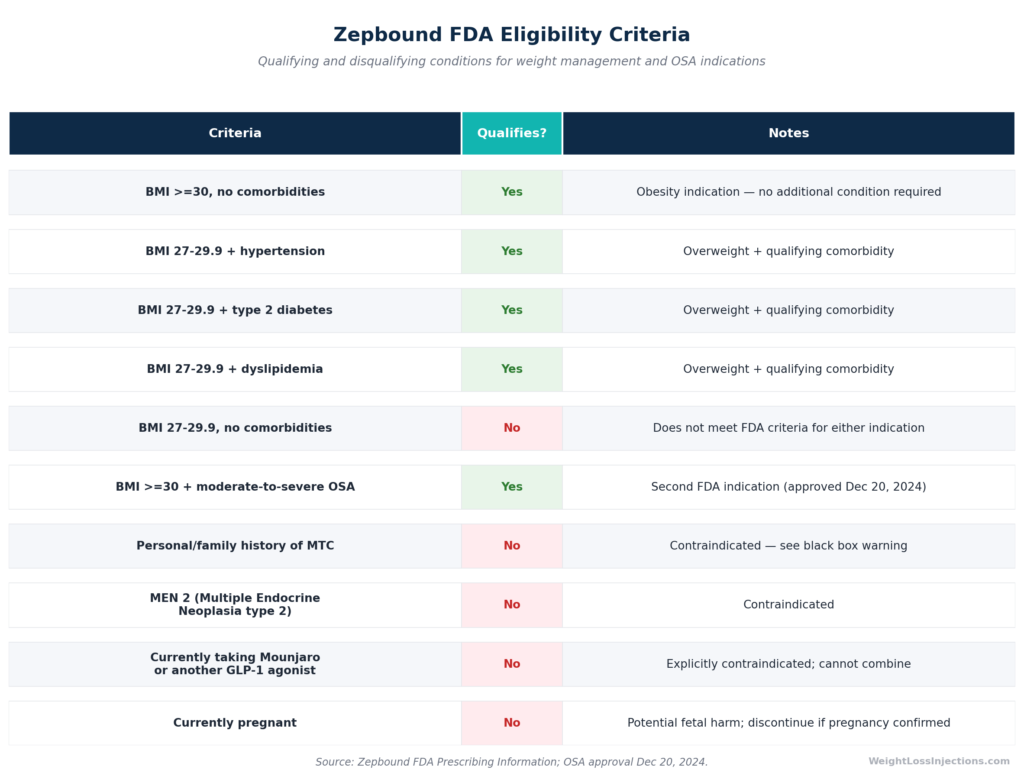
Zepbound Eligibility Criteria Table
How to Tell Legitimate Telehealth from Illegal Operators
This is the most important section of this article. The telehealth weight-loss market is crowded, and not all of it operates legally in 2026.
The Defining Test: Brand Zepbound Only
A legitimate telehealth provider in 2026 prescribes brand Zepbound, the FDA-approved product manufactured by Eli Lilly under NDA 217806. Full stop.
Any platform that offers “compounded tirzepatide,” “tirzepatide peptides,” “tirzepatide base,” “tirzepatide acetate,” or any variation of “compounded GLP-1” as a standard product is operating outside current FDA law. Both compounding windows that permitted this during the shortage — the 503A (state-licensed pharmacies) window and the 503B (outsourcing facilities) window, are permanently closed.
This distinction matters enormously because dozens of platforms built during the shortage era continue to market compounded products, either unaware of or ignoring the legal change. Some have simply removed the word “compounded” from their marketing without changing their actual pharmacy supply chain.
The 2026 Post-Compounding Landscape: What Changed and Why
Tirzepatide appeared on the FDA Drug Shortages list starting August 2022 due to demand that outpaced Eli Lilly’s manufacturing scale-up. Under the FD&C Act, that shortage status created a legal window for compounding pharmacies to produce essentially-copy tirzepatide products. Telehealth companies capitalized on this, pricing compounded tirzepatide at $150 to $400 per month and marketing it as a more affordable alternative to branded Zepbound.
That window closed in sequence:
- December 19, 2024: FDA re-confirmed the tirzepatide shortage was resolved, finding supply met or exceeded demand. (An earlier October 2024 resolution had been remanded for re-evaluation after industry litigation.)
- February 18, 2025: The 503A window for state-licensed compounding pharmacies closed. The Northern District of Texas district court denied the Outsourcing Facilities Association’s request for a preliminary injunction on March 5, 2025, confirming the window was shut, per the FDA clarification page on compounding policies.
- March 19, 2025: The 503B window for FDA-registered outsourcing facilities closed, per the same FDA clarification page.
- April 2026: FDA is actively pursuing seizure or injunction actions against manufacturers, distributors, and marketers of non-FDA-approved compounded GLP-1 products. Tirzepatide does not appear on the FDA’s 503B bulk drug substances list and is not on the current FDA Drug Shortages database.
A narrow individualized exception persists: 503A pharmacies may still compound tirzepatide for specific patients with documented allergies to branded excipients, need for a different administration route, or other individualized clinical needs not met by the branded product. Per FDA April 2026 guidance, 503A pharmacies may fill up to four such prescriptions per month without triggering “regularly or in inordinate amounts” enforcement. This is not a general-population pathway.
From a legal framework perspective, it is also worth noting that the anti-kickback statute — 42 U.S.C. §1320a-7b — applies to arrangements that improperly induce referrals for compounded drug programs. Patients and prescribers alike should understand this exposure when evaluating non-standard telehealth GLP-1 programs.
The Red Flags Checklist
Before signing up with any telehealth weight-loss platform in 2026, evaluate these warning signs:
Pricing that is too low to be legitimate. Zepbound’s lowest legal self-pay price is $299/mo for 2.5 mg via LillyDirect’s Self Pay Journey Program. Any platform advertising tirzepatide for $100 to $250 per month without a clear, verifiable explanation is almost certainly offering compounded product.
No provider names or license information visible. Legitimate telehealth providers employ named, licensed clinicians. A platform that keeps providers anonymous or cannot tell you the state license and prescriber identity upon request is not operating transparently.
Language about “peptides,” “tirzepatide base,” or “compounded tirzepatide.” These are signals that the product is not branded Zepbound. The terms are often used to obscure what the product actually is.
No prescriber evaluation before dispensing. Zepbound is a Schedule-uncontrolled prescription drug, but it still requires a valid prescriber evaluation before dispensing. Any platform dispensing without a clinical review is violating federal prescribing standards.
No follow-up structure. Zepbound’s titration schedule requires dose increases every ≥4 weeks per the Zepbound prescribing information. Platforms that provide a one-time prescription with no follow-up capacity are not providing medically appropriate supervised care.
Generic “obesity medication” language without FDA-approval specifics. Legitimate operators name the drug, cite its FDA approval, and explain how it is dispensed. Vague marketing language is a deflection tactic.
The Step-by-Step Telehealth Consultation Flow
Understanding the full consultation process helps set accurate expectations and prepares you to get through intake efficiently. At [service detail], WeightLossInjections.com follows a structured clinical workflow.
Step 1: Eligibility Quiz
The process starts with an online eligibility quiz, typically five minutes or less. You enter your BMI (or height and weight), indicate any relevant comorbidities (hypertension, type 2 diabetes, dyslipidemia, OSA), and answer screening questions about contraindications (thyroid history, prior GLP-1 use, pregnancy). The quiz screens against the FDA criteria before you commit to anything. No payment is typically required at this stage.
If the quiz result shows you do not meet the BMI threshold or have a documented contraindication, a legitimate provider will tell you directly rather than upsell you to a marginal prescription.
Step 2: Medical Consultation
A licensed clinician, physician, nurse practitioner, or physician assistant, state-licensed to prescribe in your state, reviews your health history either via live video or asynchronous questionnaire review. They evaluate:
- BMI and body weight at baseline
- Weight-related comorbidities and current management
- Current medications and potential interactions (particularly other GLP-1 agonists, insulin, sulfonylureas, and oral contraceptives, which require backup methods for four weeks after starting Zepbound and after each dose escalation per the Zepbound prescribing information)
- Prior weight-loss attempts and treatment history
- Contraindications (personal and family history of MTC or MEN 2)
- Surgical or procedural history relevant to GI tract or anesthesia risk
Not every consultation results in a prescription. Clinical appropriateness, not patient preference, is the standard a legitimate provider applies.
Step 3: Lab Work
Most reputable telehealth providers require or strongly recommend baseline labs before starting Zepbound. Typical panels include:
- Comprehensive metabolic panel (CMP) — liver and kidney function, electrolytes, glucose
- TSH (thyroid-stimulating hormone) — relevant given the thyroid C-cell tumor black box warning in the Zepbound prescribing information
- HbA1c — establishes baseline glycemic status; particularly important for patients with or at risk for type 2 diabetes
- Lipid panel — baseline lipid status, relevant if dyslipidemia is the qualifying comorbidity
Labs can come from your own primary care provider’s recent records (typically within 6 to 12 months), from at-home lab kits ordered through the telehealth platform, or from a local lab draw. [service detail] at WeightLossInjections.com handles lab logistics as part of the intake process.
Step 4: Prescription and Pharmacy Fulfillment
If the provider determines Zepbound is clinically appropriate, they send an electronic prescription. Depending on your situation, that prescription goes to one of two primary channels:
Option A — Retail pharmacy (commercially insured patients): Your prescription is sent to a retail pharmacy (CVS, Walgreens, Walmart, etc.) and your savings card reduces your copay to as little as $25/mo for commercially insured patients with coverage, per the 2026 Zepbound savings card terms. The 2026 savings card covers up to 13 fills per year with a maximum annual benefit of approximately $1,300.
Option B — LillyDirect (self-pay patients): Your prescription is sent to LillyDirect’s pharmacy partner (Gifthealth), and you pay self-pay pricing. The Zepbound Self Pay Journey Program pricing, effective December 1, 2025:
- 2.5 mg: $299/mo
- 5 mg: $399/mo
- 7.5 mg, 10 mg, 12.5 mg, 15 mg: $449/mo each
The vial format and the KwikPen — Lilly’s multi-dose pen launched February 23, 2026, are both available through LillyDirect for self-pay patients. The KwikPen contains four weekly doses per pen (one month of treatment), aligning with the once-weekly tirzepatide schedule. LillyDirect also offers retail pickup through Walmart Pharmacy, launched October 29, 2025, for patients who prefer not to wait for home delivery.
Step 5: Ongoing Follow-Up and Dose Titration
Zepbound’s titration schedule requires at least four weeks at each dose before escalating per the Zepbound prescribing information: 2.5 mg → 5 mg → 7.5 mg → 10 mg → 12.5 mg → 15 mg. Reaching the maximum 15 mg maintenance dose takes a minimum of 20 weeks. Each dose change requires clinical oversight, not just a refill.
This is where telehealth platforms diverge significantly in quality. Platforms that issue a prescription and then disappear are not providing appropriate care. Titration decisions need to account for side effects, weight-loss response, and medication tolerance. [service detail] at WeightLossInjections.com includes monthly follow-up visits at [$X/month] to manage dose progression and respond to any adverse effects that emerge.
What Will Telehealth Cost You? Full 2026 Cost Breakdown
The total cost of a Zepbound telehealth program has two components: the telehealth consultation and management fee, and the medication itself.
Telehealth Consultation Fee
WeightLossInjections.com’s bundled telehealth program is [$X/month] and includes [service detail] — initial consultation, prescription oversight, and ongoing titration management.
Third-party platforms typically charge $40 to $150 for an initial consultation and $30 to $100 per follow-up visit. Bundled models that include all visits in a monthly fee typically run $50 to $200 per month depending on the platform and services included.
Medication Cost
The medication cost depends entirely on your insurance situation and pharmacy channel:
- Commercially insured, coverage approved (savings card): As low as $25/mo for single-dose pens. Maximum annual savings under the 2026 card is approximately $1,300, covering up to 13 fills per year, per prescriber and patient tracking of the 2026 card terms.
- Commercially insured, non-covered benefit: As low as $499/mo via the non-covered savings card, per PrescriberPoint savings program details.
- Self-pay via LillyDirect (Self Pay Journey Program): $299/mo (2.5 mg), $399/mo (5 mg), $449/mo (7.5–15 mg), per CNBC December 1, 2025 reporting on the LillyDirect price cut.
- Medicare GLP-1 Bridge (July 1–December 31, 2026): $50 copayment for eligible Part D enrollees (BMI ≥35, or ≥27 with clinical criteria), per KFF analysis of the Medicare GLP-1 Bridge program from March 2026. Note: this program runs outside the standard Part D benefit and does not count toward the 2026 $2,100 OOP cap.
- List price (WAC, no program): $1,086/mo for all dose strengths per Eli Lilly’s pricing information. Do not pay this amount without first exploring the above options.
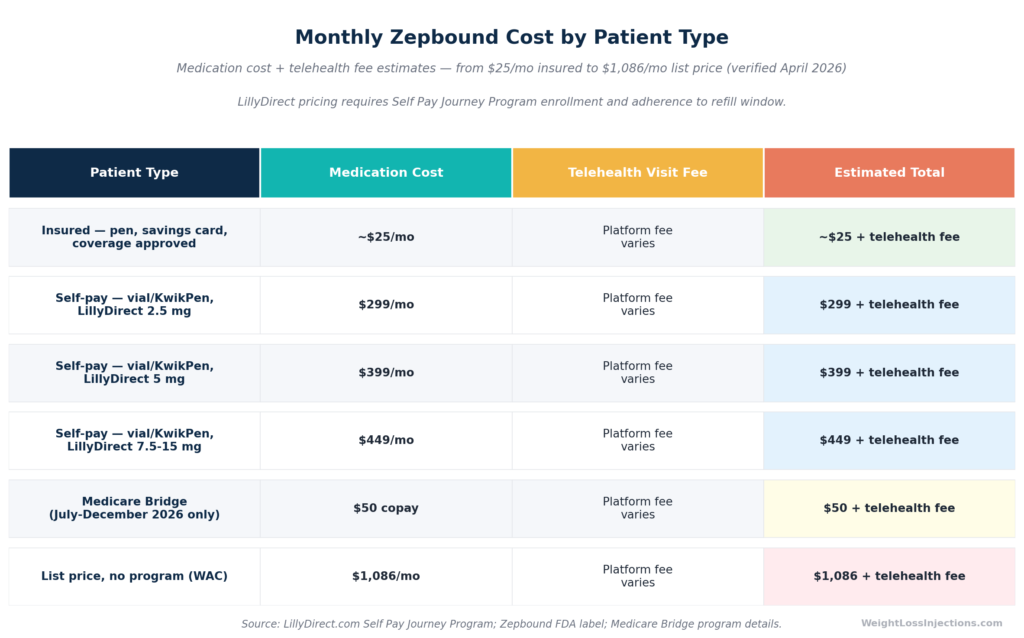
Monthly Zepbound Cost Comparison
Our Top 3 · September 2026
The best GLP-1 providers right now
Independently reviewed. Ranked by price, medication access, provider quality, and patient outcomes.
Renew GLP
Personalized GLP-1, GIP plans: Semaglutide & Tirzepatide.
Medvi
No membership or hidden fees. Everything you need is included.
Trimi
US-licensed clinicians and shipped to your door, from $99/mo.
Insurance Coverage Through Telehealth
Getting insurance to cover Zepbound through a telehealth prescription works the same way as through an in-person prescription, the coverage decision is made based on your plan’s formulary and prior authorization criteria, not on whether a telehealth provider wrote the prescription.
Approximately 43 to 45% of commercial plans cover Zepbound for weight management, rising to roughly 55% at employer-sponsored plans with prior authorization, per Pandameds insurance coverage analysis from March 2026. Prior authorization requires documentation of BMI, qualifying comorbidities, and typically a record of prior lifestyle interventions.
The value a quality telehealth provider offers in the insurance process is PA support, the ability to submit prior authorization documentation on your behalf and to appeal denials with clinical rationale. At WeightLossInjections.com, [service detail] for prior authorization support as part of our program.
Medicare coverage note: Medicare Part D is statutorily prohibited from covering Zepbound for weight management, per American College of Gastroenterology guidance from April 2025. The exception is the OSA indication, individual Part D plan formularies may cover Zepbound prescribed specifically for moderate-to-severe OSA. The temporary Medicare GLP-1 Bridge program (July 1–December 31, 2026) provides $50 copay access for eligible Part D enrollees with BMI ≥35 or ≥27 with clinical criteria, per KFF analysis. Telehealth providers can prescribe Zepbound to Medicare patients accessing the Bridge program. Government beneficiaries, Medicare, Medicaid, VA, TRICARE, are excluded from manufacturer savings card programs per program terms.
LillyDirect and Its Telehealth Partners
LillyDirect is Eli Lilly’s direct-to-consumer pharmacy and access platform, launched for Zepbound in December 2023. It operates through a network of independent pharmacy and telehealth partners, Lilly connects patients to these partners but does not employ the providers or direct their clinical decisions.
How LillyDirect Works for Self-Pay Patients
For patients without insurance coverage who want to access Zepbound at the LillyDirect self-pay price, the prescription must be routed to Gifthealth, Lilly’s pharmacy fulfillment partner. The telehealth provider, whether that is WeightLossInjections.com, Form Health, or another LillyDirect-integrated platform, sends the prescription to Gifthealth, which then processes and ships the vials or KwikPen directly to the patient’s home, or arranges retail pickup through Walmart Pharmacy locations.
The practical requirement: your telehealth provider must have an integration with LillyDirect’s pharmacy channel to route your prescription at the self-pay pricing. Providers without this integration can still prescribe Zepbound, but the prescription goes to a retail pharmacy at standard pricing unless you have commercial insurance coverage. At WeightLossInjections.com, [service detail] for LillyDirect routing.
Form Health as an Independent Telehealth Partner
Form Health is listed as an independent telehealth provider on Lilly’s platform, accessible via Lilly.com’s “Find Care” section. Form Health is board-certified-obesity-medicine–led, physician-supervised, and in-network with major commercial insurers. In March 2026, Form Health joined the Lilly Employer Connect platform, a separate employer-benefit pathway for accessing GLP-1 medications through direct employer contracts with Lilly.
The independence of Form Health from Lilly is important to understand. Form Health physicians are not employed by Lilly, are not financially compensated by Lilly for clinical services, and make prescribing decisions based solely on clinical judgment — they may prescribe a different medication or recommend non-medication treatment if that is clinically appropriate.
Other LillyDirect Telehealth Partners
Additional independent telehealth providers listed in Lilly’s “Find Care” network include:
- 9amHealth — provides care for people with diabetes or obesity; state-licensed clinicians; conducts eligibility assessment
- knownwell — provides care for people with obesity; conducts eligibility assessment
Lilly’s network criteria for listing a provider include quality of care, services offered, geographic accessibility, user-experience feedback, and regulatory compliance. Being listed does not mean Lilly has clinical oversight over those providers’ prescribing decisions. Earlier LillyDirect pharmacy integration also saw Teladoc and LifeMD connect directly with Gifthealth to offer LillyDirect self-pay Zepbound pricing to their patients as of March 2025, alongside Ro, which established its LillyDirect integration in December 2024.
The growing ecosystem of legitimate LillyDirect-integrated providers means patients have more options than ever, but also means the landscape requires careful evaluation to distinguish vetted providers from bad actors still marketing compounded product.
Telehealth vs. In-Person: What Actually Differs
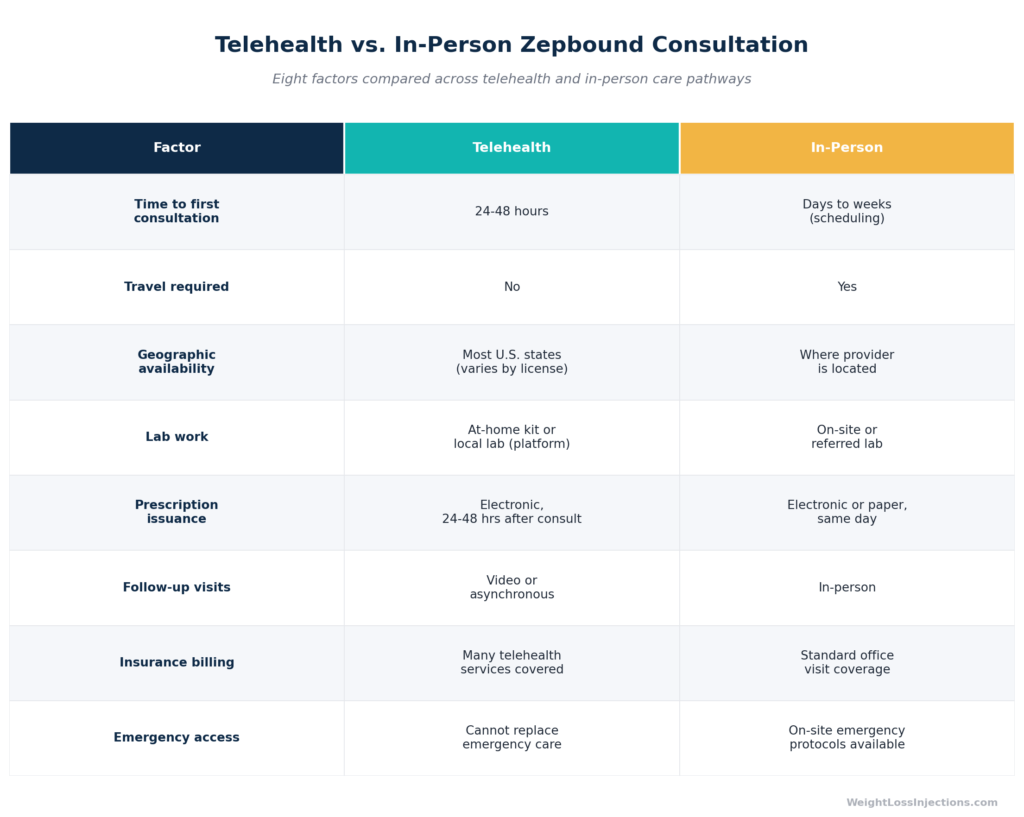
Telehealth vs. In-Person Comparison Table
Where Telehealth Excels
The most practical advantage is speed. Most telehealth platforms complete intake and issue a prescription, for eligible patients, within 24 to 48 hours of a completed consultation. An in-person appointment with a bariatric physician or endocrinologist who handles obesity medicine may take weeks to schedule. For patients who have been waiting for access, that gap is clinically meaningful given that SURMOUNT-4 data showed stopping tirzepatide results in substantial weight regain, 14.0% of body weight in the 52-week post-withdrawal period per JAMA 2023. Earlier initiation of treatment matters.
No travel means no scheduling conflict, no time off work, and no geographic barrier. For patients in rural states or underserved areas where obesity medicine specialists are scarce, telehealth may be the only accessible entry point.
Pricing transparency is another practical advantage. Most telehealth programs with LillyDirect integration offer bundled pricing — one monthly fee that includes the consultation, prescription management, and ongoing follow-up. This makes the total monthly cost predictable rather than subject to the variable copay and specialist billing of in-person care.
Where In-Person Care Has an Advantage
In-person providers can perform a physical examination, relevant for identifying signs of pancreatitis, gallbladder disease, or cardiovascular complications that may emerge during treatment. A telehealth provider can ask about symptoms but cannot palpate the abdomen.
Certain serious adverse events, acute pancreatitis, significant GI episodes, anaphylaxis, require in-person emergency evaluation that telehealth cannot provide. Patients on Zepbound should have an established relationship with a local provider for urgent medical concerns. The Zepbound prescribing information notes that GI-mediated fluid loss from nausea, vomiting, and diarrhea can cause acute kidney injury if dehydration is not managed.
Not all U.S. states allow telehealth prescribing for weight-loss medications under the same rules. Confirm state availability with WeightLossInjections.com before starting intake.
Questions to Ask a Telehealth Provider Before Signing Up
These are the specific questions that distinguish a legitimate clinical program from a prescription mill:
- Who is the prescribing provider? Can you give me their name and state license number? A legitimate platform answers this without hesitation.
- What medication will be prescribed — branded Zepbound, or a compounded product? If the answer is anything other than brand Zepbound (or Mounjaro, if you have T2D), pause.
- Which pharmacy fulfills my prescription, and what is the NDC number on the dispensed product? Zepbound’s NDC number traces back to NDA 217806 and Eli Lilly. Any other answer requires scrutiny.
- What labs do you require before or shortly after starting? A provider that skips labs entirely is cutting a clinical corner that matters.
- How do dose escalations work, and who manages them? Escalating too quickly increases GI adverse events — 56% of Zepbound patients in clinical trials experienced GI adverse reactions, including nausea in up to 28% at the 15 mg dose per Zepbound prescribing information Table 1. Thoughtful titration management reduces this burden.
- What happens if I experience a serious side effect? The platform should have a clear protocol for urgent situations, including a direct provider line.
- Does your program include prior authorization support if my insurance might cover Zepbound? Even if you plan to self-pay, knowing your insurance coverage options can save hundreds of dollars per month.
- Are you integrated with LillyDirect for self-pay pricing? This determines whether you access the $299–$449/mo Self Pay Journey Program pricing or pay retail rates.
How WeightLossInjections.com Approaches Telehealth
Our take at WeightLossInjections.com: The telehealth Zepbound market in 2026 divides cleanly into two categories: providers who prescribe FDA-approved Zepbound and route patients to verified pricing pathways, LillyDirect self-pay, retail pharmacy with savings card, or Medicare Bridge where eligible, and providers who continue to offer compounded tirzepatide in violation of current FDA enforcement rules. These are not two legitimate options between which patients are choosing a preference. One is legal and medically appropriate. The other is not.
We prescribe brand Zepbound only. Our licensed clinicians evaluate eligibility against FDA criteria, not against what would generate a prescription. If you don’t qualify, we tell you directly. If you do qualify, we route your prescription through the channel that makes the most financial sense for your situation: LillyDirect self-pay if you’re paying out of pocket, retail pharmacy with prior authorization support if your insurance may cover it, or the Medicare GLP-1 Bridge channel if you’re an eligible Part D enrollee.
At WeightLossInjections.com, our bundled telehealth program starts at [$X/month] and includes [service detail] — initial clinician consultation, prescription routing (LillyDirect-integrated where appropriate), lab coordination, monthly titration management, and direct provider access for side effect questions. We do not offer a prescription-and-disappear model. Zepbound requires ongoing clinical management; the evidence from SURMOUNT-4 is clear that patients who stop the medication, or manage it without supervision, lose the benefit. Our program is designed for the full duration of treatment, not just the first fill.
If you are ready to find out if you qualify, WeightLossInjections.com’s eligibility quiz takes under five minutes. [service detail] to get started.
Frequently Asked Questions
Do I need a prescription for Zepbound online?
Yes. Zepbound is a prescription-only medication. Any telehealth platform that provides Zepbound must conduct a clinical evaluation by a licensed healthcare provider before issuing a prescription, per federal prescribing law. The FDA’s approval of Zepbound under NDA 217806 classifies it as a Schedule-uncontrolled but prescription-required medication. Platforms that offer Zepbound, or any version of tirzepatide, without a valid prescriber evaluation are not operating within federal law.
What BMI do I need for Zepbound?
You need a BMI of at least 30 kg/m², or a BMI of at least 27 kg/m² with at least one weight-related health condition — hypertension, type 2 diabetes, or dyslipidemia — per the FDA-approved indication for Zepbound. Zepbound is also approved for moderate-to-severe obstructive sleep apnea in adults with obesity (BMI ≥30), per the Eli Lilly OSA approval press release. A BMI of 27 to 29.9 with no qualifying comorbidities does not meet FDA criteria for either indication.
Can I get Zepbound through telehealth if I have Medicare?
Medicare Part D does not cover Zepbound for the weight management indication as of April 2026 — Medicare is statutorily prohibited from covering drugs used solely for weight loss, per American College of Gastroenterology guidance from April 2025. However, the temporary Medicare GLP-1 Bridge program (July 1–December 31, 2026) provides Zepbound at a $50 copayment for eligible Part D enrollees with BMI ≥35 or ≥27 with clinical criteria, operating outside the standard Part D benefit, per KFF analysis from March 2026. Telehealth providers can prescribe Zepbound to Medicare patients who will pay through the Bridge program or out of pocket. Additionally, individual Part D plan formularies may cover Zepbound when prescribed specifically for moderate-to-severe OSA — verify with your specific plan.
How quickly can I get a Zepbound prescription through telehealth?
Most telehealth platforms, including WeightLossInjections.com, complete intake and issue a prescription for eligible patients within 24 to 48 hours of a completed consultation. Prescription fulfillment through a retail pharmacy typically takes one to three business days. LillyDirect home delivery is similar; Walmart Pharmacy retail pickup through LillyDirect offers a same-day or next-day option at participating locations, per the Walmart LillyDirect partnership announcement from October 2025.
Is Zepbound from a telehealth provider the same as in-person Zepbound?
Yes — identical. A Zepbound prescription issued by a telehealth provider is processed through the same licensed pharmacies as an in-person prescription. The active ingredient, dose, concentration, manufacturing standards, and clinical data all remain the same. The Zepbound prescribing information and FDA NDA 217806 approval letter govern the product regardless of how or where it is prescribed.
Can I still get compounded tirzepatide through telehealth in 2026?
No, not as a standard product for the general patient population. Both the 503A window for state-licensed compounding pharmacies (closed February 18, 2025) and the 503B window for outsourcing facilities (closed March 19, 2025) are permanently shut following the FDA’s December 19, 2024 confirmation that the tirzepatide shortage was resolved. Platforms offering compounded tirzepatide to general patients are operating outside current FDA enforcement parameters, per the FDA clarification page on compounding policies. A narrow individualized exception exists for patients with documented allergies to branded excipients or specific clinical needs — this is not a general weight-loss pathway.
This article is for informational purposes only and does not constitute medical advice. All pricing reflects verified sources as of April 2026; prices and program availability are subject to change. WeightLossInjections.com editorial team reviews content quarterly; last verified April 2026. Consult a licensed provider before starting or changing any medication.