![Unbranded [pillar-drug-class] injection pen on a neutral background — WeightLossInjections.com editorial hero](https://weightlossinjections.com/wp-content/uploads/2026/05/hero_zepbound_c3_safety-1200x675.png)
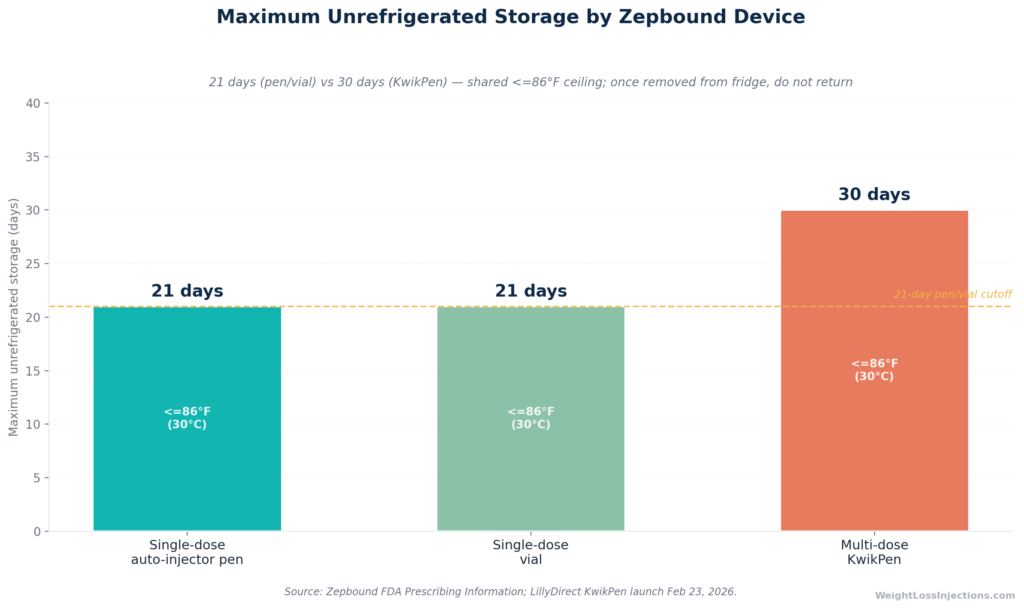
Maximum Unrefrigerated Storage by Zepbound Device
Zepbound single-dose auto-injector pens and single-dose vials can remain unrefrigerated for up to 21 days at temperatures not exceeding 86°F (30°C). The multi-dose KwikPen, which launched February 23, 2026, extends that window to 30 days at the same temperature ceiling per its updated FDA label.
Once any Zepbound device has left the refrigerator, it must never go back. Exceed the time limit, exceed 86°F, or spot cloudiness, discard, no exceptions.
The Official Unrefrigerated Storage Rules by Device
Three Zepbound delivery formats are on the U.S. market as of April 2026, and they do not share identical storage rules. The difference matters most to patients managing a vacation, a work trip, a power outage, or a KwikPen that’s been sitting on the bathroom counter for three weeks.
Single-Dose Auto-Injector Pen: 21 Days at ≤86°F
The original Zepbound device, a prefilled, color-coded, single-use auto-injector, is available in all six dose strengths (2.5 mg through 15 mg). Per the Zepbound FDA prescribing information, each pen may be stored unrefrigerated at temperatures not exceeding 30°C (86°F) for up to 21 days.
The clock starts the moment the pen leaves refrigerated storage (36°F–46°F). There is no pause, no reset, and no way to extend the countdown by briefly returning the pen to the fridge. The 21-day limit applies uniformly across all six dose strengths and is confirmed in the Zepbound single-dose pen Instructions for Use (IFU).
Two rules are non-negotiable once the pen is out:
- Do not re-refrigerate. The FDA label explicitly states that once a pen has been stored at room temperature, it must not be returned to the refrigerator. Temperature cycling — repeated transitions between cold and warm — accelerates peptide degradation beyond what either temperature alone would produce.
- Discard after 21 days. Even if the solution looks completely clear and normal, a pen at room temperature for more than 21 days must be discarded in a puncture-resistant sharps container.
Single-Dose Vial: 21 Days at ≤86°F
Single-dose vials, available through LillyDirect’s self-pay program at lower price points than pens — follow identical unrefrigerated storage parameters to the auto-injector pen. Per the Zepbound prescribing information, vials may be stored at temperatures not exceeding 30°C (86°F) for up to 21 days after removal from the refrigerator.
Unlike the pen, each vial requires a separate syringe and needle for each dose draw. That handling difference does not change the 21-day stability window, but there is an important vial-specific rule: once punctured to draw a dose, the vial must be used immediately. There is no partial-use storage for a punctured vial, draw the dose, inject, then discard the remaining contents and the vial per Zepbound IFU guidance. The 21-day countdown applies to the sealed, unpunctured vial stored outside the fridge.
Multi-Dose KwikPen: 30 Days at ≤86°F
The Zepbound KwikPen received FDA label expansion approval on February 23, 2026, and launched the same day through LillyDirect for self-pay patients. As reported at the CNBC KwikPen launch coverage (February 23, 2026), the KwikPen contains four weekly doses per pen, one full month of treatment, and was designed to simplify once-monthly dispensing.
The unrefrigerated window for the KwikPen is 30 days at ≤86°F (30°C) — the longest of any current Zepbound device format. This extended window directly reflects the multi-dose design: the pen is intended to be in active use for a full month, so its stability data and label specifications accommodate that duration. The no-re-refrigeration rule applies equally to the KwikPen.
One availability note: as of April 2026, the KwikPen is accessible only through LillyDirect for self-pay patients. It is not yet available through traditional retail pharmacies or for commercially insured patients, per the Eli Lilly KwikPen launch announcement.
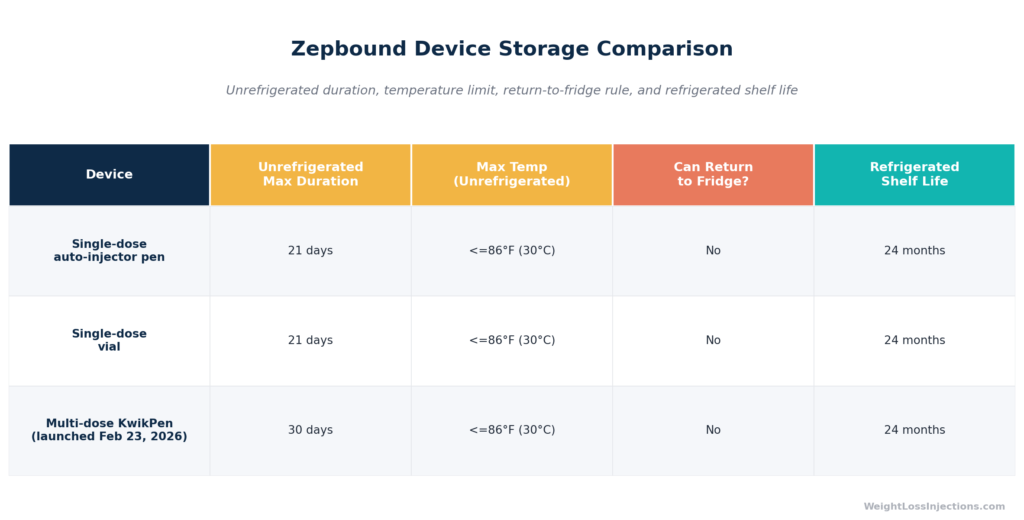
Zepbound Device Storage Comparison Table
Why 86°F and Why It’s a Hard Ceiling
Temperature-Dependent Protein Stability
Tirzepatide is a 39-amino-acid synthetic peptide, a carefully folded molecular structure that must arrive at your GIP and GLP-1 receptors in its intact, correctly shaped form to produce appetite suppression and metabolic effects, per the FDA pharmacology review for NDA 217806. When that structure is compromised by heat, the drug becomes less effective or inert, not toxic, but unreliable.
At refrigerated temperatures (36°F–46°F), tirzepatide is highly stable. The Zepbound prescribing information specifies a 24-month shelf life from manufacture when stored continuously in the original carton in the refrigerator. As temperature rises, two degradation pathways accelerate:
- Aggregation: Tirzepatide molecules begin clustering into larger assemblages that precipitate from solution. Early aggregation is invisible to the naked eye; advanced aggregation produces cloudiness or visible particles.
- Oxidation: Amino acid residues — particularly methionine — oxidize at elevated temperatures, altering the peptide’s three-dimensional conformation and reducing its receptor-binding affinity.
Both processes are cumulative and irreversible. A pen stored at 75°F for 18 days has undergone a predictable, manageable amount of degradation that the 21-day window accounts for. The same pen stored at 92°F for just three days may have exceeded that degradation threshold entirely. This is why 86°F is not a comfortable average — it is the hard ceiling above which stability data no longer apply.
What “Controlled Room Temperature” Actually Means
Standard pharmaceutical terminology defines “controlled room temperature” as approximately 68°F–77°F (20°C–25°C), with short excursions up to 30°C (86°F) permitted under certain conditions. For Zepbound, the FDA label sets the ceiling at 30°C and treats it as an absolute limit — not an average, not a range to fluctuate around, per the Zepbound prescribing information.
In real-world terms:
- A well-air-conditioned home at 70°F is comfortably within range year-round.
- A hotel room set to 78°F is still within range.
- A car parked in shade on a mild 70°F day may stay within range.
- A car parked in direct sunlight on an 85°F summer day will exceed 86°F within 10–15 minutes — and can reach 120°F–150°F within an hour.
The 86°F ceiling means that “room temperature” storage is not safe in all rooms, at all times, in all seasons. The environment matters, and it requires active monitoring in edge cases.
Why You Can Never Put It Back in the Fridge
The no-re-refrigeration rule is among the most counterintuitive Zepbound storage rules for patients who are accustomed to other medications. The reasoning is mechanistic, not arbitrary.
When a peptide solution transitions from refrigerated to room temperature and back repeatedly, three things happen: the solution undergoes micro-expansion and contraction cycles that stress the glass-liquid interface; condensation forms and re-dissolves at the inner surfaces of the pen or carton; and the tirzepatide molecule itself experiences repeated shifts in its hydration shell, the water molecules that stabilize its three-dimensional structure. These cycling stresses compound one another and can drive aggregation faster than continuous storage at either temperature alone.
Critically, the 21-day and 30-day stability windows were established using continuous room-temperature exposure in controlled FDA review studies, per the Zepbound prescribing information. A pen that has cycled between fridge and counter three times in 10 days has not simply “used up” 10 days, it has accumulated stresses that those studies did not account for. The one-way gate exists to prevent patients from incorrectly believing the countdown has been paused.
Hot Cars: The Single Biggest Unrefrigerated Risk
Leaving Zepbound in a parked car is the most common way patients unknowingly exceed the 86°F storage ceiling — and unlike most storage errors, it can happen in under an hour.
Vehicle interior temperatures are dramatically higher than ambient air temperatures. A car parked in direct summer sunlight at an 85°F ambient temperature can reach 104°F within 10 minutes and 119°F within 20 minutes, according to published vehicle heat studies cited by the National Highway Traffic Safety Administration. Dashboard surfaces and glove compartment areas can run 30°F–40°F hotter than the ambient car interior. Any Zepbound pen, vial, or KwikPen left on a dashboard or in a glove compartment on a warm sunny day has almost certainly exceeded 86°F.
Key car-related scenarios and what to do:
Scenario: You drove to work and forgot the pen in the car for 4 hours on a 90°F day.
The car interior almost certainly exceeded 86°F. Discard the pen even if it was only a few days into the room-temperature window. The temperature exceedance, not the time elapsed, is the trigger for discard.
Scenario: You drove to the pharmacy, picked up your Zepbound, and left it in the car for 30 minutes while running another errand on a mild 65°F overcast day.
The vehicle interior likely remained below 86°F, particularly in a shaded area or with windows cracked. This is within the acceptable range. Proceed, but do not make a habit of car storage.
Scenario: You keep your Zepbound in your car’s center console for “easy access” all week.
Unless your vehicle is consistently in a temperature-controlled garage and the ambient temperature never exceeds 70°F, this is not a safe storage strategy. Any day that the sun warms the car above 86°F at the pen’s location has triggered a discard obligation. Use your home refrigerator.
If you are ever unsure whether a pen was exposed to heat above 86°F in a vehicle, the conservative answer is to discard and replace it. A single degraded injection carries more consequence than the cost and inconvenience of a replacement.
Air Travel With Zepbound: TSA, Altitude, and Insulated Bags
Flying with Zepbound introduces two distinct storage concerns: temperature during transit and security screening.
Carry-On Only, Never Checked Luggage
This rule is absolute and applies regardless of season or destination. Cargo holds on commercial aircraft are not temperature-controlled to a consistent standard. During cruise altitude, cargo hold temperatures can fall well below 32°F, which means a pen or vial in checked luggage could freeze at altitude, permanently denaturing the tirzepatide peptide per the Zepbound prescribing information. (For more on freezing risk, see Can Zepbound Be Frozen?.) Conversely, on a hot tarmac during a connection delay, unventilated cargo holds can reach temperatures well above 86°F.
Carry-on storage keeps Zepbound in the climate-controlled cabin where ambient temperature is approximately 70°F–75°F throughout the flight, safely within range.
TSA Screening
The TSA’s medical items policy permits injectable medications, including auto-injector pens and vials, in carry-on luggage in quantities exceeding the standard 3.4 oz liquid limit for personal medical use. You do not need a separate clear bag. Recommended steps:
- Keep the pen or vial in its original labeled carton.
- Carry the prescription label or pharmacy printout — TSA may request it, and it significantly speeds screening.
- Inform the officer at the checkpoint that you are carrying injectable medication and a cooling pack if applicable.
- Gel ice packs and cooling pouches used with injectable medications are generally allowed through security, though they may trigger additional inspection. Completely frozen ice packs are treated as solids and pass without restriction; partially melted gel packs may be scrutinized under liquid rules.
Never use dry ice. Dry ice (solid CO₂) transitions to gaseous form at −109.3°F and is regulated as a hazardous material by the TSA and airlines. In an enclosed overhead bin, dry ice off-gassing can displace oxygen. Use standard gel packs or evaporative cooling pouches instead.
Insulated Travel Cases and Gel Packs
For flights under four hours in a temperature-controlled cabin, most passengers do not need an insulated case — standard room-temperature storage applies throughout. For longer flights, layovers in hot terminals, or travel to high-temperature destinations, consider:
- Soft-sided insulated medical cooler bags (Medicool, 4AllFamily, and similar brands) maintain temperatures in the 36°F–77°F range for 24–48 hours with standard gel packs. These are appropriate for Zepbound whether or not you need refrigeration, as they provide a temperature buffer against terminal heat and tarmac delays.
- Gel ice packs: Do not place gel packs in direct contact with the pen or vial. A frozen gel pack will be −4°F to 23°F at the surface — cold enough to freeze the medication. Wrap the gel pack in a cloth layer or place it in a compartment separated from the pen by insulation. The goal is maintaining 36°F–77°F, not achieving maximum cold.
- Frio® evaporative cooling pouches: These neoprene pouches activate with water and maintain temperatures between 59°F and 77°F for up to 45 hours without ice, relying on evaporative cooling. They are compact, reusable, and TSA-compatible. They are widely used for insulin travel and are equally appropriate for Zepbound. The temperature range they maintain (59°F–77°F) is well within Zepbound’s unrefrigerated ceiling.
If your destination has a refrigerator (hotel, rental accommodation, family home), plan to refrigerate on arrival for trips under the applicable RT window, this preserves the countdown and keeps the pen within the 21-day or 30-day limit throughout a longer stay.
Power Outages: How Long Is Your Zepbound Safe?
Power outages introduce a distinct storage challenge: you have Zepbound correctly refrigerated, and suddenly you don’t know when the cold will return.
What Happens Inside a Closed Refrigerator
A full, well-sealed refrigerator maintains safe temperatures (below 40°F) for approximately 4 hours after a power outage with the door kept closed, according to FDA food safety guidance on power outages. This same general principle applies to medication storage — the insulated environment slows warming significantly as long as the door is not opened repeatedly.
During a power outage:
- Keep the refrigerator door closed. Every time the door opens, cold air escapes and the interior warms faster. If you are not accessing Zepbound, keep the door shut.
- After 4 hours without power (full fridge) or 2 hours (less-full fridge), the interior temperature begins to approach the Zepbound storage ceiling. If the power outage is expected to extend beyond 4 hours, move your Zepbound to a cooler with ice.
- Cooler setup: A soft-sided insulated cooler with ice packs can maintain 36°F–46°F for 12–24 hours depending on insulation quality and ambient temperature. Place the Zepbound pen or vial inside the original carton and keep it away from direct ice contact (use the wrapped-pack approach described above). Monitor with a small thermometer if possible.
- If the outage ends and power is restored within 4 hours: Return Zepbound to the refrigerator. The transition was brief enough that no room-temperature countdown was triggered.
- If the power outage exceeds 4 hours and Zepbound was held at controlled room temperature during that time: The unrefrigerated clock is now running. Note the date and time you are certain the medication exceeded refrigerator temperature. That moment is Day 0 of the 21-day (or 30-day for KwikPen) countdown.
After an extended outage, do not assume the pen is fine simply because it feels cool. Surface temperature is not a reliable indicator of whether the interior of the pen or vial exceeded 86°F during the warmest part of the outage. If you have a temperature data logger (see below) or a min/max thermometer in the storage area, use those readings to verify. If you have no temperature record and the outage lasted more than 4–6 hours in a warm environment, treating the pen as having entered room-temperature storage is the conservative and correct approach.
Hotel Rooms: Don’t Use the Mini-Fridge Without Checking It
Extended hotel stays — over 21 days for pen/vial users, or over 30 days for KwikPen users — require refrigerated storage. The hotel mini-fridge seems like an obvious solution, but there is a significant caveat: many hotel mini-fridges run at 35°F–50°F, meaning some will maintain appropriate Zepbound temperatures and some will not.
More importantly, hotel mini-fridges are notorious for inconsistent temperature control. A mini-fridge set to its coldest setting can easily dip below 32°F — freezing your Zepbound — especially overnight when the ambient room temperature drops with the AC running. A mini-fridge set to medium may run at 45°F–50°F, which is marginally acceptable but warmer than ideal.
Steps for hotel storage:
- Bring a small thermometer (a compact probe or adhesive min/max thermometer). Place it in the fridge compartment when you arrive and check it 1–2 hours later. Aim for 36°F–46°F (2°C–8°C).
- Do not use the freezer compartment — even for brief storage. A mini-fridge freezer runs at 0°F to 10°F and will freeze Zepbound within minutes.
- Keep the pen in its original carton inside the fridge, not loose on the shelf.
- For trips under 21 days (pen/vial) or 30 days (KwikPen), you do not need the mini-fridge at all — as long as the room stays at or below 86°F. A hotel room with functional air conditioning and no direct sun exposure on the medication typically maintains well below the 86°F ceiling.
Our Top 3 · October 2026
The best GLP-1 providers right now
Independently reviewed. Ranked by price, medication access, provider quality, and patient outcomes.
Renew GLP
Personalized GLP-1, GIP plans: Semaglutide & Tirzepatide.
Medvi
No membership or hidden fees. Everything you need is included.
Trimi
US-licensed clinicians and shipped to your door, from $99/mo.
Camping, Beach Days, and Outdoor Events
Camping trips and beach outings present the same core challenge as car storage: ambient temperatures can exceed 86°F, and there may be no refrigerator anywhere in range.
Camping
For overnight camping trips under 21 days (pen/vial) or 30 days (KwikPen), room-temperature storage is entirely acceptable, provided temperatures stay within range. Key considerations:
- Tent and vehicle storage: A tent in direct afternoon sun can easily reach 100°F+. Store Zepbound in the shadiest, most insulated location available — inside a soft cooler with ambient ice (not direct contact), a shaded gear bag, or an insulated pouch. If daytime highs are reliably below 86°F, a shaded bag at ground level will typically stay within range.
- Camping coolers: A hard-sided cooler with ice packs maintains cold temperatures for 24–72 hours depending on cooler quality and ice replenishment. This is appropriate for Zepbound, with the same wrapped-ice-pack precaution to prevent freezing.
- Temperature loggers: For multi-day backpacking where you have no way to monitor conditions, a small USB temperature data logger (discussed below) attached to the pen carton provides a verifiable temperature record for the duration of the trip.
Beach Days
A single beach day, 6–8 hours out, does not pose a time problem; even the shortest Zepbound window is 21 days. The risk is temperature. A Zepbound pen left in a beach bag in direct sunlight on an 85°F beach day can reach temperatures well above 86°F within an hour. Solutions:
- Keep the pen in an insulated pouch or small soft-sided cooler in the shade.
- If you bring a beach cooler with ice, store the pen there using the wrapped-pack method.
- Do not leave Zepbound unattended in a hot car while you are at the beach.
Returning From Vacation: “Oops, I Forgot” Situations
The most common real-world scenario: you come home, unpack your bag, and find a Zepbound pen that has been sitting at room temperature for an indeterminate number of days. What do you do?
Build the Timeline
Work backward from when you are certain the pen was last refrigerated. Check:
- When did you last take an injection from a refrigerated pen? That date establishes the latest possible removal date.
- Do you have any record — a pharmacy receipt, a calendar reminder, a shipping notification — that pins down when the pen came out of the fridge?
- Was the pen in a cool environment (air-conditioned bag, insulated pouch) during travel, or in an ambient environment?
If you can establish that the pen has been unrefrigerated for fewer than 21 days (pen/vial) or fewer than 30 days (KwikPen), and that it has not been exposed to temperatures above 86°F, it is within the approved storage window.
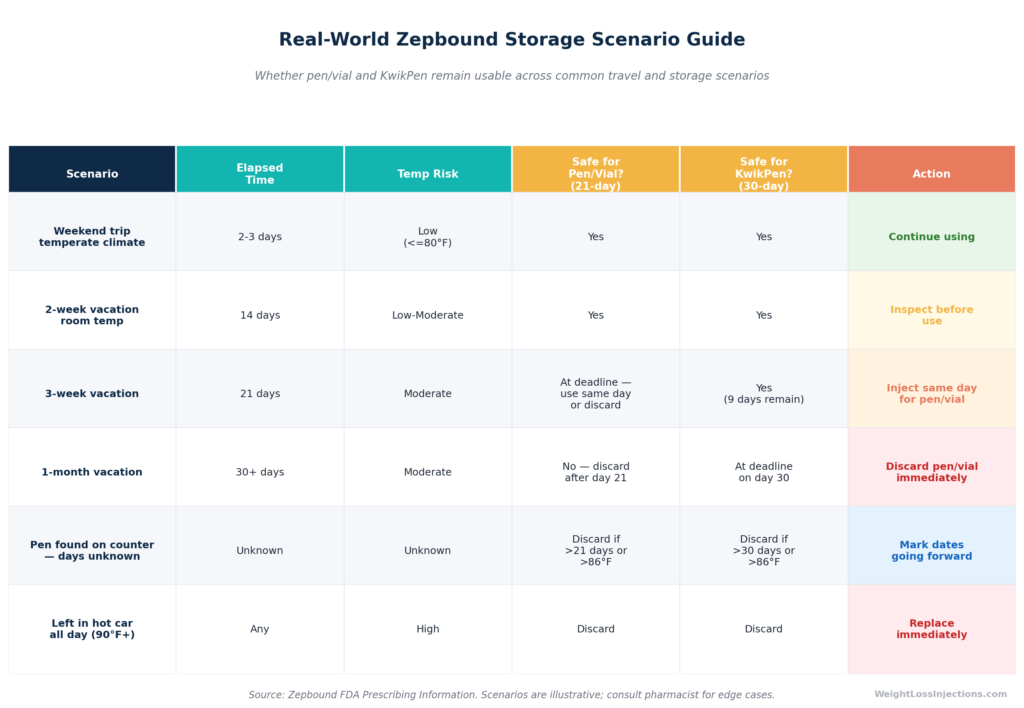
Real-World Scenario Decision Table
The “I Have No Idea How Long It’s Been” Problem
If you genuinely cannot reconstruct the timeline and the pen could plausibly have exceeded 21 days (or 30 days for the KwikPen), discard it. A replacement prescription is worth far more than the risk of an ineffective injection, and the Zepbound prescribing information does not leave room for guessing.
A simple habit prevents this scenario going forward: write the removal date on the pen carton with a permanent marker the moment it leaves the fridge. Two seconds now eliminates all ambiguity later.
When Room-Temperature Storage Was Unplanned
If the pen was out for more than 21 days but the temperature was consistently cool, say, an air-conditioned 72°F apartment where you are certain the pen was kept, the tirzepatide has still exceeded its tested stability window. The 21-day limit is based on controlled stability studies reviewed by the FDA, not a conservative estimate with a hidden safety buffer. Do not assume that “cool enough” extends the window. Per the Zepbound FDA prescribing information, the time limit applies regardless of temperature within the acceptable range.
What to Check Before Every Injection
Regardless of how long the pen has been out, a pre-injection appearance check is required before every dose. Per the Zepbound single-dose pen Instructions for Use, the solution should be:
- Colorless to slightly yellow: A faint yellow tint is normal and acceptable.
- Clear: No cloudiness, no haze.
- Particle-free: No visible specks, floating material, or precipitate.
Discard the pen or vial immediately — regardless of storage history — if you observe:
- Cloudiness or haziness (early-stage aggregation)
- Marked discoloration (beyond pale yellow — brown, amber, or opaque)
- Visible particles or precipitate (advanced aggregation)
- Damaged or compromised packaging (cracked pen, compromised carton)
An appearance check catches gross degradation but not sub-threshold molecular degradation. A solution can pass a visual inspection and still be partially degraded if it has been stored improperly. The storage rules are your primary protection; the appearance check is your safety net for catching visible signs of failure.
Temperature Monitoring Tools
For patients who travel frequently, camp, or manage power outages, passive observation is not enough. Several affordable tools let you verify that Zepbound has stayed within range:
Min/Max Thermometers
A compact digital min/max thermometer (available for $10–$20 at hardware and pharmacy retailers) records the highest and lowest temperatures reached since last reset. Place one in the storage bag, cooler, or hotel fridge. When you return, check the maximum temperature. If it stayed below 86°F, your Zepbound is within range. Reset before the next trip.
USB Temperature Data Loggers
USB data loggers (brands include Elitech, Govee, and MadgeTech; prices range from $15–$80) record a continuous time-stamped temperature log that you download to a computer after the trip. They provide an auditable record of every temperature point during storage — invaluable for multi-day camping trips, international travel, or any situation where you need to verify a full temperature timeline. Some models send real-time alerts via Bluetooth or WiFi if the temperature exceeds a threshold.
Bluetooth Refrigerator Sensors
Bluetooth-connected temperature sensors (Inkbird, Govee Refrigerator Sensor, and similar) pair with a smartphone app and send alerts if your refrigerator temperature goes out of range. These are useful for catching refrigerator malfunctions before they compromise your supply — particularly helpful if you stock multiple months of Zepbound at home.
For most patients, a simple min/max thermometer in their travel bag is sufficient. For patients who frequently travel to hot climates or who have experienced storage uncertainty before, a USB data logger adds a level of confidence that is worth the modest cost.
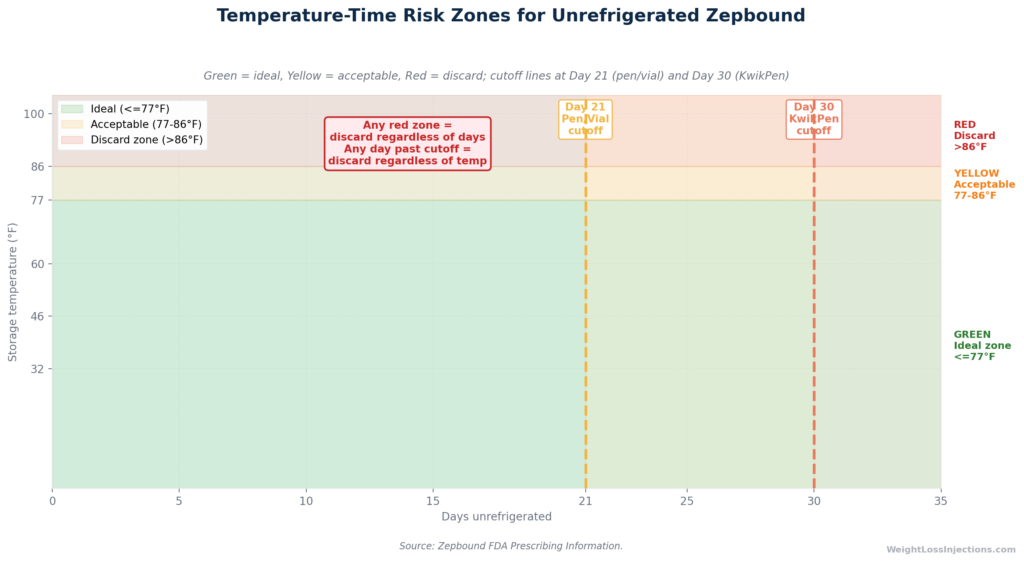
Temperature-Time Risk Zones for Unrefrigerated Zepbound
Zepbound Storage Best Practices: Summary by Situation
At Home
- Store all Zepbound in the original carton on a middle refrigerator shelf — away from the door, away from cooling vents, and never in the freezer.
- Refrigerator temperature: 36°F–46°F (2°C–8°C) per the Zepbound prescribing information.
- Take pens out one at a time, only when you are ready to start the 21-day countdown (usually the night before your injection day, or 30 minutes before use if you prefer a shorter warm-up).
- Mark the removal date on the carton immediately.
Short Trips (Under 21 Days for Pen/Vial, Under 30 Days for KwikPen)
- Room-temperature storage is fully acceptable if ambient temperatures stay at or below 86°F.
- Keep the pen in its original carton in a carry-on bag for air travel, never checked luggage.
- Use an insulated pouch or min/max thermometer if ambient temperature may approach the 86°F ceiling.
Extended Trips and Hot Destinations
- Plan for refrigeration at your destination for trips exceeding the applicable RT window.
- For hot-weather destinations, use an evaporative cooling pouch (Frio® or equivalent) or insulated travel case during transit.
- Confirm hotel mini-fridge temperature on arrival with a probe thermometer before placing Zepbound inside.
Power Outages
- Keep the refrigerator door closed.
- If outage exceeds 4 hours: move to an insulated cooler with wrapped ice packs.
- Note the exact time Zepbound entered room-temperature conditions — that is Day 0 of the countdown.
When in Doubt
Contact Eli Lilly’s customer service line at 1-800-545-5979, or reach out to the WeightLossInjections.com care team. Both can advise on whether a replacement prescription is needed based on your specific storage situation. Do not skip an injection while waiting for guidance, contact your prescriber about a temporary bridge dose if the situation is unclear and your injection day is approaching.
Our Take at WeightLossInjections.com
Our take at WeightLossInjections.com: Zepbound’s unrefrigerated storage rules are among the most practically consequential details of the treatment, and also among the least consistently communicated at the point of dispensing. Many patients learn the 21-day rule but do not know that it applies differently to the KwikPen. Fewer still know the exact implications of a hot car, a multi-day power outage, or a pen left in a hotel room without air conditioning.
The three device-specific numbers are worth memorizing: 21 days for single-dose pens, 21 days for single-dose vials, 30 days for the KwikPen — all at ≤86°F, all one-way (no return to the fridge), and all non-negotiable.
The clinical stakes are worth emphasizing: tirzepatide’s efficacy in SURMOUNT-1 through SURMOUNT-4, the weight loss results ranging from 15.0% to 22.5% at 72 weeks for the 15 mg dose, was produced by patients who received intact, properly stored medication on a strict weekly schedule, per the SURMOUNT-1 trial published in the New England Journal of Medicine (Jastreboff et al., 2022). A storage error that produces even a partially degraded dose breaks that pharmacological chain. Patients who notice their appetite returning unusually early after an injection should consider storage history as a possible variable, not just dose or timing.
At WeightLossInjections.com, patients enrolled in [service detail] work with licensed telehealth prescribers who are available to evaluate replacement prescriptions for storage-compromised pens, typically on a same-day or next-day basis. Our monthly program starts at [$X/month]. If you have ever discarded a pen and delayed your next injection by days waiting for a replacement, that delay gap is exactly what our team exists to minimize.
The single best habit: date every pen the day it leaves the fridge. Two seconds now, zero ambiguity later.
Frequently Asked Questions
Single-dose auto-injector pens and single-dose vials can remain unrefrigerated at temperatures not exceeding 86°F (30°C) for a maximum of 21 days per the Zepbound FDA prescribing information. The multi-dose KwikPen, launched February 23, 2026, has a longer window of 30 days at the same temperature ceiling, per its updated FDA label covered in CNBC’s KwikPen launch coverage (February 2026). Once either window is exceeded, the device must be discarded in a sharps container, do not inject, even if the solution appears normal.
No. The Zepbound prescribing information explicitly states that once Zepbound has been stored at room temperature, it must not be returned to the refrigerator. Once the countdown starts, it is a single uninterrupted window. Temperature cycling between cold and warm, even when each temperature is within its individual acceptable range — accelerates peptide degradation through mechanisms including aggregation, oxidation, and physical stress at the glass-solution interface. This rule applies equally to all three device formats: single-dose pen, single-dose vial, and KwikPen.
Discard it immediately. The Zepbound prescribing information specifies that storage temperatures must not exceed 30°C (86°F). Any confirmed or likely exposure above 86°F, whether from a hot car, direct sun, extreme ambient heat, or a warm environment during a power outage — triggers an immediate discard obligation regardless of where the pen is in its 21-day or 30-day window. Heat above 86°F accelerates the aggregation and oxidation processes that degrade tirzepatide’s receptor-binding activity. The degraded dose is not toxic, but it is ineffective. Contact your pharmacy or prescriber for a replacement.
Yes. The TSA’s medical items policy permits injectable medications in carry-on luggage in quantities exceeding the standard 3.4 oz liquid limit for personal medical use. Carry Zepbound in its original labeled carton with your prescription label. Declare the medication and any cooling packs at the checkpoint. Always carry Zepbound in carry-on luggage, never in checked baggage, where cargo hold temperatures can drop below freezing at altitude or rise above 86°F on hot tarmacs. Freezing permanently destroys tirzepatide’s effectiveness, per the Zepbound prescribing information.
Discard it and contact your pharmacy or prescriber for a replacement. Car interiors in direct sun can reach 120°F–150°F within 20–30 minutes on warm days, far above the 86°F ceiling. If the pen was in the car for more than a few minutes during warm weather, assume the temperature limit was breached. Do not inject. A visual inspection is not sufficient to detect heat-induced molecular degradation, the solution can look perfectly clear and normal while being significantly compromised. For ongoing travel, use a soft-sided insulated bag with the medication kept inside the cabin at all times.
The 30-day room-temperature window for the KwikPen begins the moment the pen is removed from refrigerated storage, not the first time a dose is administered, per the Zepbound prescribing information. If you take the KwikPen out of the fridge on Day 0 but do not inject your first dose until Day 3, you have 27 days remaining in the window, not 30 days from Day 3. Mark the removal date on the pen’s carton at the moment you take it out of the fridge. After 30 days from that removal date, discard the pen even if doses remain unused.