![Unbranded [pillar-drug-class] injection pen on a neutral background — WeightLossInjections.com editorial hero](https://weightlossinjections.com/wp-content/uploads/2026/05/hero_zepbound_c3_safety-1200x675.png)
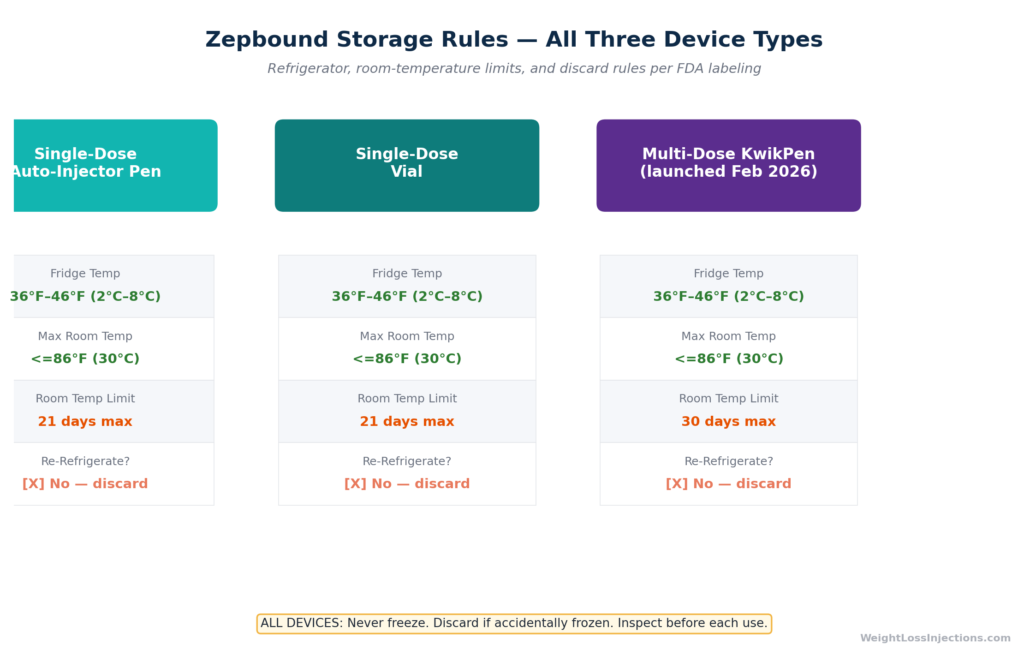
Zepbound Storage Rules Hero: All Three Device Types
Zepbound single-dose auto-injector pens and single-dose vials can be stored at room temperature, at or below 86°F (30°C), for up to 21 days per the Zepbound prescribing information (Eli Lilly). The newer multi-dose KwikPen, launched February 23, 2026, carries a separate 30-day room-temperature allowance per its updated FDA label. Once any Zepbound device has been stored at room temperature, it must never be returned to the refrigerator. After the applicable window closes, the pen or vial must be discarded, no exceptions, even if the solution looks normal.
The Short Answer: Device-Specific Room-Temperature Windows
Most patients pull their Zepbound out of the fridge the night before an injection to let it warm up, or they forget and find it sitting on the counter for days. The answer to “is it still okay?” depends entirely on which device you have and how long it has been out.
As of April 2026, three Zepbound delivery formats are on the market, and they do not all share the same storage rules.
Single-Dose Auto-Injector Pens: 21 Days Maximum
The original and most widely used Zepbound device, the single-dose auto-injector pen, may be stored outside the refrigerator at temperatures not exceeding 30°C (86°F) for up to 21 days, per the Zepbound FDA prescribing information, How Supplied/Storage section. The 21-day clock starts the moment the pen is removed from refrigerated storage. The pen is available in all six dose strengths — 2.5 mg, 5 mg, 7.5 mg, 10 mg, 12.5 mg, and 15 mg — and this 21-day rule applies uniformly across all strengths.
Two critical rules accompany that window:
- Do not re-refrigerate. Once the pen has been stored at room temperature, it must stay there until use or until discarded. Returning it to the refrigerator, even once, even briefly, accelerates peptide degradation via temperature cycling and is explicitly prohibited by the FDA label.
- Discard after 21 days. If the pen has been at room temperature for more than 21 days, discard it in a puncture-resistant sharps container regardless of appearance. The Zepbound single-dose pen Instructions for Use (IFU) states this without qualification.
Single-Dose Vials: 21 Days Maximum
Zepbound single-dose vials, available through LillyDirect’s self-pay program at lower price points than pens — follow the identical storage parameters as the auto-injector pen. Per the Zepbound prescribing information, vials may be stored at room temperature (≤86°F) for up to 21 days after removal from the refrigerator. The same “no re-refrigeration” rule applies, and the same discard rule governs vials that exceed the window.
Unlike the pen, the vial requires a separate syringe and needle for each dose draw. This does not change the 21-day stability window, but it is worth noting that each vial contains a single dose (0.5 mL), there is no partial-use consideration once the vial has been punctured.
Multi-Dose KwikPen: 30 Days Maximum
The multi-dose Zepbound KwikPen received FDA label expansion approval on February 23, 2026, and launched the same day through LillyDirect for self-pay patients. As reported in the CNBC coverage of the KwikPen launch (February 23, 2026), the KwikPen contains four weekly doses per pen, one month of treatment, and was specifically designed for once-monthly dispensing convenience.
The KwikPen’s room-temperature allowance is 30 days at ≤86°F (30°C). This extended window reflects the multi-dose design: because the pen is intended to last a full month between refills, the stability data and label specifications accommodate the longer in-use period. The “no re-refrigeration” rule applies equally to the KwikPen, once it has been stored at room temperature, it stays there.
One practical note: as of April 2026, the KwikPen is available only through LillyDirect for self-pay patients and is not yet available through traditional retail pharmacies or for commercially insured patients, per Eli Lilly’s LillyDirect KwikPen launch announcement.
Why There Is a Time Limit: Tirzepatide Protein Stability
Understanding the “why” behind storage limits helps make the rules feel less arbitrary, and makes it easier to take them seriously.
Tirzepatide, the active ingredient in Zepbound, is a 39-amino-acid synthetic peptide based on the native GIP sequence with structural modifications, including a C20 fatty diacid moiety that promotes albumin binding, per the FDA pharmacology review for NDA 217806. At refrigerated temperatures (36°F–46°F), this peptide is highly stable, the shelf life in original carton refrigerated storage is 24 months from manufacture, per the Zepbound prescribing information.
At room temperature, the picture changes. Heat accelerates two primary degradation pathways in peptide drugs:
- Protein aggregation: Individual tirzepatide molecules begin to cluster, forming larger molecular assemblages that are less pharmacologically active and may precipitate as visible particles.
- Oxidation: Certain amino acid residues, particularly methionine, are susceptible to oxidation at elevated temperatures. Oxidized residues alter the three-dimensional conformation of the peptide, reducing its ability to bind GIP and GLP-1 receptors with normal affinity.
These processes are cumulative and irreversible. A pen that has spent 15 days at 85°F has not simply “used up” 15 of its 21 days — the structural changes that have occurred cannot be reversed by returning it to the fridge. This is the mechanistic basis for both the time limit and the no-re-refrigeration rule. Temperature cycling between refrigerated and room temperature does not “reset” the degradation clock; it may actually accelerate it by introducing additional physical stress to the solution, per the storage guidance principles reflected in the Zepbound prescribing information.
With an elimination half-life of approximately 5–6 days per the Zepbound prescribing information, tirzepatide stays active in your body for weeks after each injection — but only if it arrives as an intact, properly folded peptide. A degraded dose may produce diminished or absent GIP/GLP-1 receptor activation, leading to less appetite suppression and reduced weight-loss effect. Importantly, degraded tirzepatide is not toxic, the degradation products are peptide fragments that are rapidly cleared, but the dose becomes ineffective.
Appearance Check: Before Every Injection
Per the Zepbound single-dose pen Instructions for Use (IFU), the solution should be colorless to slightly yellow and clear. Before every injection, inspect the solution through the pen’s inspection window. Discard the pen immediately — regardless of where it is in the storage window — if the solution is:
- Cloudy or hazy
- Discolored (markedly yellow, brown, or other colors)
- Containing visible particles or floating material
A slightly yellow tint is normal and acceptable. Cloudiness or particles are not.
Full Storage Rules: Device-by-Device Reference Table
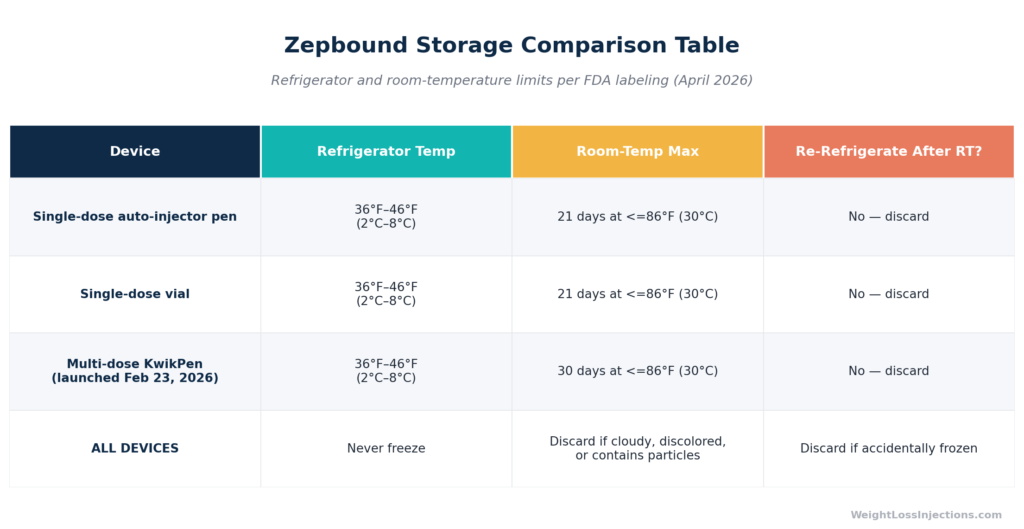
Zepbound Storage Comparison Table
The complete picture, drawn entirely from primary sources:
Refrigerator storage (all devices): 2°C to 8°C (36°F to 46°F). Store in the original carton to protect from light. Shelf life: 24 months from manufacture when refrigerated continuously, per the Zepbound prescribing information. Do not store near the refrigerator’s cooling element or in the door, where temperatures can fluctuate.
Room-temperature storage (pens and vials): Up to 21 days at temperatures not exceeding 30°C (86°F). Protect from light and excessive heat. Do not return to refrigerator, per Zepbound.lilly.com How-to-Use guidance.
Room-temperature storage (KwikPen): Up to 30 days at temperatures not exceeding 30°C (86°F). Same protections, same no-re-refrigeration rule, per the Eli Lilly KwikPen launch announcement.
Freezing — never permitted (all devices): If a Zepbound pen or vial is accidentally frozen, discard it immediately. Do not attempt to thaw and use it. Freezing permanently denatures the peptide structure, it does not simply “pause” stability the way it might for some medications. The Zepbound prescribing information is explicit: do not freeze, do not use if frozen.
Light protection: Keep all Zepbound devices in their original carton when in storage. Peptide drugs can degrade under prolonged UV or fluorescent light exposure; the original packaging provides adequate protection.
I Forgot to Refrigerate My Zepbound — What Now?
This is the most common storage question providers and pharmacists receive, and the answer follows a clear decision tree.
If It Has Been Fewer Than 21 Days (Pens/Vials) or Fewer Than 30 Days (KwikPen)
You are almost certainly fine. Room-temperature stability windows are not conservative estimates with large safety margins trimmed off, they reflect the point at which the drug’s potency begins to fall below acceptable thresholds under controlled study conditions, per pharmaceutical stability testing standards used for FDA approval. Fourteen days left on the counter at 75°F is well within the window.
The action steps:
- Mark the date the pen was removed from the refrigerator if you have not already. Use a label or a phone calendar reminder.
- Store the pen away from direct sunlight and heat sources (not on a windowsill, not in a hot car) for the remainder of its room-temperature window.
- Inspect the solution before your next injection per the appearance check above.
- Proceed with your injection on schedule.
If It Has Been More Than 21 Days (Pens/Vials) or More Than 30 Days (KwikPen)
Discard the pen or vial in a puncture-resistant sharps container, do not inject it. This applies even if the solution looks completely normal. Degradation at the molecular level is not visible to the naked eye; a clear solution can still be a degraded solution once the stability window has passed.
Do not skip your weekly dose without taking action. A missed injection matters because tirzepatide requires consistent weekly exposure to maintain steady-state plasma levels, a lapse can cause appetite and metabolic effects to return before the next dose brings levels back up. Contact your prescribing provider or reach out to WeightLossInjections.com’s telehealth team for a replacement prescription as quickly as possible.
Unsure How Long It Has Been Out?
If you genuinely cannot determine when the pen left the refrigerator, and it could plausibly have been more than 21 days (or 30 days for a KwikPen), the safest course is to discard it and replace it. The cost of discarding one pen is significantly lower than the cost of injecting a degraded dose that fails to suppress appetite and potentially leads to a week of treatment gaps.
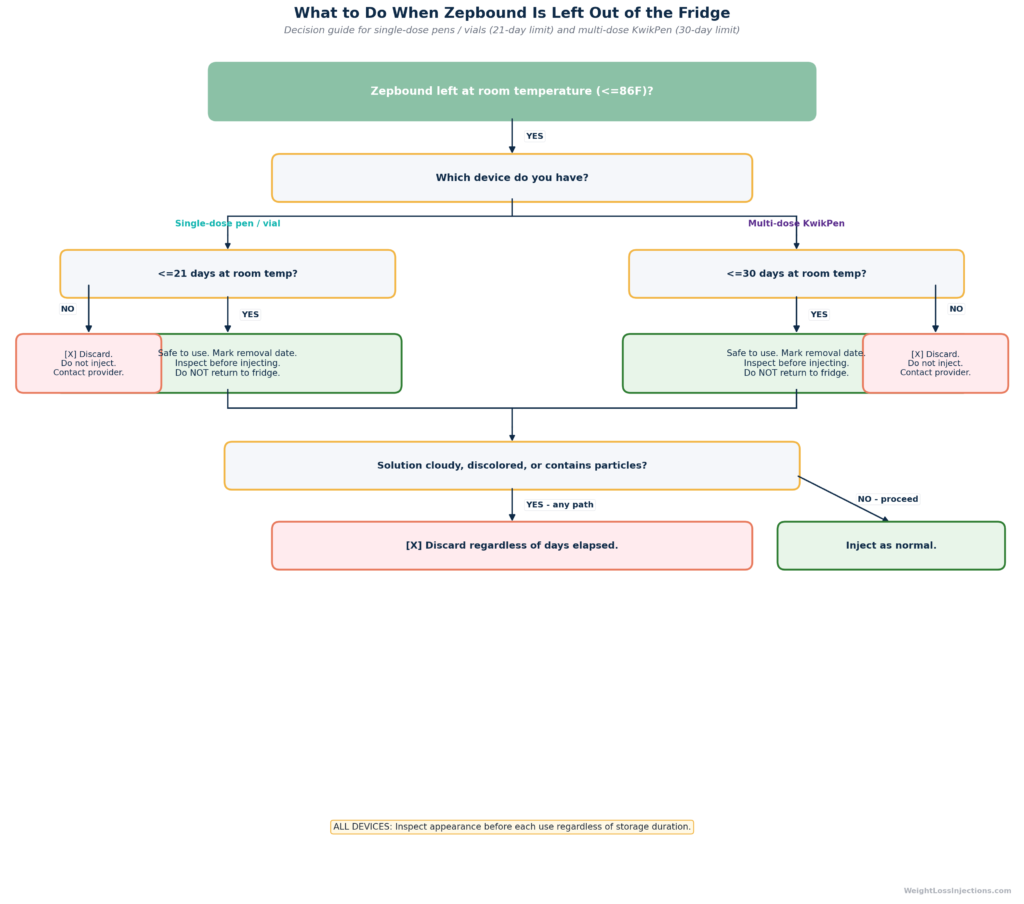
Flowchart: What to Do When Zepbound Is Left Out of the Fridge
Our Top 3 · October 2026
The best GLP-1 providers right now
Independently reviewed. Ranked by price, medication access, provider quality, and patient outcomes.
Renew GLP
Personalized GLP-1, GIP plans: Semaglutide & Tirzepatide.
Medvi
No membership or hidden fees. Everything you need is included.
Trimi
US-licensed clinicians and shipped to your door, from $99/mo.
Traveling With Zepbound: Keeping It Safe Away From Home
Travel is one of the most practically challenging storage situations for Zepbound users, and it is where the 21-day and 30-day room-temperature windows become immediately useful.
Short Trips: Under 21 Days (Pen/Vial) or 30 Days (KwikPen)
For domestic travel lasting less than the applicable room-temperature window, you do not need to keep Zepbound refrigerated, provided the ambient temperature stays at or below 86°F throughout the trip. This covers most short business trips, weekend travel, and domestic vacations during temperate weather.
Practical tips for any trip:
- Keep the pen in its original carton, inside a carry-on bag or personal item, not checked luggage, where cargo holds can expose medications to extreme cold or heat.
- Avoid leaving the pen in a car, especially in summer. Car interiors can reach 120°F–150°F in direct sun, far exceeding the 86°F ceiling within minutes. A single afternoon in a parked car is enough to compromise the stability window.
- TSA and airport security: Zepbound auto-injectors are medical devices and are permitted through airport security. Declare the medication if asked; TSA does not require a separate bag for medical injectables but recommends carrying the prescription label. There is no quantity limit for personal-use medication per TSA medical items policy. Keep ice packs declared separately if you are using a cooler pack, ice packs may require additional screening.
Longer Trips: Over 21 Days (Pen/Vial)
For trips exceeding 21 days, you need to maintain refrigerated storage. Hotel mini-fridges set between 36°F and 46°F are adequate — verify the setting on arrival, as some hotel units run warmer or colder than the display suggests. Insulated travel medication cases with gel ice packs can bridge the hotel check-in period and airport transit; verify that the case holds temperatures between 36°F and 46°F for your expected transit time.
If you are traveling with a KwikPen and the trip is under 30 days, room-temperature storage is acceptable by the label — but if the trip involves destinations with consistently high ambient temperatures (see below), plan accordingly.
Hot-Weather Destinations and International Travel
The 86°F (30°C) ceiling is not generous in many real-world environments. Phoenix in July regularly reaches 110°F outdoors; tropical destinations run 85°F–95°F with high humidity. In these settings, “room temperature” is above the storage limit, which means you cannot safely leave Zepbound in an air-conditioned room and assume the ambient temperature will stay within range if the AC is off or a power outage occurs.
For hot-destination travel, consider:
- Frio® evaporative cooling pouches: These reusable neoprene pouches use evaporative cooling to maintain temperatures between 59°F and 77°F (15°C–25°C) without ice or refrigeration, relying on water activation. They are widely used by insulin-dependent travelers and are equally appropriate for Zepbound storage during transit. Note: this is a lower-temperature range than the 86°F ceiling, giving additional buffer.
- Portable medication coolers with digital temperature monitoring, available from medical travel supply retailers.
- Confirming hotel room air conditioning before booking, and keeping the pen in the coolest part of the room (not near windows).
For international travel, bring the original prescription label on the box. Some countries require documentation for medication quantities that exceed a single traveler’s personal supply; confirm import rules with the embassy of your destination country for extended trips.
Can You Put Zepbound Back in the Fridge After It’s Been Out?
No. This is one of the most commonly misunderstood Zepbound storage rules. The Zepbound prescribing information is explicit: once a pen or vial has been stored at room temperature, it must not be returned to the refrigerator.
The reason is not bureaucratic caution, it is chemistry. Temperature cycling between refrigerated and room-temperature conditions introduces physical stress on the tirzepatide peptide solution beyond what either temperature alone would produce. The repeated contraction and expansion of the solution, along with the condensation and redissolving cycles that occur at the glass-solution interface, can accelerate aggregation. Even if the pen is re-refrigerated and then re-warmed within the 21-day window, the stability data that support the 21-day allowance assume continuous room-temperature storage, not cycling.
There is also a practical risk: if patients believe they can “reset” the clock by re-refrigerating, they may use a pen that has cycled multiple times and is past its actual stability endpoint. The rule is a one-way gate: once out, it stays out, and the 21-day (or 30-day) window counts down continuously from removal.
What Happens if Zepbound Degrades?
A degraded Zepbound dose does not become dangerous, it becomes ineffective. This distinction matters for two reasons.
First, it means patients who inject a degraded pen are not at risk of a toxic reaction. The peptide fragments produced by tirzepatide degradation are cleared through normal metabolic pathways and do not accumulate or cause harm at the concentrations present in a single dose.
Second, and clinically more significant, a degraded dose may produce little to no appetite suppression or glycemic effect for that week’s injection. Per the Zepbound prescribing information, tirzepatide’s pharmacological action depends on intact GIP and GLP-1 receptor engagement. A peptide that has aggregated or oxidized at critical residues will bind these receptors poorly or not at all.
The patient consequence: someone who injects a degraded pen on a Thursday may notice that their appetite returns by the weekend, that food noise comes back earlier than expected, or that the week feels generally different from their usual post-injection pattern. They may incorrectly attribute this to the medication “not working” or to having hit a plateau. This misattribution can lead to unnecessary dose escalation requests or premature discontinuation, both of which carry real clinical consequences.
The practical implication of this is simple: follow the storage rules precisely, and inspect the solution before every injection. Degraded Zepbound rarely looks obviously wrong, the inspection check catches cases of gross degradation (clouding, particles), but sub-threshold molecular degradation is invisible. Proper storage is the only reliable protection.
Our Take at WeightLossInjections.com
Our take at WeightLossInjections.com: The storage rules for Zepbound are not complicated, but they demand consistent attention, and the distinction between device types is something many patients on the KwikPen (launched February 2026) may not have received clear guidance on at the time of their prescription.
Here is the practical framework we recommend communicating to every Zepbound patient:
Step 1: Label every pen or vial when it comes out of the fridge. Use a permanent marker or a small label on the carton: write the date it left refrigeration. This two-second habit eliminates the single biggest source of storage errors — the “I think it’s been about two weeks” problem.
Step 2: Know your device. Pen or vial: 21-day window. KwikPen: 30-day window. These are not interchangeable.
Step 3: Treat 86°F as a hard ceiling, not a comfortable range. Room temperature in a well-air-conditioned home is typically 68°F–72°F — comfortably within range. A car dashboard in summer, a gym bag left in direct sun, or a bathroom that gets steamy during showers are all higher-risk environments than people typically assume.
Step 4: If the pen has been out too long, discard it and reorder quickly. At WeightLossInjections.com, patients enrolled in [service detail] have access to telehealth prescribers who can generate replacement prescriptions for discarded pens on a same-day or next-day basis, minimizing the gap between discard and re-dose. Our monthly telehealth program starts at [$X/month], which includes prescriber access for exactly these situations.
The broader point: Zepbound’s clinical efficacy, the weight-loss results seen in SURMOUNT-1 through SURMOUNT-4, was established under conditions where patients received correctly stored medication on a strict weekly schedule, per the SURMOUNT-1 published trial in the New England Journal of Medicine (Jastreboff et al., 2022). Storage errors introduce an uncontrolled variable that compromises those outcomes. The 21- and 30-day windows exist precisely to give patients real-world flexibility without crossing the line into compromised efficacy.
Traveling With Zepbound: Summary Timeline
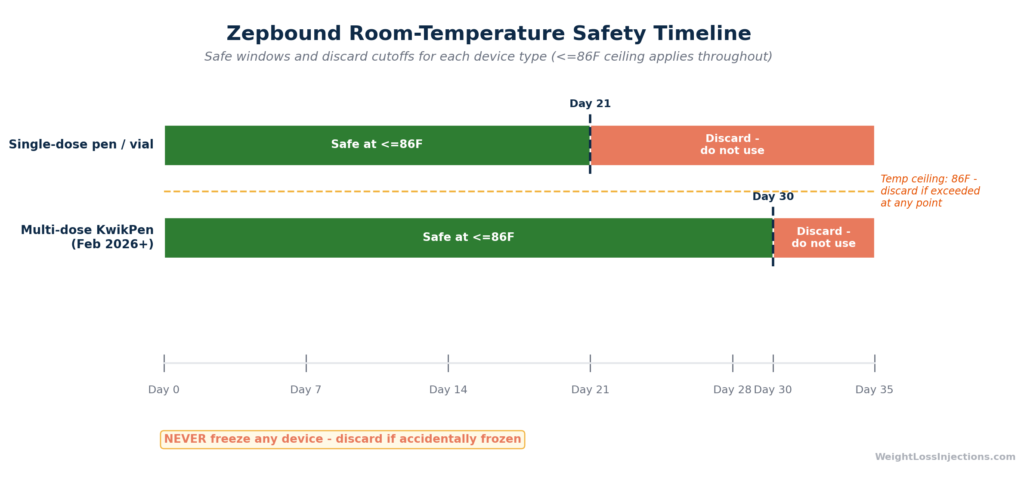
Zepbound Room-Temperature Safety Timeline
Frequently Asked Questions
Single-dose auto-injector pens and single-dose vials: up to 21 days at temperatures at or below 86°F (30°C), per the Zepbound prescribing information. The multi-dose KwikPen (launched February 23, 2026): up to 30 days at the same temperature ceiling, per the KwikPen’s updated FDA label as reported at the Eli Lilly KwikPen launch (CNBC, February 2026). After either window, the device must be discarded, do not inject.
No. The Zepbound prescribing information states that once a pen or vial has been stored at room temperature, it must not be returned to the refrigerator. Temperature cycling between refrigerated and room-temperature conditions accelerates peptide degradation beyond what either temperature alone would produce, even if both temperatures are individually within acceptable ranges. The no-re-refrigeration rule is absolute and applies to all three device types.
Freezing permanently damages tirzepatide’s peptide structure. Per the Zepbound prescribing information, Zepbound must never be frozen. If a pen or vial is accidentally frozen, in a refrigerator with its thermostat set too low, in checked luggage in an unheated cargo hold, or by being placed in a freezer, it must be discarded immediately, even after it has thawed. Thawing does not restore the peptide’s structure after freeze-induced denaturation.
Yes, under the right conditions. For trips shorter than 21 days (pens/vials) or 30 days (KwikPen), you do not need refrigeration as long as the ambient temperature consistently stays at or below 86°F. Keep the pen in a carry-on bag, not checked luggage. For hot-weather destinations where ambient temperatures regularly exceed 86°F, summer travel to desert regions, tropical climates — use an evaporative cooling pouch (such as a Frio® pouch) or an insulated travel case to maintain temperatures within range. For any trip exceeding the applicable room-temperature window, refrigerated storage throughout the trip is required, per the Zepbound.lilly.com How-to-Use page.
Before every injection, inspect the solution through the pen’s viewing window. Per the Zepbound single-dose pen Instructions for Use (IFU), the solution should appear colorless to slightly yellow and clear. Discard the pen and do not inject if the solution is cloudy, hazy, significantly discolored, or contains visible particles or floating matter. A slightly yellow tint is normal. If the solution passes the appearance check but the pen has exceeded its room-temperature window, discard it anyway, molecular-level degradation is not visible to the naked eye.
Yes. The multi-dose KwikPen, launched February 23, 2026 and available via LillyDirect for self-pay patients, has a 30-day room-temperature allowance (vs. 21 days for single-dose pens and vials), per its updated FDA label expansion as covered in the Eli Lilly KwikPen launch announcement (CNBC, February 2026). This extended window was built into the KwikPen’s design to accommodate a full month of once-weekly dosing from a single pen without requiring refrigerator access between uses. The temperature ceiling (≤86°F) and the no-re-refrigeration rule are the same for all three device types. Note that the KwikPen is currently only available through LillyDirect for self-pay patients and is not yet accessible through traditional pharmacies or for commercially insured patients.