
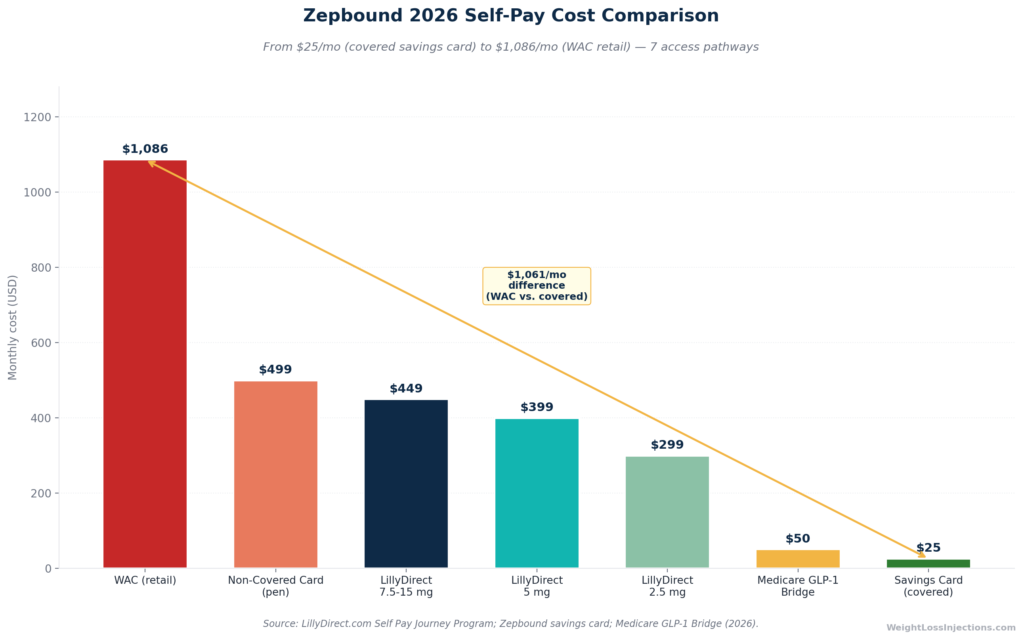
Zepbound 2026 Self-Pay Cost Comparison
Zepbound’s list price is $1,086/mo for all six dose strengths, but six legitimate paths exist in 2026 that can cut that cost dramatically. For most uninsured patients under 65, LillyDirect’s Self Pay Journey Program delivers single-dose vials or KwikPens starting at $299/mo (2.5 mg), $399/mo (5 mg), or $449/mo (7.5–15 mg). Medicare Part D beneficiaries gain a new $50/mo bridge program running July 1–December 31, 2026.
Low-income patients without insurance may qualify for free medication through the Lilly Cares Foundation. Compounded tirzepatide is no longer legally available from general pharmacy compounders, both the 503A and 503B windows closed in early 2025. Every path in this guide requires a valid prescription; that is where the process starts.
Why Getting Zepbound Without Insurance Is More Manageable Than the List Price Implies
When the pharmacy runs a Zepbound prescription without any insurance or savings program, the cash register reflects the Wholesale Acquisition Cost: $1,086/mo for all dose strengths, per Eli Lilly’s published pricing. That number appears in most news coverage and makes Zepbound sound categorically unaffordable for uninsured patients.
The actual picture in 2026 is more nuanced. Since late 2024, Eli Lilly has built a direct-to-consumer infrastructure that puts branded Zepbound within reach of patients who have no commercial coverage. Two new access pathways launched in 2026, the multi-dose KwikPen (February 23, 2026) and the Medicare GLP-1 Bridge program (July–December 2026), expand those options further. The Lilly Cares Foundation patient assistance program has long covered the lowest-income tier at no cost.
What this guide does that most competitors do not: it covers all six paths in order from lowest to highest cost, explains who qualifies for each, and provides a step-by-step enrollment process so you can actually use the cheapest program that applies to your situation. The companion article How Much Does Zepbound Cost Without Insurance in 2026? covers pricing mechanics in detail; this article focuses on how to get it.
Your Six Paths to Zepbound Without Standard Insurance in 2026 — At a Glance
| Path | Who Qualifies | Estimated Monthly Cost |
|---|---|---|
| 1. LillyDirect vials (Self Pay Journey Program) | Uninsured or self-pay patients; valid prescription required | $299–$449/mo |
| 2. LillyDirect KwikPen (Self Pay Journey Program) | Uninsured or self-pay patients; valid prescription required | $299–$449/mo |
| 3. Savings card — non-covered benefit (commercially insured, plan doesn’t cover Zepbound) | Must have commercial drug insurance; NOT for uninsured | $499/mo (pen) or $299–$449/mo (KwikPen) |
| 4. Lilly Cares Foundation PAP | Low-income, uninsured or underinsured; income-based | $0 (if approved) |
| 5. Medicare GLP-1 Bridge (July–December 2026) | Medicare Part D enrollees, BMI ≥35 or ≥27 with criteria | $50/mo |
| 6. Telehealth prescription + LillyDirect | Any qualifying patient who needs a prescription | Consult fee + applicable path above |
One number not on this table: the savings card for commercially insured patients with Zepbound coverage, that brings cost to as low as $25/mo. That path requires insurance, so it is addressed in its own section. Full coverage details are in Zepbound Savings Card 2026.
Path 1: LillyDirect Vials: Self Pay Journey Program ($299–$449/mo)
What LillyDirect Is
LillyDirect is Eli Lilly’s direct-to-consumer pharmacy platform. It offers Zepbound at self-pay prices that entirely bypass the retail list price. No insurance is required. What is required: a valid prescription, U.S. residency, and enrollment in the Self Pay Journey Program to access the lowest pricing tier.
Eli Lilly launched the vial format in April 2024 at higher prices, then cut prices significantly on December 1, 2025, per CNBC’s reporting on the price reduction. All six dose strengths are now available.
Self-Pay Vial Pricing (Effective December 1, 2025)
| Dose Strength | Monthly Cost — Self Pay Journey Program | What You Get |
|---|---|---|
| 2.5 mg | $299/mo | 4 single-dose vials (one month) |
| 5 mg | $399/mo | 4 single-dose vials |
| 7.5 mg | $449/mo | 4 single-dose vials |
| 10 mg | $449/mo | 4 single-dose vials |
| 12.5 mg | $449/mo | 4 single-dose vials |
| 15 mg | $449/mo | 4 single-dose vials |
Source: CNBC Dec 1, 2025; Eli Lilly pricing page
Critical enrollment note: Without the Self Pay Journey Program enrollment, LillyDirect’s regular vial prices are substantially higher, $599 for 7.5 mg, $699 for 10 mg, $849 for 12.5 mg, and $1,049 for 15 mg. The discounted tier is not automatic. You must actively enroll, and you must maintain a 45-day refill cadence to sustain program pricing. Missing the refill window can affect pricing on that specific fill.
Vial logistics. Each vial contains one 0.5 mL dose. You need a separate syringe and needle, purchased independently, these are not included. Vials are available via mail delivery from LillyDirect and also for in-store pickup at all Walmart Pharmacy locations, following the LillyDirect–Walmart partnership launched October 29, 2025. Walmart membership is not required.
Path 2: LillyDirect KwikPen — Self Pay Journey Program ($299–$449/mo)
On February 23, 2026, Eli Lilly launched the multi-dose Zepbound KwikPen through LillyDirect, per CNBC’s coverage of the launch. This is a single-patient-use pen containing four weekly doses, one full month of treatment per device.
KwikPen Self-Pay Pricing
| Dose Strength | Monthly Cost — Self Pay Journey Program | Format |
|---|---|---|
| 2.5 mg | $299/mo | Multi-dose KwikPen (4 weekly doses) |
| 5 mg | $399/mo | Multi-dose KwikPen |
| 7.5 mg | $449/mo | Multi-dose KwikPen |
| 10 mg | $449/mo | Multi-dose KwikPen |
| 12.5 mg | $449/mo | Multi-dose KwikPen |
| 15 mg | $449/mo | Multi-dose KwikPen |
Source: CNBC Feb 23, 2026
KwikPen vs. vials: The cost is identical under the Self Pay Journey Program. The difference is entirely in administration experience. The KwikPen requires priming before each use but eliminates the need for a separate syringe — each weekly dose is dialed and injected directly. It is the same device Lilly uses for Mounjaro (tirzepatide for type 2 diabetes), making it familiar to patients transitioning from that medication. For first-time injectable medication users, the KwikPen is generally more accessible than syringe-and-vial technique.
Availability: As of April 2026, the KwikPen is available only through LillyDirect — for self-pay patients via mail delivery and at Walmart Pharmacy pickup locations. It is not yet available through traditional retail pharmacy channels for commercially insured patients.
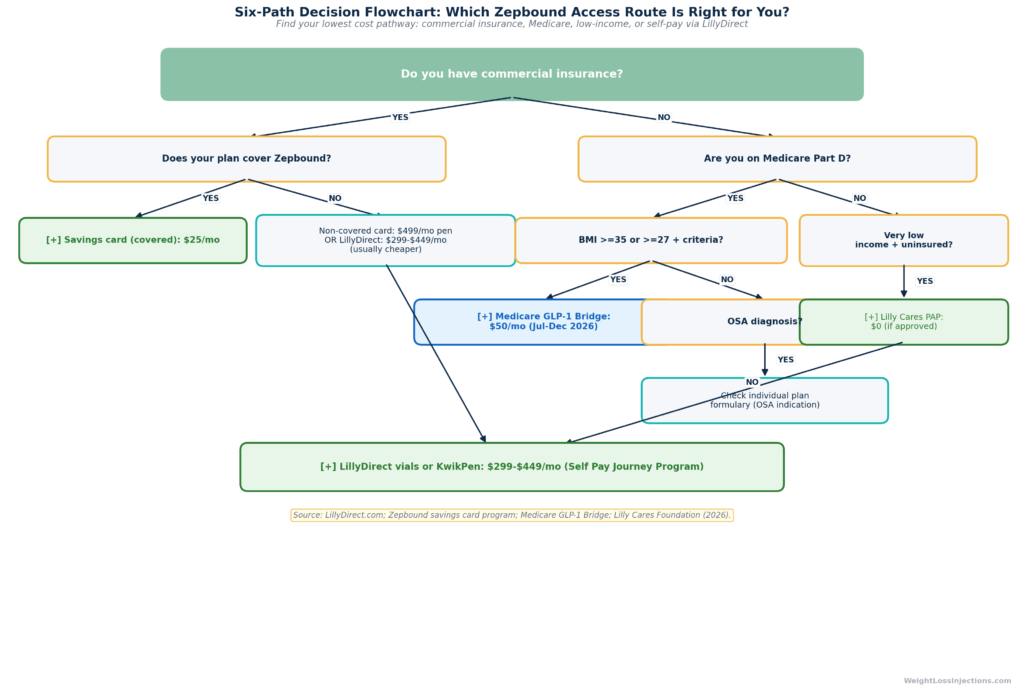
Six-Path Decision Flowchart: Which Zepbound Access Route Is Right for You?
Path 3: Savings Card — Non-Covered Benefit (Commercially Insured, Plan Doesn’t Cover Zepbound)
This path is for a specific patient type: you have commercial health insurance (employer-sponsored, ACA marketplace, or individual private plan), but your plan does not cover Zepbound for weight management or OSA. You are not uninsured, you have commercial drug insurance, but Zepbound is not on your plan’s formulary.
Why this matters: Uninsured patients cannot use the savings card at all. The savings card, whether covered-benefit or non-covered-benefit track, requires an active commercial insurance claim to process. If you have no insurance, go directly to LillyDirect (Paths 1 or 2).
Non-Covered Benefit Track: Single-Dose Pen
For commercially insured patients whose plan does not cover Zepbound, the non-covered benefit savings card allows access to single-dose pens at $499/mo for all dose strengths from 2.5 mg through 15 mg, per PrescriberPoint’s Zepbound savings card data. Annual maximum benefit is approximately $3,283, covering up to 7 fills per year.
Important comparison: At $499/mo for pens, LillyDirect’s Self Pay Journey Program at $449/mo for all doses 7.5 mg and above is actually cheaper. Patients prescribed 7.5 mg or higher who have commercial insurance but no Zepbound coverage should compare these two options before defaulting to the non-covered pen card.
Non-Covered Benefit Track: KwikPen (New for 2026)
Following the February 23, 2026 KwikPen launch, Lilly introduced a corresponding non-covered savings card track for the KwikPen. Per zepbound.lilly.com/savings, KwikPen pricing under this track matches the LillyDirect self-pay prices: $299/mo (2.5 mg), $399/mo (5 mg), $449/mo (7.5–15 mg). Maximum 11 fills per calendar year.
Why the Savings Card Cannot Be Used by Uninsured Patients
This is the most common misconception in Zepbound savings navigation. The savings card is not a manufacturer coupon anyone can apply, it is a secondary payer that reduces a patient’s cost-share on an insurance claim. There is no insurance claim for an uninsured patient, so there is no mechanism for the card to function. Additionally, the savings card is explicitly prohibited for Medicare, Medicaid, VA, TRICARE, and all government-funded program beneficiaries under the federal Anti-Kickback Statute (42 U.S.C. § 1320a-7b), per the HHS Office of Inspector General. There are no exceptions for any government program enrollees.
For the full mechanics of each savings card track, see Zepbound Savings Card 2026.
Path 4: Lilly Cares Foundation, Patient Assistance Program ($0 for Qualifying Patients)
The Lilly Cares Foundation Patient Assistance Program (PAP) may provide Zepbound at no cost to qualifying patients. This is the least-known of the six paths and the most valuable for those who qualify.
Who Qualifies
Eligibility is income-based and requires lack of adequate coverage. General criteria for Lilly Cares PAP include:
- U.S. residency
- Household income at or below program thresholds (income limits adjust annually, verify current thresholds directly at LillyCares.com before applying)
- No commercial insurance that covers Zepbound, or no insurance at all
- A valid Zepbound prescription from a licensed prescriber
E-E-A-T note: Income thresholds and program terms change annually. The figures on this page are current as of April 2026. Confirm eligibility requirements directly at LillyCares.com before submitting your application.
How to Apply
- Visit LillyCares.com and locate the Zepbound PAP application
- Have your prescribing provider complete the clinical section — they must co-sign the application
- Submit income documentation as required by the current application terms
- Allow several weeks for processing — apply early, ideally before or concurrent with your prescription
Processing timelines vary but typically run multiple weeks. For patients who need Zepbound immediately while waiting for PAP approval, LillyDirect self-pay (Paths 1 or 2) provides a bridge option at $299–$449/mo while the application processes.
Path 5: Medicare GLP-1 Bridge — July 1 Through December 31, 2026 ($50/mo)
This is the single most significant new access development for seniors in 2026, and the one path that most published guides omit entirely.
What the Program Is
CMS announced a temporary Medicare GLP-1 Bridge program that provides Zepbound coverage to eligible Part D enrollees at a $50 copayment per month for the obesity indication. Per KFF’s March 2026 analysis of the Medicare GLP-1 Bridge:
- Eligible period: July 1, 2026 through December 31, 2026 only
- Copayment: $50/mo
- Eligibility criteria: BMI ≥35, or BMI ≥27 with at least one qualifying clinical condition
- Cost structure: Operates outside the standard Part D benefit — payments do not count toward the $2,100 annual out-of-pocket cap established by the Inflation Reduction Act, per Wellcare Medicare guidance
- Bridge destination: Transitions to the BALANCE Model demonstration starting January 1, 2027
The $50 copay against an $1,086 WAC drug is the most dramatic pricing differential in the entire 2026 Zepbound landscape. For eligible Medicare beneficiaries, there is no less expensive legal path.
Why Standard Medicare Part D Still Doesn’t Cover Zepbound for Weight Loss
Before the Bridge program, Medicare beneficiaries had no coverage path for Zepbound prescribed for weight management. Medicare is statutorily prohibited from covering drugs prescribed solely for weight loss under Part D. As of April 2026, the American College of Gastroenterology’s April 2025 analysis confirms that anti-obesity drugs remain excluded from Medicare and Medicaid for the weight management indication. The Bridge program is a temporary administrative program operating outside the Part D benefit — it does not change the underlying statutory exclusion. Congress has not passed legislation lifting the prohibition as of April 2026.
The OSA Pathway for Medicare Patients
Zepbound received FDA approval as the first medication indicated for moderate-to-severe obstructive sleep apnea (OSA) in adults with obesity on December 20, 2024, per the Eli Lilly OSA approval press release. Because this is not a weight-loss indication, Medicare Part D plans may cover Zepbound when prescribed specifically for OSA — but this is plan-dependent and not guaranteed. If you have a documented OSA diagnosis, contact your Part D plan directly to ask whether Zepbound is covered on your plan’s formulary for that indication.
What If the Bridge Program Eligibility Criteria Don’t Apply to You?
If you are on Medicare but your BMI falls below the Bridge program thresholds and you do not have an OSA diagnosis, the standard Part D benefit does not cover Zepbound for weight management. Your options in that scenario: ask your prescribing physician whether your clinical presentation meets the Bridge criteria at the ≥27 BMI with clinical conditions threshold; explore the Lilly Cares PAP if income qualifies; or access LillyDirect at self-pay pricing (noting that Medicare beneficiaries cannot use the commercial savings card regardless of circumstances).
Path 6: Legitimate Telehealth — Getting the Prescription That Makes All of This Work
Every path above requires a valid Zepbound prescription from a licensed prescriber. LillyDirect does not prescribe, it fills. The savings card does not prescribe, it reduces copays on fills. The Lilly Cares PAP requires a prescriber co-signature on the application.
Getting a prescription is therefore the foundational step in any Zepbound access path, and telehealth makes it accessible to patients who do not have a primary care provider who prescribes GLP-1s.
Who Qualifies for a Zepbound Prescription
Per the FDA approval of Zepbound on November 8, 2023, the FDA-approved indications for chronic weight management are:
- BMI ≥30 kg/m² (obesity), or
- BMI ≥27 kg/m² with at least one weight-related comorbid condition: hypertension, type 2 diabetes, or dyslipidemia
Zepbound’s second indication — moderate-to-severe obstructive sleep apnea in adults with obesity, approved December 20, 2024 — requires a documented OSA diagnosis with an AHI ≥15 events per hour and obesity (BMI ≥30), per the Eli Lilly OSA approval press release.
Prescribing decisions are made by a licensed provider based on your complete clinical picture — meeting BMI criteria is a necessary but not sufficient condition.
How Telehealth Prescription Works
Telehealth providers can prescribe Zepbound through a virtual visit, no in-person appointment is required in most U.S. states. The typical process:
- Complete an online health questionnaire covering medical history, current medications, and BMI
- Video or asynchronous consultation with a licensed provider who reviews your eligibility
- If approved, prescription issued electronically and sent to your pharmacy of choice, or directly to LillyDirect
Your PCP or an obesity medicine specialist can also prescribe Zepbound for ongoing care. Many prescribers handle refills without a full in-person visit once the initial evaluation is complete.
WeightLossInjections.com positioning: WeightLossInjections.com provides licensed prescriber access to FDA-approved Zepbound starting at [$X/month], including [service detail]. Every patient intake includes insurance and income screening to identify the correct access path — LillyDirect Journey Program, savings card track, Medicare Bridge eligibility, or Lilly Cares PAP — before your first fill. [Start your eligibility assessment →]
Why You Should Not Use Compounded Tirzepatide in 2026
This section exists because patients continue to encounter websites claiming to offer “compounded tirzepatide” at lower prices. As of April 2026, this category of product is not a legal discount option — it is an illegal one.
The Timeline That Closed the Door
- August 2022: FDA added tirzepatide to the national drug shortage list due to surging demand for Mounjaro
- October 2, 2024: FDA initially declared the shortage resolved — decision was temporarily remanded following litigation by the Outsourcing Facilities Association
- December 19, 2024: FDA re-evaluated and re-confirmed the tirzepatide shortage as resolved, per the FDA memorandum of December 19, 2024
- February 18, 2025: Enforcement discretion for 503A compounding pharmacies ended. The U.S. District Court for the Northern District of Texas denied the OFA’s preliminary injunction on March 5, 2025, confirming the window was closed, per the FDA’s compounding clarification page
- March 19, 2025: The 503B outsourcing facility window closed
Current status as of April 2026: Both 503A and 503B compounding windows for tirzepatide are closed. Compounding “essentially identical” tirzepatide for general dispensing is not legally permissible. Per the FDA’s clarification of compounding policies, FDA is actively targeting manufacturers, distributors, and marketers of non-FDA-approved compounded GLP-1 products with potential seizure or injunction, per Pharmacy Times reporting from February 2026.
The Narrow Exceptions That Do Not Apply to Most Patients
503A pharmacies may still prepare tirzepatide in limited circumstances: documented patient-specific allergies to branded excipients, required alternative administration routes, or other individualized clinical needs. An FDA statement from April 1, 2026 noted that 503A pharmacies may fill up to 4 prescriptions per month without triggering “regularly or in inordinate amounts” enforcement. These exceptions are narrow, patient-specific, and clinician-directed — they do not apply to general weight-loss patients seeking a cheaper alternative to Zepbound.
What This Means for You
Any website currently marketing “compounded tirzepatide” to general patients for weight loss as of April 2026 is operating outside FDA’s current enforcement framework. The risks: unknown potency, contamination, and no FDA oversight of manufacturing quality — plus legal exposure. The legal self-pay alternative — LillyDirect at $299–$449/mo — is substantially less expensive than it was during the period when compounding was accessible. There is no legal workaround at general scale.
Do not confuse tirzepatide (Zepbound/Mounjaro) with semaglutide (Wegovy/Ozempic). These are different molecules with separate regulatory timelines. The compounding windows described above apply specifically to tirzepatide.
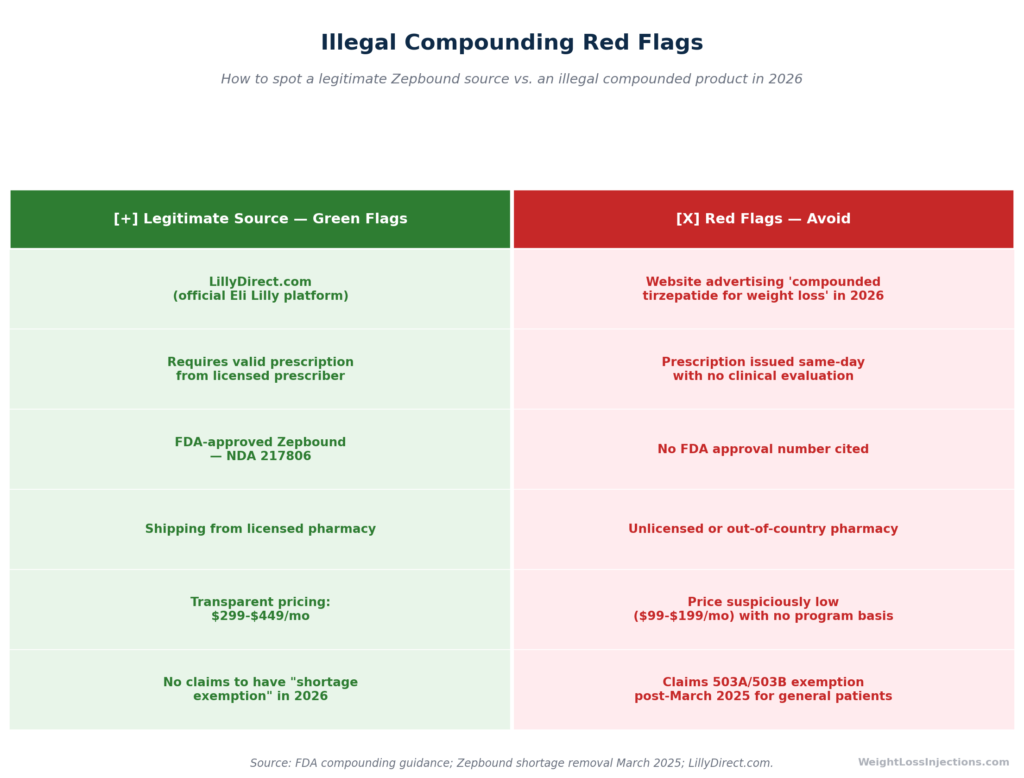
Illegal Compounding Red Flags
Step-by-Step: How to Get Zepbound Without Insurance in 2026
The following steps apply to the LillyDirect path, the primary route for most uninsured patients under 65. Medicare Bridge and Lilly Cares PAP steps are embedded in their respective sections above.
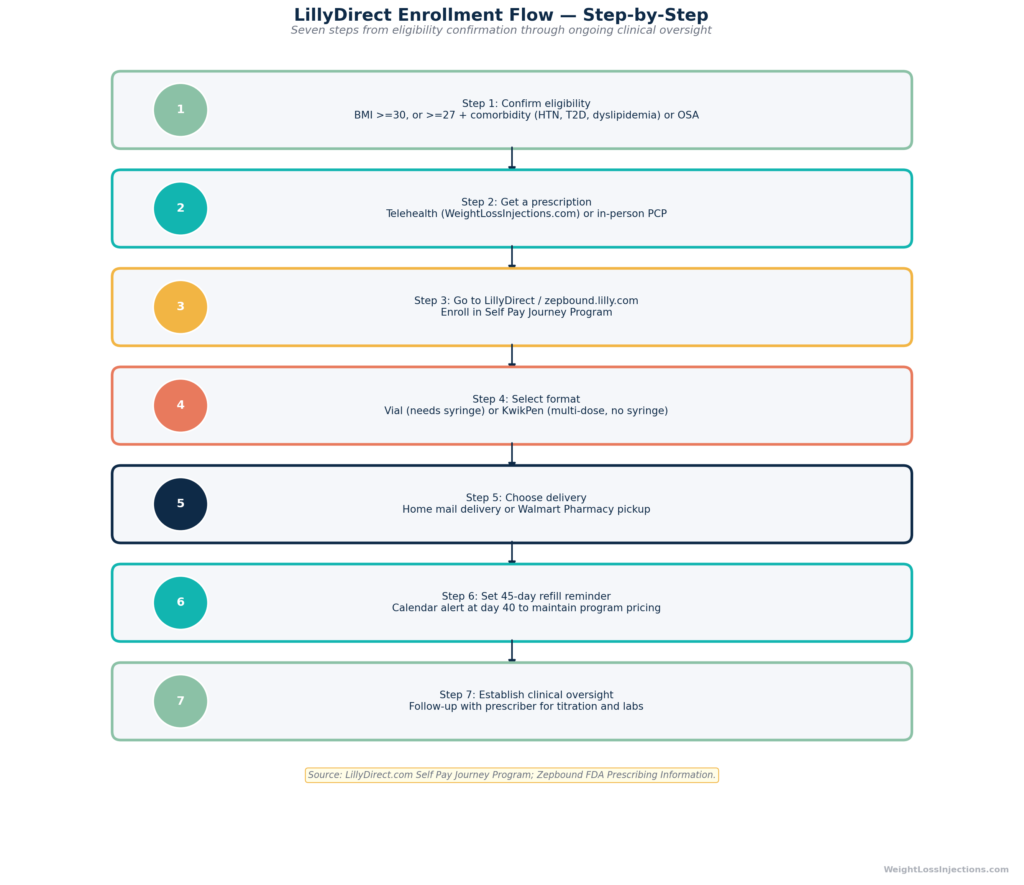
LillyDirect Enrollment Flow: Step-by-Step
Step 1: Confirm You Meet FDA Eligibility Criteria
Zepbound is FDA-approved for adults with BMI ≥30, or adults with BMI ≥27 plus at least one weight-related comorbidity, hypertension, type 2 diabetes, or dyslipidemia, per the FDA press release approving Zepbound on November 8, 2023. The OSA indication adds moderate-to-severe sleep apnea with obesity as a qualifying condition. Meeting these criteria does not guarantee a prescription, that is a clinical decision made by your provider, but it is the necessary starting point.
Zepbound contains tirzepatide, which should not be combined with Mounjaro (also tirzepatide) or any GLP-1 receptor agonist such as semaglutide (Ozempic, Wegovy), per the Zepbound prescribing information. Inform your prescriber of all current medications.
Step 2: Get a Valid Prescription
Contact a licensed provider, your primary care physician, an obesity medicine specialist, an endocrinologist, or a telehealth service. Telehealth consultation is valid in most U.S. states and does not require an in-person visit. At WeightLossInjections.com, the intake process starts at [$X/month] and includes [service detail].
LillyDirect is a pharmacy platform, not a prescriber. You must have the prescription before placing your first LillyDirect order.
Step 3: Determine Your Optimal Pricing Path
Use the decision matrix in Image 2 above to identify which path applies to your situation before enrolling in anything. The most common enrollment error: patients with commercial insurance who do not have Zepbound coverage enrolling in LillyDirect self-pay when they could be accessing the KwikPen non-covered savings card track (which covers up to 11 fills per year), or vice versa. Compare your options at your specific dose before committing.
Step 4: Enroll in the LillyDirect Self Pay Journey Program
Navigate to LillyDirect at zepbound.lilly.com. Have your prescription and basic payment information ready. Complete enrollment in the Self Pay Journey Program, without this enrollment, the $449/mo flat rate for higher doses does not apply. Select your dose (starting at 2.5 mg per the standard titration schedule in the Zepbound prescribing information) and your preferred format.
Step 5: Choose Home Delivery or Walmart Pharmacy Pickup
LillyDirect offers two fulfillment options:
- Mail delivery: Ships to your home address via LillyDirect’s mail-order pharmacy network
- Walmart Pharmacy pickup: In-store pickup at participating Walmart locations nationwide, per the October 2025 LillyDirect–Walmart announcement. No Walmart membership required. LillyDirect pricing applies regardless of fulfillment method
Both options maintain the same Self Pay Journey Program pricing. If you prefer same-day access or want to avoid shipping uncertainty, Walmart pickup is the more convenient option.
Step 6: Set Your 45-Day Refill Reminder
The Self Pay Journey Program’s discounted pricing tier requires refill within the 45-day window from each delivery. Set a calendar reminder at day 40, five days before the deadline, to initiate your next refill. This is the most common administrative error that disrupts ongoing program pricing.
Step 7: Establish Clinical Oversight
LillyDirect delivers medication; it does not manage your treatment. The SURMOUNT-1 trial data published in NEJM — which demonstrated an average 20.9% weight reduction at 72 weeks with tirzepatide 15 mg in adults without type 2 diabetes, was conducted in a structured clinical setting with regular follow-up. Achieving outcomes comparable to trial conditions requires ongoing prescriber involvement for dose titration, periodic metabolic labs, and management of adverse effects.
At minimum, establish follow-up appointments with your prescribing provider every 4–8 weeks during the initial titration phase (2.5 mg → 5 mg → 7.5 mg and beyond, per the standard schedule in the Zepbound prescribing information).
Common Access Denials and What to Do About Them
“The pharmacy says this isn’t covered and wants $1,086”
If you have enrolled in LillyDirect, you are not filling at a traditional retail pharmacy, you are ordering through LillyDirect directly or picking up at Walmart. If a traditional pharmacy is quoting you the WAC price, you have not yet enrolled in LillyDirect. Go to zepbound.lilly.com/coverage-savings to begin enrollment, or call 1-866-923-1953.
“My insurance denied Zepbound prior authorization”
A prior authorization (PA) denial from your commercial insurer means your plan did not approve coverage under the standard benefit, it does not prevent you from accessing LillyDirect self-pay pricing. The PA process and LillyDirect are entirely separate channels. If your plan denied PA, you can simultaneously appeal the denial through your insurer while starting LillyDirect at self-pay pricing. For commercially insured patients, see Zepbound Insurance Coverage for the PA appeal process.
“Lilly Cares said my income is too high”
Lilly Cares income thresholds change annually. If you were denied in a prior year, re-apply with current income documentation for 2026, as program terms may differ. Alternatively, consider whether you meet Medicare GLP-1 Bridge criteria or whether LillyDirect at $299–$449/mo is financially manageable.
“The Medicare Bridge program hasn’t started yet”
The Bridge program runs July 1 through December 31, 2026 only. If you are on Medicare before July 1, 2026 and neither the OSA indication nor the Lilly Cares PAP applies to your situation, LillyDirect self-pay pricing (noting Medicare beneficiaries cannot use the manufacturer savings card) is the available option. Starting July 1, contact your Part D plan to confirm Bridge enrollment procedures.
“The telehealth provider said I don’t qualify because of my BMI”
If your BMI is between 27 and 30, you need a documented comorbidity, hypertension, type 2 diabetes, or dyslipidemia — to meet the FDA-approved indication for weight management. Per the Zepbound prescribing information, these comorbidities must be present and clinically documented. If your BMI is below 27, Zepbound is not FDA-approved for weight management regardless of comorbidities, and off-label prescribing carries additional clinical considerations. Discuss your complete clinical picture with your provider.
Real-World Annual Cost at Each Path
| Access Path | Monthly Cost | Annual Cost (12 months) |
|---|---|---|
| WAC — no program | $1,086/mo | ~$13,032/yr |
| Non-covered savings card (pen) | $499/mo | ~$5,988/yr |
| LillyDirect Journey — 7.5–15 mg | $449/mo | ~$5,388/yr |
| LillyDirect Journey — 5 mg | $399/mo | ~$4,788/yr |
| LillyDirect Journey — 2.5 mg | $299/mo | ~$3,588/yr |
| Medicare GLP-1 Bridge (6 months Jul–Dec) | $50/mo | ~$300 for bridge period |
| Lilly Cares PAP (if approved) | $0 | $0 |
For context: the LillyDirect $449/mo annual cost of approximately $5,388 represents roughly 41% of the retail WAC annual cost. The SURMOUNT-4 data published in JAMA makes clear that stopping tirzepatide after successful weight loss leads to substantial weight regain — patients who discontinued regained an average 14.0% of their body weight versus an additional 5.5% reduction for those who continued. Long-term treatment is the expected course, making annual cost calculation a relevant planning variable.
Our Take at WeightLossInjections.com
Our take at WeightLossInjections.com: The most important insight from this guide is the one most patients miss: the $1,086 WAC is the price almost no patient should pay. In 2026, Eli Lilly has built a direct-to-consumer infrastructure, LillyDirect, the Self Pay Journey Program, the KwikPen launch, that effectively creates a parallel self-pay market for Zepbound at $299–$449/mo. The drug is the same branded, FDA-approved tirzepatide; only the purchasing channel is different.
The three most common expensive mistakes we see: (1) Patients who are technically “commercially insured but not covered” enrolling in the $499/mo non-covered pen card without comparing it to LillyDirect’s $449/mo — paying $50 more per month for the same drug. (2) Medicare beneficiaries after July 1, 2026 who do not know about the Bridge program and attempt to access Zepbound at list price or through the savings card (which they cannot legally use). (3) Patients who see a “$99/month compounded tirzepatide” offer online and assume it is a legitimate savings path. As of April 2026, it is not.
WeightLossInjections.com provides licensed prescriber access to FDA-approved Zepbound starting at [$X/month], including [service detail]. Our intake process includes an insurance status screening that identifies the correct savings or access path — LillyDirect Journey Program, savings card track, Medicare Bridge eligibility, or Lilly Cares PAP, before your first fill. We do not offer compounded tirzepatide. Both the 503A and 503B compounding windows are closed as of April 2026. Only branded, FDA-approved Zepbound from licensed pharmacies. [Start your eligibility assessment →]
Frequently Asked Questions
What is the cheapest legal way to get Zepbound without insurance in 2026?
For most uninsured patients under 65, Eli Lilly’s LillyDirect Self Pay Journey Program is the cheapest available path: $299/mo for the 2.5 mg starting dose, $399/mo for 5 mg, and $449/mo for all maintenance doses from 7.5 mg through 15 mg, per CNBC’s December 2025 reporting. Both vials and the new KwikPen (launched February 23, 2026) are available at these prices. For Medicare Part D beneficiaries who meet BMI criteria, the Medicare GLP-1 Bridge program offers Zepbound at $50/mo from July 1 through December 31, 2026, per KFF’s March 2026 analysis. For qualifying low-income individuals, the Lilly Cares Foundation PAP may provide Zepbound at no cost.
Can I get Zepbound through LillyDirect without a prescription?
No. LillyDirect is a pharmacy fulfillment platform, not a prescribing service. You must have a valid Zepbound prescription from a licensed provider before placing any order. LillyDirect does not offer telemedicine consultations itself. Patients who need a prescription can obtain one through a primary care physician, obesity medicine specialist, endocrinologist, or telehealth service. At WeightLossInjections.com, the process starts with an eligibility assessment that connects you with a licensed prescriber if you qualify, starting at [$X/month] for the bundled consult including [service detail].
Does Medicare cover Zepbound for weight loss in 2026?
Standard Medicare Part D does not cover Zepbound prescribed solely for weight management, Medicare is statutorily prohibited from covering weight-loss drugs under Part D, as confirmed by the American College of Gastroenterology’s April 2025 analysis. However, two separate pathways exist in 2026. First, the Medicare GLP-1 Bridge program (July 1 – December 31, 2026) covers Zepbound at a $50/mo copay for eligible Part D enrollees with BMI ≥35 or ≥27 with clinical criteria — operating outside the Part D benefit, per KFF analysis from March 2026. Second, some Medicare Part D plans may cover Zepbound when prescribed specifically for moderate-to-severe obstructive sleep apnea (FDA-approved December 20, 2024), subject to individual plan formulary. Medicare beneficiaries cannot use the manufacturer savings card under any circumstances.
Is compounded tirzepatide still available from online pharmacies in 2026?
Not legally for general weight-loss patients. The FDA resolved the tirzepatide shortage on December 19, 2024, per the FDA memorandum of that date. Enforcement grace periods for 503A pharmacies ended February 18, 2025, and for 503B outsourcing facilities March 19, 2025, per the FDA’s compounding clarification page. As of April 2026, FDA is actively targeting mass-marketed compounded GLP-1 products. Any website broadly advertising compounded tirzepatide for weight loss in 2026 is operating outside FDA’s enforcement framework. The legitimate uninsured path is LillyDirect at $299–$449/mo.
What is the Lilly Cares Patient Assistance Program and do I qualify?
The Lilly Cares Foundation Patient Assistance Program may provide Zepbound at no cost to qualifying patients who are uninsured or underinsured and meet income eligibility thresholds. Program terms and income limits change annually, the most current eligibility requirements are available directly at LillyCares.com. To apply, you need a valid Zepbound prescription and your prescribing provider must co-sign the application. Processing typically takes several weeks. Apply as early as possible, ideally before or concurrent with your initial prescription, to minimize any gap in access. If you need medication immediately while awaiting PAP approval, LillyDirect self-pay provides a bridge option.
Can a telehealth provider prescribe Zepbound in all 50 states?
Telehealth providers can prescribe Zepbound in most U.S. states, but specific regulations on prescribing controlled and non-controlled substances via telehealth vary by state. The DEA’s post-pandemic rules regarding virtual prescribing continue to evolve. A properly licensed telehealth provider will confirm state-specific eligibility during your intake. In states where synchronous telemedicine prescribing is permitted, a video or asynchronous consultation is sufficient, no in-person visit is required. WeightLossInjections.com operates within applicable state telehealth laws; [service detail] is confirmed at intake.
This article is for informational purposes only and does not constitute medical or legal advice. All pricing reflects verified sources as of April 2026; prices, program availability, and eligibility requirements are subject to change by Eli Lilly, CMS, and the Lilly Cares Foundation at any time without notice. WeightLossInjections.com editorial team reviews content quarterly; last verified April 2026. Always confirm current program terms directly with Eli Lilly (1-866-923-1953 or zepbound.lilly.com/savings) or the Lilly Cares Foundation (lillycares.com) before making coverage or access decisions. Consult a licensed provider before starting or changing any medication.