Ozempic 4–6 Week Weight Loss Plan: Realistic Results, Week-by-Week Data, and a Full Protocol
Medically reviewed by WeightLossInjections.com Staff•Updated July 23, 2026•12 min readMedically reviewed
⤢
Ozempic 4-6 Week Weight Loss Timeline
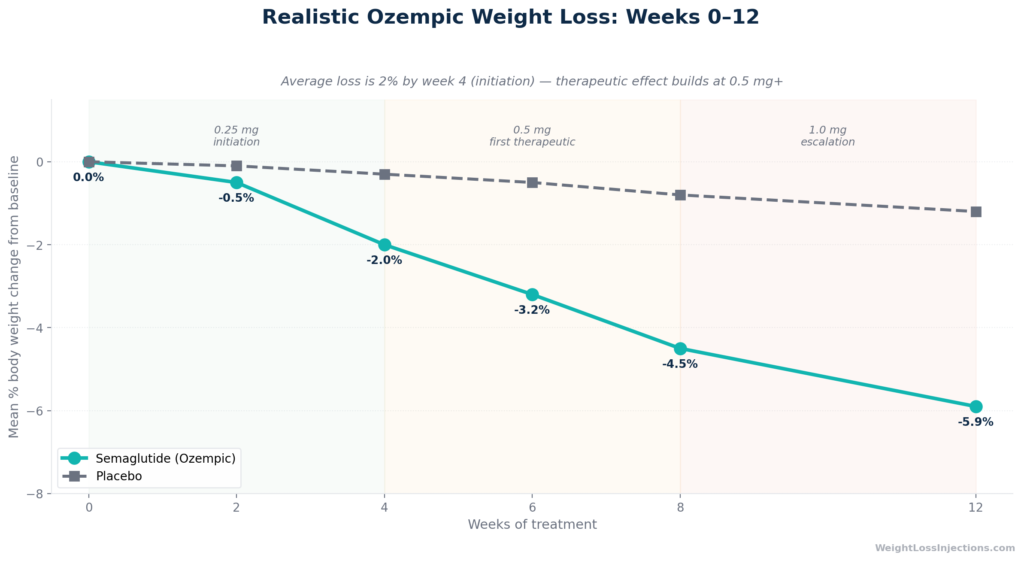
During the first four weeks of Ozempic, you are on the 0.25 mg initiation dose, a GI tolerance phase, not a therapeutic weight-loss phase. Expect roughly 2% body weight loss by week 4 and 3–4% by week 6 once the 0.5 mg dose begins. For a 200-pound person, that is 4–8 lbs over six weeks, real, but far less than the 5–15 lbs some clinic websites advertise. Primary-source data from SUSTAIN trials and real-world Ghusn 2022 Mayo Clinic data tell the full story.
Safety notice: This article is educational only. Dosing decisions are your prescriber’s call. Contact your provider immediately if you experience severe or persistent side effects.
What Is the Ozempic 4–6 Week Weight Loss Plan?
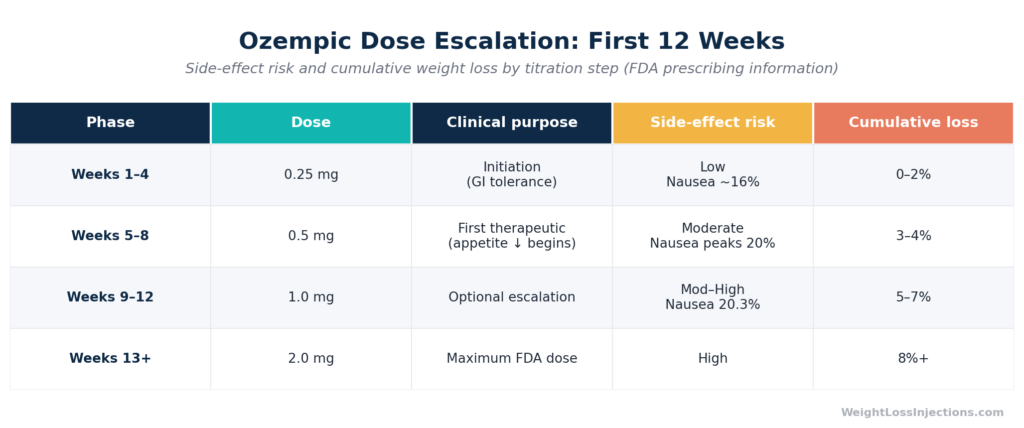
The phrase “4–6 week Ozempic plan” describes the dose-initiation window that every new patient goes through before reaching a meaningful therapeutic dose. Per the FDA Ozempic Prescribing Information, the labeled schedule begins at 0.25 mg once weekly for the first four weeks, with an increase to 0.5 mg once weekly starting at week five. The 0.25 mg starting dose is explicitly not intended for glycemic control, its sole purpose is GI adaptation.
This matters enormously for setting expectations. The internet is full of before-and-after posts and clinic pages claiming 10–15 lbs of loss in the first six weeks. What those accounts routinely omit is that week-four patients are still on a sub-therapeutic dose. The appetite suppression that drives meaningful weight loss does not fully arrive until after the 0.5 mg transition, and it builds further at 1 mg. Overpromising early results sets up unnecessary disappointment and, worse, sometimes leads patients to push for faster dose escalation, which is a primary driver of GI-related discontinuation.
The realistic six-week objective is this: build tolerance to the medication, begin the appetite-suppression pathway, establish the dietary habits that will amplify results at higher doses, and shed approximately 1–2 kg (~2–4 lbs) in a 200-lb individual by week four, scaling to 3–4 kg (~6–8 lbs) by the end of week six as the 0.5 mg dose takes effect.
Realistic Expectations: Weight Loss Timeline Week by Week
Weeks 1–2: Adjustment Phase (0.25 mg)
The first two weeks are characterized by mild GI adjustment, nausea in 15–20% of patients, occasional early satiety, rather than significant fat loss. Any weight reduction in weeks one and two is predominantly fluid loss driven by reduced caloric intake from nausea-related appetite suppression and reduced carbohydrate consumption. Early-phase weight change in clinical data averages roughly 0.5–1 kg at two weeks and is not reliably reproducible as a drug effect at this dose level (FDA Ozempic PI).
What you should notice: mild queasiness within 24–48 hours of each injection, possibly earlier satiety at meals. What you should not expect: measurable fat loss. The 0.25 mg dose is pharmacologically designed not to produce clinical effect.
Weeks 3–4: Early Changes (0.25 mg Continued)
By weeks three and four, GI side effects typically ease as tolerance develops. Some patients begin noticing reduced food cravings, early evidence that the GLP-1 receptor agonist pathway is engaging. Mean weight loss at week four across SUSTAIN program data is approximately ~2% of body weight, roughly 4 lbs for a 200-lb person, with the range spanning 1–5 lbs depending on starting weight, dietary changes, and adherence (SUSTAIN 1–7 review, Aroda et al., Diabetes Metab 2019). For context, SUSTAIN trials reported mean body weight reductions of 3.3–4.2 kg with semaglutide 0.5 mg and 4.6–6.0 kg with 1.0 mg across 30 weeks, the early weeks contribute a minority of that total.
A 200-lb (91 kg) person losing 2% at week four has lost approximately 1.8 kg (4 lbs). That is not dramatic on a scale, but it represents the beginning of a clinically significant trajectory.
Weeks 5–6: First Dose Increase (0.5 mg Begins)
Week five brings the transition to 0.5 mg, the first dose at which appetite suppression becomes clinically noticeable and where reproducible weight loss begins in earnest. Nausea often resurfaces briefly at the dose transition but typically diminishes within 10–14 days as tolerance rebuilds. By the end of week six, cumulative weight loss in clinical populations averages approximately 3–4% of starting body weight, translating to roughly 6–8 lbs for a 200-lb person (SUSTAIN 1–7 review, Aroda et al., Diabetes Metab 2019; Ghusn et al., JAMA Network Open 2022). Patients who have used the first four weeks to establish high-protein, high-fiber dietary habits consistently achieve results at the upper end of that range.
Ozempic suppresses appetite, but the quality and composition of what you eat during the initiation phase determines whether you preserve lean muscle and establish habits that compound over months. The protocol below is calibrated for the 1,500–1,800 calorie range that balances a meaningful deficit without undermining the muscle preservation that real-world semaglutide studies highlight as a concern:
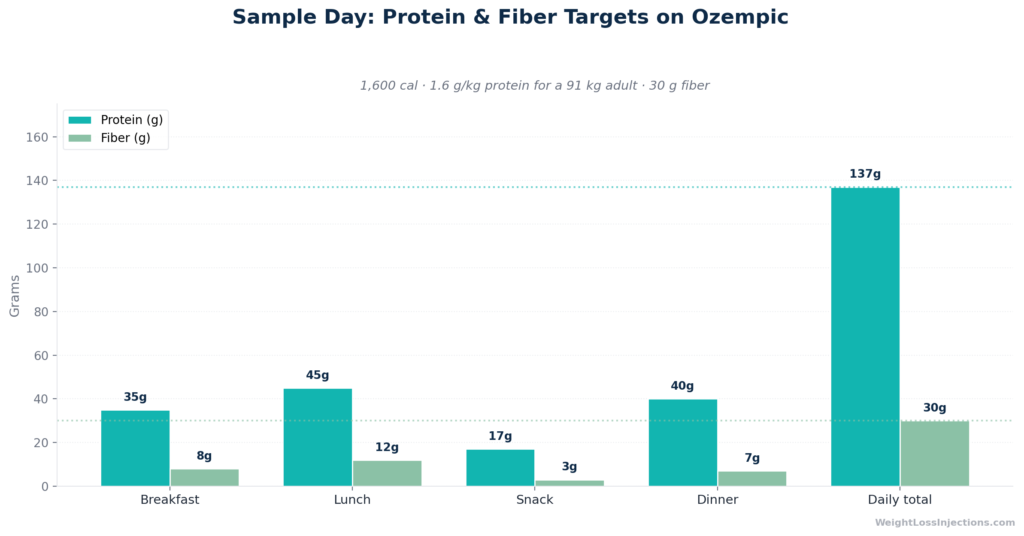
Protein: 1.6 g per kg of body weight per day — for a 91 kg (200 lb) person, that is approximately 145 g/day. High protein intake is the single most important dietary variable for maintaining lean mass during GLP-1-driven weight loss (Ghusn et al., JAMA Network Open 2022, which noted 1–2% lean mass loss in the early real-world cohort).
Fiber: 30 g/day minimum. Fiber slows gastric emptying (synergistic with Ozempic’s mechanism), improves satiety, and supports the gut microbiome changes associated with GLP-1 therapy.
Fat: 40–60 g/day, prioritizing unsaturated fats. High-fat meals accelerate nausea in the first weeks because Ozempic already slows gastric emptying, pairing a high-fat meal with a new dose is a reliable way to feel significantly unwell.
Carbohydrates: Remaining calories from whole-grain, high-fiber sources. Reducing refined carbohydrates in weeks one through four accelerates early water-weight loss and blunts insulin spikes.
Sample Daily Meal Structure (1,600 cal target)
Breakfast (~400 cal): 3 scrambled eggs + 1 cup spinach + 1 slice whole-grain toast + black coffee or water. ~35 g protein, 8 g fiber.
Lunch (~450 cal): 150 g grilled chicken breast + 1 cup cooked lentils + unlimited salad greens + 2 tbsp olive oil vinaigrette. ~45 g protein, 12 g fiber.
Snack (~150 cal): 1 cup plain Greek yogurt (0% fat) + 1 tbsp flaxseed. ~17 g protein, 3 g fiber.
Dinner (~500 cal): 150 g baked salmon + 1 cup roasted broccoli + ½ cup cooked quinoa. ~40 g protein, 7 g fiber.
Daily totals (approximate): 1,600 cal · 137 g protein · 30 g fiber.
Exercise Protocol
Walking: Target 10,000 steps per day. This is non-negotiable and accessible — it does not require gym access, does not exacerbate nausea the way high-intensity exercise can in weeks one and two, and produces meaningful caloric expenditure over a full week. For a 200-lb person, 10,000 steps burns approximately 400–500 additional calories per day.
Resistance training: Two to three sessions per week from week three onward. Focus on compound movements (squats, deadlifts, rows, presses) at moderate intensity. The muscle-preservation argument for resistance training during GLP-1 therapy is supported by real-world data — lean mass loss is a documented risk with rapid weight reduction, and resistance exercise is the primary countermeasure.
Weeks 1–2 modification: If nausea is present, scale back to gentle walking only. Do not use GI discomfort as a reason to skip all movement; light activity often alleviates nausea by improving gastric motility.
Managing Side Effects in Weeks 1–6
GI side effects are the primary reason patients discontinue Ozempic early. The FDA Ozempic Prescribing Information reports the following incidence rates from pooled placebo-controlled trials:
The majority of nausea, vomiting, and diarrhea events occurred during dose escalation, not as steady-state effects. Most resolve within one to two weeks of stabilizing at a given dose. Practical management strategies that are evidence-compatible:
Eat small, low-fat meals. A large, fatty meal on injection day is the most reliable trigger for severe nausea. Keep portions modest and fat content low for the first 48 hours after each injection.
Inject at night. Many patients tolerate injecting before sleep better than injecting in the morning, peak nausea from semaglutide typically occurs in the first 12–24 hours post-injection, and sleeping through the peak reduces perceived severity.
Ginger. Ginger tea, ginger chews, or ginger capsules have consistent evidence for nausea reduction in other GI contexts and are widely used by patients on GLP-1 therapy. No semaglutide-specific RCT data exists, but the safety profile is favorable.
Hydration. Nausea combined with vomiting or diarrhea creates dehydration risk. Sip water, broth, or electrolyte solutions consistently throughout the day rather than drinking large volumes at once.
Do not rush escalation. If nausea is persistent beyond 10–14 days at 0.5 mg, contacting your prescriber to hold at the current dose for an additional four weeks is a legitimate and common clinical decision. Slower escalation does not mean worse long-term outcomes.
Red-flag symptoms that require contacting your provider immediately: severe, constant abdominal pain (especially radiating to the back); persistent vomiting or diarrhea causing dehydration; yellowing of skin or eyes; severe constipation with abdominal distension (FDA Ozempic PI, 2023).
Factors That Affect Your 4–6 Week Results
Starting BMI and body weight. Absolute pounds lost in weeks one through six scale with starting weight. A 250-lb person losing 2% has lost 5 lbs; a 180-lb person loses 3.6 lbs. Percentage loss is the scientifically appropriate benchmark, not pounds.
Diabetes status. Ozempic is FDA-approved for type 2 diabetes, and a substantial share of its real-world users carry a T2D diagnosis. Multiple SUSTAIN trials showed that weight loss in T2D populations is modestly lower than in the non-diabetic populations studied in the STEP trials. STEP 2, which enrolled patients with T2D, produced -7.0% at 68 weeks on semaglutide 1.0 mg — compared to -14.9% at 68 weeks in STEP 1 (no diabetes) (STEP 1, Wilding et al., NEJM 2021; Journal of Pharmacy Technology 2022 review). For T2D patients, the six-week trajectory is proportionally lower. This is biology, not failure, the weight-regulating mechanisms altered by diabetes create a higher floor.
Dietary adherence. Ozempic is a powerful appetite suppressant, but it does not make calorie quality irrelevant. Patients who use the reduced appetite as cover to eat ultra-processed foods at lower volumes lose less than patients who redirect the appetite reduction toward protein- and fiber-dense whole foods. The meal plan above is designed to maximize the signal from the medication.
Physical activity. The STEP 1 trial included lifestyle counseling with a reduced-calorie diet and increased physical activity for all participants, including placebo recipients who lost 2.4% over 68 weeks (STEP 1, NEJM 2021). The drug effect itself is net of lifestyle. Adding 10,000 steps/day accelerates weekly loss by approximately 0.5–1 lb above drug-only effect estimates.
Dose adherence. Missing weekly injections or injecting erratically degrades both the appetite-suppression effect and the progressive GI tolerance buildup. Consistent injection on the same day of the week is a non-negotiable habit to establish in week one.
Beyond 6 Weeks: What Happens Next
The six-week mark is a checkpoint, not a ceiling. Patients who complete the initiation phase with intact GI tolerance are typically escalated to 1.0 mg after at least four additional weeks at 0.5 mg, then optionally to the maximum 2.0 mg dose if additional clinical effect is needed.
The real-world trajectory beyond six weeks is instructive. In the Ghusn et al. 2022 Mayo Clinic cohort (n=175 patients, overweight/obese, semaglutide for weight management), mean weight loss reached 5.9% at 3 months (approximately week 12–13) and 10.9% at 6 months (approximately week 24–26). Critically, 53.7% of patients had lost more than 5% of body weight by three months, and 87.3% had done so by six months. For a 200-lb person, this projects to approximately 12 lbs at three months and 22 lbs at six months, with sustained adherence to the dose schedule and the lifestyle protocol above.
The STEP 1 trial (semaglutide 2.4 mg / Wegovy) provides the long-horizon benchmark: 14.9% body weight loss at 68 weeks, with 86.4% of participants achieving ≥5% loss and 50.5% achieving ≥15% loss. Ozempic doses (0.5–1.0 mg) for weight management in T2D populations show more modest but clinically meaningful trajectories, approximately 4.5–6.0% over 30 weeks in SUSTAIN, with real-world data in overweight/obese patients closer to the STEP figures at higher doses (SUSTAIN 1–7 review, Aroda et al.).
The key message: the first six weeks is the smallest chapter. The patients who achieve the best long-term outcomes are the ones who use those six weeks to lock in habits, not the ones who chase the scale in week two.
Our take at WeightLossInjections.com: The most common mistake we see discussed in GLP-1 patient communities is expecting therapeutic results during the initiation dose. If you’re in weeks one through four and the scale isn’t moving dramatically, that is not the drug failing, it is the drug working exactly as designed. The 0.25 mg phase builds the GI foundation for everything that follows. Patients who understand this upfront stay on therapy longer and achieve substantially better six-month results than those who quit early out of misaligned expectations. If you’re ready to start or want an independent review of your current plan, WeightLossInjections.com offers a [service detail] telehealth intake — a licensed provider reviews your history and quotes an all-in price of [$X/month].
Protein and Fiber Targets in the Ozempic 4-6 Week Diet Plan
Frequently Asked Questions
Approximately 2–5 lbs (1–2% of body weight) for most people during the first four weeks. This covers the entire 0.25 mg initiation phase, during which the dose is sub-therapeutic — designed for GI tolerance, not weight loss. The SUSTAIN trial program reported mean weight reductions of 3.3–4.2 kg with semaglutide 0.5 mg across 30 weeks; early weeks contribute proportionally less (SUSTAIN 1–7 review, Aroda et al., Diabetes Metab 2019). For a 200-lb person, 2% equals 4 lbs. Results at the lower end of this range are normal and not a signal that the drug isn’t working.
It is possible but not the average. Clinical data and real-world cohorts suggest a mean of 5–8 lbs at 6 weeks for a 200-lb person transitioning to 0.5 mg at week five. Ten pounds in six weeks would represent approximately 5% body weight loss — achievable in the Ghusn 2022 Mayo Clinic real-world data at three months (where 53.7% of patients had lost ≥5%), but early for a six-week endpoint. Claims of 10–15 lbs in four to six weeks circulate online but typically conflate therapeutic-dose outcomes or individual outliers with population averages. Plan for the average; be pleasantly surprised if you exceed it.
Three changes have the most evidence-compatible impact: (1) increase protein to 1.6 g/kg body weight per day to preserve lean mass as weight drops; (2) reach 30 g fiber per day through vegetables, legumes, and whole grains to amplify satiety signals synergistically with Ozempic’s gastric emptying effects; and (3) reduce high-fat, ultra-processed foods during the first two weeks of any new dose to minimize nausea. The 1,500–1,800 calorie framework above implements all three simultaneously. Walking 10,000 steps per day adds approximately 400–500 calories of daily expenditure for a 200-lb person without the GI-exacerbating risk of high-intensity exercise in week one.
Appetite suppression becomes clinically noticeable for most patients in weeks 5–6, coinciding with the 0.5 mg dose transition. The 0.25 mg initiation phase produces minimal appetite suppression by design. By week eight at 0.5 mg, most patients report a significant reduction in baseline hunger and — for many — the quieting of “food noise,” the persistent preoccupation with eating that characterizes obesity in many people. Full therapeutic effect at each dose level typically takes three to four weeks to reach steady state, which is why the FDA label mandates a minimum of four weeks at each dose before escalating (FDA Ozempic PI, 2023).
Yes — and you should, with modifications. In weeks one and two, nausea is the primary limiter; stick to low-intensity walking (10,000 steps/day) and avoid exercise that increases intra-abdominal pressure or involves prolonged exertion in the first 24–48 hours after injection. From week three onward, resistance training two to three times per week is strongly recommended to counteract the lean mass loss that is documented in real-world GLP-1 cohorts (Ghusn et al., JAMA Network Open 2022). High-intensity cardio is fine once GI tolerance is established, but it does not outperform resistance training for the muscle-preservation goal.

![Unbranded [pillar-drug-class] injection pen on a neutral background — WeightLossInjections.com editorial hero](https://weightlossinjections.com/wp-content/uploads/2026/04/hero_ozempic_c1_cost-1200x675.png)