![Unbranded [pillar-drug-class] injection pen on a neutral background — WeightLossInjections.com editorial hero](https://weightlossinjections.com/wp-content/uploads/2026/04/hero_ozempic_c1_cost-1200x675.png)
- Ozempic list price: $1,028/month. Wegovy list price: $1,349/month. Both drugs contain semaglutide — the price gap reflects different FDA approvals and doses, not different active ingredients.
- With commercial insurance and a savings card, both drugs can cost as little as $25/month — but eligibility requirements differ.
- Self-pay through NovoCare Pharmacy: Ozempic runs $349–$499/month (after a $199 intro); Wegovy injection runs $349/month ongoing (same $199 intro). The Wegovy pill starts at $149/month.
- In January 2027, Novo Nordisk will cut both list prices to $675/month — but that change does not affect the self-pay programs most cash patients use today.
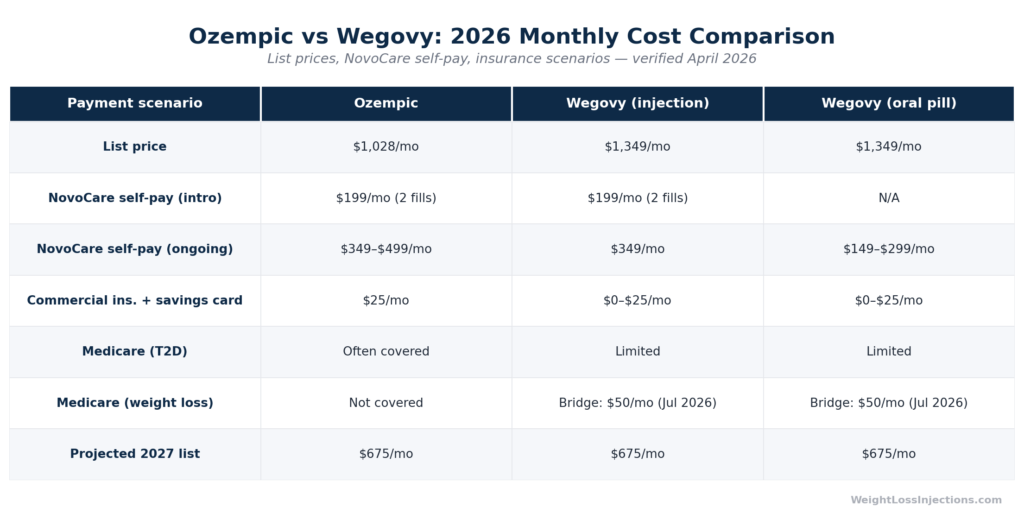
Side-by-Side Cost Comparison
Side-by-side monthly cost comparison table for Ozempic vs Wegovy across list price, self-pay NovoCare, commercial insurance savings card, and 2027 projected list price.
What This Guide Covers
- Ozempic vs Wegovy: Same Drug, Different Approvals
- List Prices Without Insurance
- Cash Pay Prices in 2026: NovoCare, GoodRx, Telehealth
- Insurance and Savings Cards: Who Actually Qualifies
- Telehealth Bundled Costs at WeightLossInjections.com
- The 2027 Price Cuts: What They Mean for You
- Which Is Cheaper? A Decision Framework
- Side Effects and Safety: What You Should Know
- Frequently Asked Questions
Ozempic vs Wegovy Basics: Same Drug, Very Different Approvals
Before comparing prices, it’s worth being precise about what these two drugs actually are — because the cost difference makes no sense without that context.
Both Ozempic and Wegovy are semaglutide, a once-weekly injectable GLP-1 receptor agonist made by Novo Nordisk. The active ingredient is chemically identical. What differs is the FDA approval, the maximum dose, and the intended patient population.
According to the current FDA prescribing information for Ozempic (2025), Ozempic is approved for type 2 diabetes management and cardiovascular risk reduction, not for weight loss. The Wegovy prescribing information covers a higher maximum dose (2.4 mg weekly vs. Ozempic’s 2.0 mg) and an explicit chronic weight management indication in adults with BMI ≥30, or ≥27 with at least one weight-related comorbidity.
That distinction matters enormously for what you pay. Ozempic is commonly prescribed off-label for weight loss — legal, but it means you’re using a diabetes drug for a purpose not on the FDA label, which affects insurance coverage, savings card eligibility, and which self-pay programs you can access.
Efficacy at maximum doses is meaningfully different. In the landmark STEP 4 trial published in JAMA, patients on semaglutide 2.4 mg (Wegovy’s dose) who continued treatment through 68 weeks achieved an estimated cumulative body weight reduction of approximately 17.4%. Ozempic at its maximum 2.0 mg dose typically produces 8–14% total body weight loss over 12 months in real-world settings, meaningful, but less than Wegovy’s higher-dose outcome. For patients deciding between the two purely on weight-loss results, Wegovy has the stronger evidence base at its maximum dose.
Our take at WeightLossInjections.com: The semaglutide molecule is the same. The price premium on Wegovy exists because Novo Nordisk brought it through a separate FDA approval process and positioned it as a dedicated obesity drug. Whether that premium is worth it for you depends almost entirely on your insurance situation and how much weight you need to lose.
List Prices Without Insurance: The Numbers Most People Never Pay
The “list price”, technically the wholesale acquisition cost (WAC), is what pharmacies pay Novo Nordisk before any markups, discounts, or insurance adjustments. It’s the starting point for coverage calculations, but few patients without insurance actually pay it.
As confirmed by Novo Nordisk’s official February 2026 announcement via PR Newswire:
- Ozempic list price (all doses): $1,027.51/month
- Wegovy list price (all doses, pen and pill): $1,349.02/month
One important technical note: unlike some medications where higher doses cost more, both Ozempic pens and Wegovy pens are priced per pen regardless of dose strength, the 0.25 mg and 2.0 mg Ozempic pens carry the same list price. This means the list price comparison is straightforward: Wegovy costs $321.51 more per month than Ozempic at sticker price, which compounds to nearly $3,900 more per year.
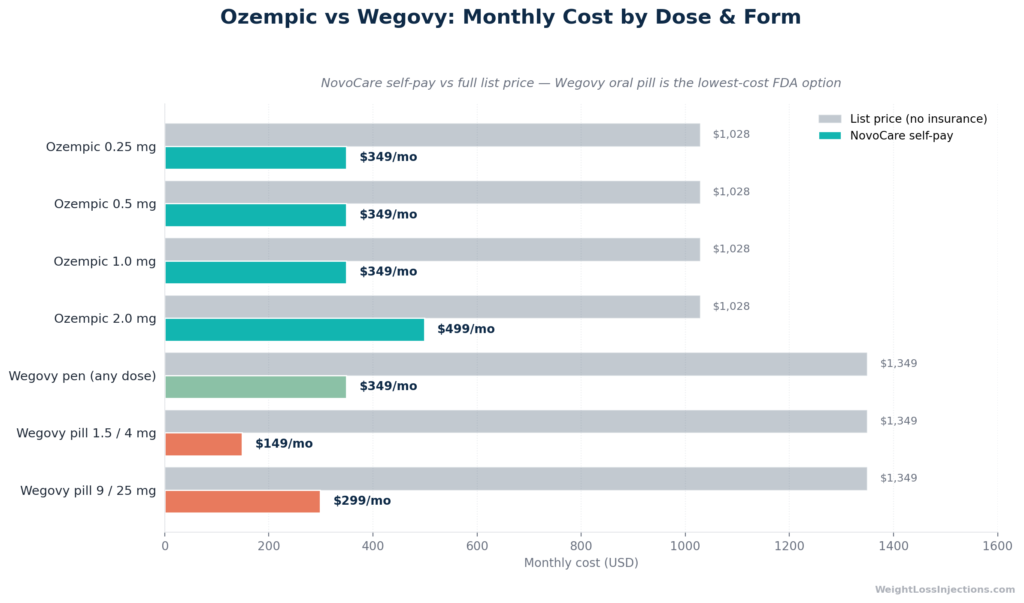
Dose-by-Dose Cost Comparison
Bar chart comparing Ozempic and Wegovy monthly costs by dose at list price and NovoCare self-pay rates, showing Wegovy pill as lowest-cost option at $149/month.
| Dose | Drug | List Price/Month | NovoCare Self-Pay |
|---|---|---|---|
| 0.25 mg | Ozempic | $1,027.51 | $199 (intro, 2 fills) → $349 |
| 0.5 mg | Ozempic | $1,027.51 | $349 |
| 1.0 mg | Ozempic | $1,027.51 | $349 |
| 2.0 mg | Ozempic | $1,027.51 | $499 |
| 0.25–2.4 mg | Wegovy (pen) | $1,349.02 | $199 (intro, 2 fills) → $349 |
| 1.5 mg / 4 mg | Wegovy (pill) | $1,349.02 | $149 |
| 9 mg / 25 mg | Wegovy (pill) | $1,349.02 | $299 |
NovoCare introductory pricing available for new patients through June 30, 2026, then standard self-pay rates apply. Source: NovoCare Pharmacy
Cash Pay Prices in 2026: NovoCare, GoodRx, and Telehealth Options
NovoCare Pharmacy Self-Pay Program
The most direct path to discounted brand-name semaglutide is Novo Nordisk’s own NovoCare Pharmacy, which offers direct-to-patient dispensing with free home delivery.
For Ozempic (as of April 2026):
- New patients: $199/month for the first two fills at 0.25 mg or 0.5 mg (introductory offer available through June 30, 2026)
- Ongoing: $349/month for 0.25 mg, 0.5 mg, or 1 mg doses
- Ongoing: $499/month for the 2 mg dose
For Wegovy (as of April 2026):
- New patients: $199/month for the first two fills at 0.25 mg or 0.5 mg injection (offer through June 30, 2026, per official Wegovy savings page)
- Ongoing injection (all doses 0.25 mg–2.4 mg): $349/month
- Wegovy HD (7.2 mg): $399/month
- Wegovy pill (1.5 mg, 4 mg): $149/month (4 mg price available until August 31, 2026, then $199/month)
- Wegovy pill (9 mg, 25 mg): $299/month
At the ongoing maintenance dose, the injectable formulations of Ozempic and Wegovy cost exactly the same through NovoCare: $349/month for doses up to 1 mg (Ozempic) and up to 2.4 mg (Wegovy). The 2.0 mg Ozempic dose is the exception, running $499/month. The Wegovy pill at $149/month represents the lowest-cost entry point for any brand-name semaglutide product in 2026.
GoodRx and Discount Card Pricing
GoodRx’s April 2026 pricing data shows that GoodRx coupons now channel through the same NovoCare Pharmacy network for semaglutide. The pricing is functionally equivalent:
- New patients (first two fills): $199/month for Ozempic or Wegovy injections; $149/month for the Wegovy pill
- Ongoing: $349/month for most Ozempic and Wegovy injection doses; $299/month for higher-dose Wegovy pills
These prices reflect GoodRx’s collaboration with Novo Nordisk announced in 2025 to expand access to brand-name GLP-1 medications at structured self-pay rates.
The Wegovy Subscription Program
In March 2026, Novo Nordisk launched a Wegovy subscription option via Ro, offering additional savings on the oral Wegovy pill for patients who commit to multi-month supplies:
- 3-month subscription: $289/month
- 6-month subscription: $269/month
- 12-month subscription: $249/month
These are modest reductions from the $299/month standard self-pay rate for higher-dose Wegovy pills, and require upfront commitment.
Our take at WeightLossInjections.com: The self-pay landscape in 2026 is more structured than it was even 12 months ago. Novo Nordisk has essentially set a two-tier market: $199 to onboard new patients into the $349/month ongoing tier for injections, or $149/month for the new pill. For patients who want injectable semaglutide without insurance, $349/month is now the realistic floor for brand-name Ozempic or Wegovy.
Insurance and Savings Cards: Who Actually Qualifies
Commercial Insurance Savings Cards
Both Ozempic and Wegovy have savings card programs through Novo Nordisk that can reduce costs to as little as $25/month for patients with qualifying commercial (private or employer-sponsored) insurance. The details matter:
Ozempic Savings Card (official terms via ozempic.com):
- Pay as little as $25 for any dose for up to a 3-month prescription
- Maximum savings: $100/month (1-month fill), $200/2-month fill, $300/3-month fill
- Valid for up to 48 months of active enrollment
- Requires commercially insured patients with coverage for Ozempic
- Government beneficiaries (Medicare, Medicaid, TRICARE, VA) are excluded
Wegovy Savings Card (official terms via novomedlink.com):
- Pay as little as $25/month (28-day supply for pen; 30-day supply for pill)
- Maximum savings: $100/month
- Requires commercially insured patients with coverage for Wegovy
- Government beneficiaries excluded
The critical catch: the Ozempic savings card is for patients whose commercial insurance covers Ozempic — typically requiring a type 2 diabetes diagnosis. Patients using Ozempic off-label for weight loss, whose insurance denies the claim, generally cannot access the $25/month rate. Wegovy’s savings card has the same commercial insurance requirement, but the coverage hurdle is different: some employer plans cover Wegovy for weight management, while others exclude it.
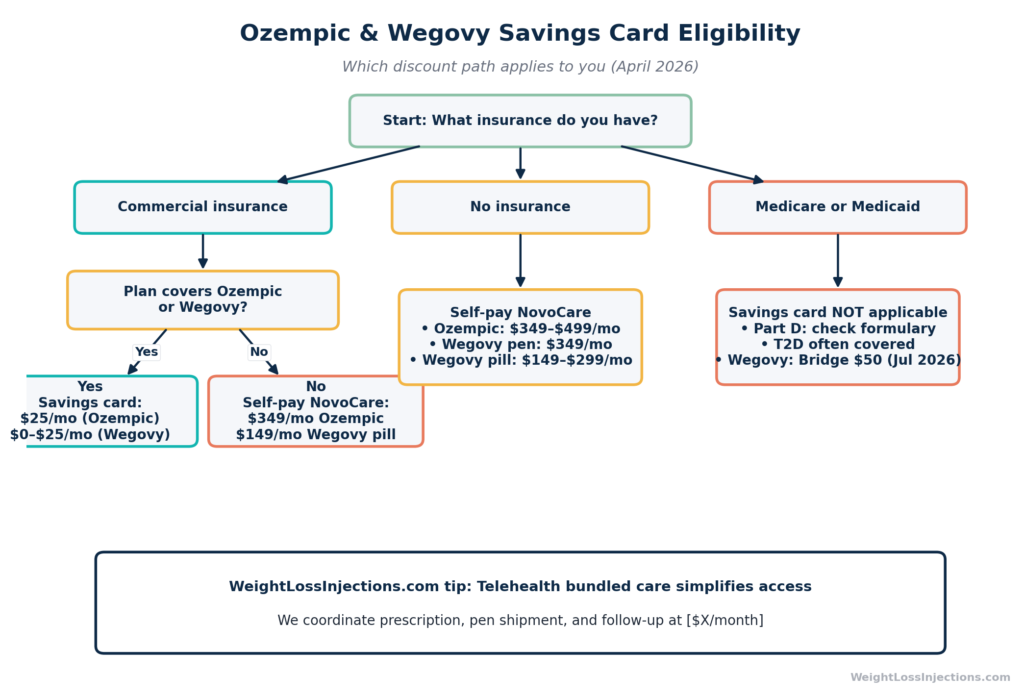
Savings Card Eligibility Flowchart
Insurance Coverage for Wegovy vs Ozempic for Weight Loss
This is where the drugs diverge most sharply on cost. Noom’s insurance coverage analysis (March 2026) found that major commercial insurers, Aetna, BCBS, Cigna, UnitedHealthcare, may cover Wegovy for weight management, but virtually all require:
- Prior authorization (PA)
- Documented BMI ≥30, or BMI ≥27 with a weight-related comorbidity (hypertension, sleep apnea, type 2 diabetes, etc.)
- Evidence of prior lifestyle intervention attempts
- In some cases, step therapy (trying other medications first)
Ozempic, by contrast, is reliably covered by commercial insurance for type 2 diabetes but is routinely denied for weight loss because it lacks the weight-management label.
Medicare follows federal law: traditional Medicare Part D does not cover medications solely for weight loss. Wegovy is covered under Part D when prescribed for cardiovascular risk reduction in patients with established cardiovascular disease, not weight loss alone. Ozempic is generally covered under Part D for type 2 diabetes, per GoodRx Medicare coverage data. Under the Inflation Reduction Act, Medicare’s negotiated price for Wegovy and Ozempic will reach $274/month starting January 2027, per Novo Nordisk’s announcement.
Medicaid is highly state-dependent. Massachusetts added Wegovy as a preferred anti-obesity agent in February 2026, while Pennsylvania restricted weight-loss-only GLP-1 coverage in early 2026. Check your state’s Preferred Drug List directly.
Patient Assistance Program (PAP)
For uninsured patients with limited income, Novo Nordisk’s PAP (novocare.com) provides Ozempic at no cost to patients with household income at or below 200% of the federal poverty level (approximately $30,120/year for an individual in 2026). Wegovy PAP eligibility is at or below 400% FPL for most products. No equivalent savings card program applies to government insurance, PAP is the primary relief valve for Medicare/Medicaid patients who don’t qualify for their plan’s drug coverage.
| Scenario | Ozempic Monthly Cost | Wegovy Monthly Cost |
|---|---|---|
| List price (no insurance, no discount) | $1,027.51 | $1,349.02 |
| NovoCare self-pay, intro (first 2 fills) | $199 | $199 (pen) / $149 (pill) |
| NovoCare self-pay, ongoing (0.5–1 mg) | $349 | $349 (pen) / $149–$299 (pill) |
| NovoCare self-pay, 2 mg dose | $499 | $349 (pen, all doses) |
| Commercial insurance + savings card | As low as $25 | As low as $25 |
| Medicare Part D (T2D / CVD indication) | Covered (Part D cost-sharing applies) | Covered for CVD indication only |
| Medicare Part D from Jan 2027 (negotiated) | $274 | $274 |
Our Top 3 · September 2026
The best GLP-1 providers right now
Independently reviewed. Ranked by price, medication access, provider quality, and patient outcomes.
Renew GLP
Personalized GLP-1, GIP plans: Semaglutide & Tirzepatide.
Medvi
No membership or hidden fees. Everything you need is included.
Trimi
US-licensed clinicians and shipped to your door, from $99/mo.
Telehealth Bundled Costs at WeightLossInjections.com
Comparing raw drug prices misses a real part of what you pay. Every GLP-1 prescription requires an initial provider consultation, typically quarterly follow-ups, dose adjustments as you titrate, and, if using mail-order, shipping. Brick-and-mortar pharmacy pricing doesn’t include any of that. Telehealth bundles often do.
At WeightLossInjections.com, patients on Ozempic or Wegovy pay [$X/month], which includes the medication, provider evaluation, dose management, and [service detail]. That all-in number is the comparison to make when evaluating any telehealth platform, not the per-pen sticker price.
The major telehealth platforms for context in 2026:
- Ro: Wegovy pricing starts at $199/month for starter doses through NovoCare Pharmacy access with Ro’s The Body membership adding $45/month (first month) then a recurring monthly fee. Ro is one of the largest branded Wegovy telehealth providers after compounded semaglutide access tightened.
- NovoCare direct: $199 intro → $349/month ongoing for injectable Ozempic or Wegovy, with free shipping and no membership fee. No built-in provider care.
When evaluating any platform, compare:
- Total monthly cost (medication + consult + labs + shipping)
- Provider access model (asynchronous messaging vs. synchronous visits; included vs. add-on)
- Dose adjustment process (how quickly can your provider respond to side effects or plateau?)
- Brand-name vs. compounded (compounded semaglutide availability has tightened significantly since the FDA resolved the shortage in February 2025)
Our take at WeightLossInjections.com: The $349/month NovoCare self-pay rate is a reasonable benchmark for injectable semaglutide in 2026, but it’s medication only. A telehealth platform that includes ongoing clinical support at or near that price point is typically better value for first-time GLP-1 users who need titration guidance.
The 2027 List Price Cuts: What They Mean — and What They Don’t
On February 24, 2026, Novo Nordisk announced that beginning January 1, 2027, the list prices for Ozempic, Wegovy, and Rybelsus will be uniformly cut to $675/month — a 50% reduction for Wegovy and approximately 35% for Ozempic, per the official Novo Nordisk press release. CNBC reported the change is specifically designed to help patients in high-deductible health plans whose out-of-pocket costs are pegged to a percentage of the list price, rather than a flat copay.
What changes in 2027:
- Patients in high-deductible plans paying co-insurance (e.g., 20% of list price) will see lower annual costs
- Insurance plan negotiations tied to WAC will reset at the lower baseline
- The Medicare negotiated price ($274/month) takes effect simultaneously
What does NOT change in 2027:
- The NovoCare self-pay program prices ($349/month for most doses) are explicitly not affected, per Novo Nordisk’s announcement
- Patients already paying $349/month through NovoCare will see no automatic reduction in their monthly cost
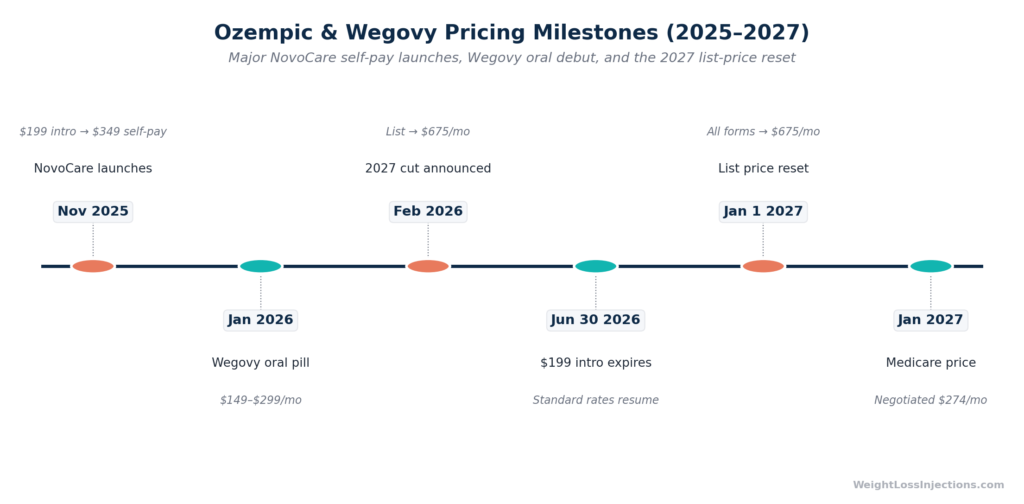
Price Timeline 2025–2027
Timeline showing Ozempic and Wegovy pricing milestones from November 2025 through January 2027, including NovoCare self-pay program launch, oral Wegovy introduction, list price cut announcement, and 2027 implementation dates.
The practical implication: if you have employer-sponsored insurance with a coinsurance structure (paying a percentage of the drug’s cost rather than a fixed copay), the 2027 list price cut may meaningfully reduce what you owe. If you’re on NovoCare self-pay today, the 2027 announcement changes nothing about your current out-of-pocket cost.
Which Is Cheaper? A Decision Framework
The answer depends entirely on your specific situation. Here’s how to think through it:
If you have commercial insurance that covers Ozempic for type 2 diabetes:
Ozempic is cheaper. With the savings card, you pay as little as $25/month — identical to Wegovy’s insured rate, but easier to access because diabetes coverage is more broadly available than weight-management coverage.
If you have commercial insurance with Wegovy weight-management coverage:
Wegovy is accessible at the same $25/month savings card rate as Ozempic, with the advantage of a higher maximum dose and a weight-loss FDA indication that aligns with your treatment goal. The higher list price is irrelevant if your copay is $25 either way.
If you’re paying self-pay through NovoCare:
For the injectable pen, Ozempic and Wegovy cost exactly the same — $349/month ongoing for doses up to 1 mg (Ozempic) or 2.4 mg (Wegovy). At the 2.0 mg Ozempic dose, Ozempic is more expensive ($499/month) than the equivalent Wegovy 2.4 mg pen ($349/month). The Wegovy pill at $149/month is the cheapest semaglutide option available in 2026 for self-pay patients who are willing to try the oral formulation.
If you have Medicare:
Ozempic is more accessible for type 2 diabetes patients on Part D. Wegovy is covered for cardiovascular risk reduction (not weight loss). Neither is covered for weight loss alone.
Bottom line for most patients seeking weight loss:
- Lowest cost self-pay (injectable): Ozempic = Wegovy at $349/month (standard) — identical
- Lowest cost semaglutide overall: Wegovy pill at $149/month
- Best coverage odds with insurance: Wegovy (FDA weight-management label makes prior authorization more straightforward than off-label Ozempic for weight loss)
- Best efficacy evidence: Wegovy 2.4 mg, per the STEP 4 trial data
Side Effects and Safety: What to Factor Into the Real Cost
Costs aren’t only measured in dollars. Side effects that cause dose delays, add GI medication, or require provider visits are real costs that vary between the two drugs.
Because Ozempic and Wegovy are both semaglutide, their side effect profiles are nearly identical. The primary difference is that Wegovy’s higher maximum dose (2.4 mg vs. 2.0 mg) produces somewhat more GI side effects at the maintenance dose. In the STEP 4 trial, gastrointestinal events were reported in 41.9% of participants on semaglutide 2.4 mg — nausea, constipation, diarrhea, and vomiting were the most common.
Both carry the same FDA boxed warning for a possible risk of medullary thyroid carcinoma based on rodent studies. Neither drug should be used by patients with a personal or family history of medullary thyroid carcinoma or Multiple Endocrine Neoplasia syndrome type 2 (MEN2). The Wegovy prescribing information carries the same contraindication.
For most patients, side effect costs are manageable with proper titration and dietary adjustments. The standard start-low-go-slow dosing ladder (beginning at 0.25 mg weekly) exists specifically to allow GI adaptation before reaching therapeutic doses.
WeightLossInjections.com editorial note: A side effect that causes you to stop treatment after two months is a 100% cost with 0% return. GI tolerability should factor into which drug and which formulation you start with — and into choosing a provider who can actively manage dose titration. The Wegovy pill may offer different GI tolerability than the injection for some patients, though head-to-head data between oral and injectable semaglutide is still limited.
Frequently Asked Questions
It depends on how you’re paying. At list price, Ozempic ($1,027.51/month) is cheaper than Wegovy ($1,349.02/month), per Novo Nordisk’s official pricing. But at self-pay through NovoCare, injectable Ozempic and Wegovy both run $349/month for most doses — and the Wegovy pill is actually cheaper at $149/month for starter doses. With commercial insurance and savings cards, both drugs can cost as little as $25/month. Ozempic is only definitively cheaper at the 2.0 mg max dose ($499/month for Ozempic vs. $349/month for Wegovy 2.4 mg injection).
Without insurance, Wegovy’s list price is $1,349.02/month. However, self-pay patients using NovoCare Pharmacy or Novo Nordisk’s savings program can pay $199/month for the first two injectable fills (new patients, through June 30, 2026), then $349/month for ongoing injectable doses, or $149/month for the Wegovy pill (1.5 mg and 4 mg doses). The pill is the most affordable self-pay option for brand-name semaglutide in 2026. GoodRx coupons channel through the same NovoCare network and reflect equivalent pricing, per GoodRx’s April 2026 data.
The Ozempic savings card requires commercially insured patients whose plan covers Ozempic — typically meaning a type 2 diabetes diagnosis on the prescription. Maximum savings are $100/month (1-month fill), $200 (2-month fill), or $300 (3-month fill), bringing the patient cost to as little as $25/month. Eligible patients can use the card for up to 48 months. Government insurance beneficiaries (Medicare, Medicaid, TRICARE, VA) are excluded from the savings card but may qualify for the Novo Nordisk Patient Assistance Program if they meet income requirements — per NovoCare PAP details.
It depends on your plan. Many commercial insurers (Aetna, BCBS, Cigna, UnitedHealthcare) do have formulary coverage for Wegovy for weight management, but nearly all require prior authorization, documented BMI ≥30 (or ≥27 with a comorbidity), and evidence of prior lifestyle intervention, per Noom’s insurer analysis. Employer self-funded plans set their own rules, and many explicitly exclude GLP-1 weight-management coverage in 2026. Traditional Medicare Part D does not cover Wegovy for weight loss alone — coverage is available for cardiovascular risk reduction in patients with established cardiovascular disease. Medicaid coverage varies by state, with Massachusetts expanding coverage in February 2026 and Pennsylvania restricting it in early 2026.
The cheapest options depend on your situation:
- With commercial insurance: Both can reach $25/month via savings cards (Ozempic for T2D indication; Wegovy with weight-management coverage).
- Self-pay, injectable: $349/month through NovoCare for either drug (same price at most doses); $199/month for the first two fills for new patients through June 30, 2026.
- Self-pay, lowest absolute cost: Wegovy pill at $149/month for 1.5 mg or 4 mg doses through NovoCare Pharmacy.
- Low income, uninsured: Novo Nordisk’s Patient Assistance Program may provide Ozempic at no cost for household incomes at or below 200% FPL (~$30,120/year for an individual).
- High-deductible insurance: In January 2027, both list prices drop to $675/month, which will reduce coinsurance costs for patients on percentage-based cost-sharing.
Internal Links
- The Complete Guide to Ozempic for Weight Loss — full mechanism, dosing, efficacy, and side effect guide
- Wegovy for Weight Loss: Complete 2026 Guide
- GLP-1 Cost Guide: Ozempic, Wegovy, Mounjaro, and Zepbound
- Ozempic vs Mounjaro: Which Is Better for Weight Loss?
- Telehealth GLP-1 Comparison: Which Platform Is Right for You?
Get your personalized Ozempic or Wegovy cost estimate — and find out if you qualify. WeightLossInjections.com’s intake takes under 3 minutes. A licensed provider reviews your history within 24 hours.
[Start your free intake →]
This article is for educational purposes only and is not a substitute for medical advice. WeightLossInjections.com’s medical team reviews content quarterly; last medical review: April 2026. All pricing information is subject to change by manufacturers and pharmacies at any time. Consult a licensed provider about your individual medical history and coverage before starting any GLP-1 medication.
t list price, Ozempic ($1,027.51/month) is cheaper than Wegovy ($1,349.02/month). However, at self-pay through NovoCare, injectable Ozempic and Wegovy both run $349/month for most doses. The Wegovy pill is actually cheaper at $149/month for starter doses. With commercial insurance and savings cards, both drugs can cost as little as $25/month.
Without insurance, Wegovy’s list price is $1,349.02/month. Self-pay patients using NovoCare Pharmacy can pay $199/month for the first two injectable fills (new patients, through June 30, 2026), then $349/month for ongoing injectable doses, or $149/month for the Wegovy pill. The pill is the most affordable self-pay option for brand-name semaglutide in 2026.
The Ozempic savings card requires commercially insured patients whose plan covers Ozempic — typically with a type 2 diabetes diagnosis. Maximum savings are $100/month (1-month fill), bringing the patient cost to as little as $25/month. Eligible patients can use the card for up to 48 months. Government insurance beneficiaries (Medicare, Medicaid, TRICARE, VA) are excluded but may qualify for the Novo Nordisk Patient Assistance Program.
Many commercial insurers have formulary coverage for Wegovy for weight management, but nearly all require prior authorization, documented BMI ≥30 (or ≥27 with a comorbidity), and evidence of prior lifestyle intervention. Traditional Medicare Part D does not cover Wegovy for weight loss alone, coverage is available for cardiovascular risk reduction in patients with established cardiovascular disease. Medicaid coverage varies by state.
With commercial insurance and savings cards, both Ozempic and Wegovy can reach $25/month. Self-pay patients can pay $349/month for injectable semaglutide through NovoCare, or $149/month for the Wegovy pill (lowest-cost brand-name semaglutide option). Low-income uninsured patients may qualify for the Novo Nordisk Patient Assistance Program at no cost. In January 2027, both list prices drop to $675/month, which will reduce costs for patients on high-deductible coinsurance plans.